Most ocean worlds present the same brutal engineering problem. The water may be scientifically irresistible, but it is buried beneath an ice shell that no spacecraft has yet drilled through.
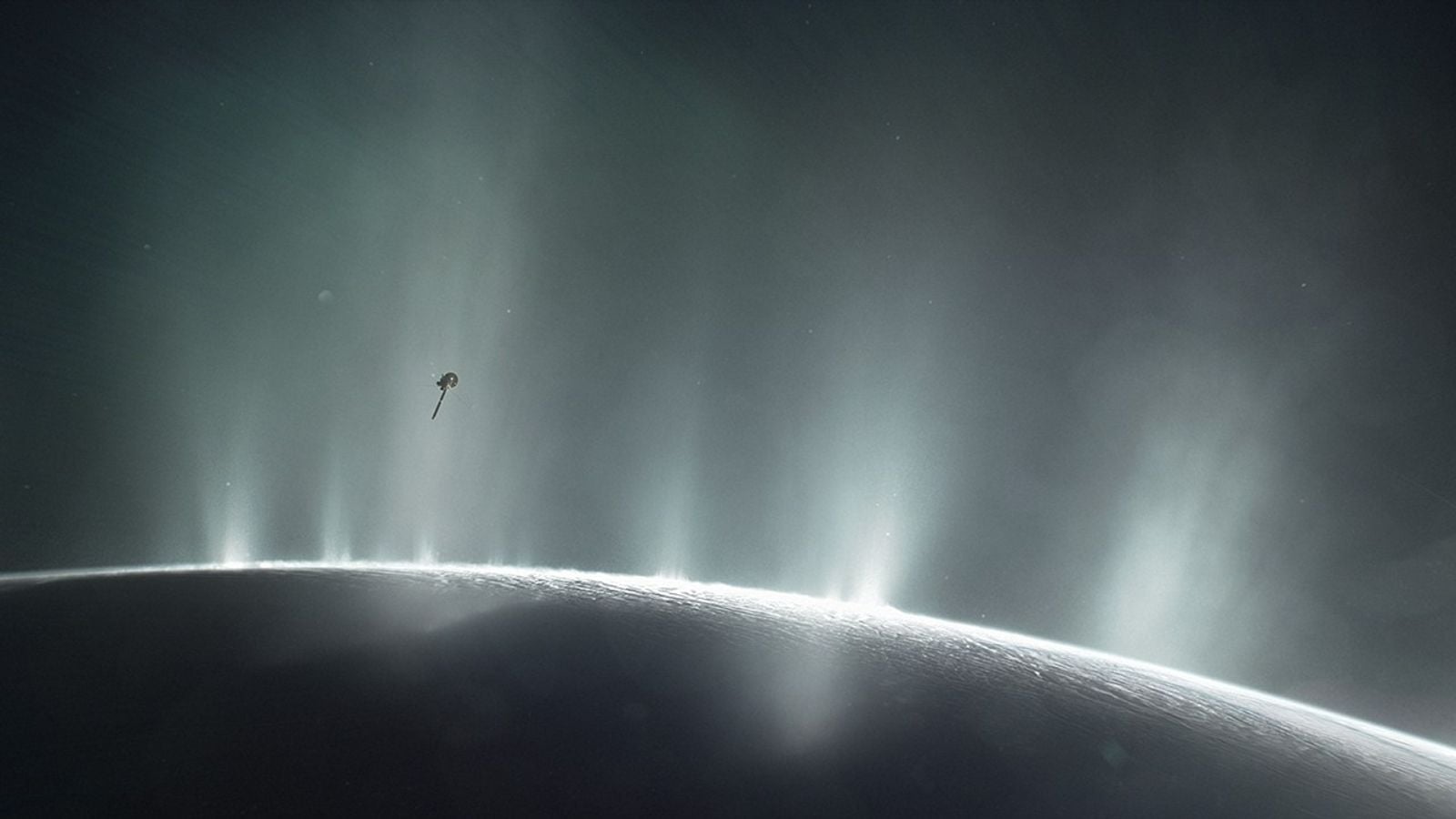
Enceladus is different. Saturn’s small icy moon pushes water vapour and frozen droplets through fractures near its south pole, accelerating the material into space. A spacecraft can cross that plume with its instruments open and analyse ocean-linked material without touching the surface.
NASA once described these eruptions as “free samples” from the moon’s global ocean. That phrase captures the extraordinary advantage, but it can also make the measurement sound cleaner than it is. The plume offers access, not a perfectly preserved jar of seawater. Understanding what happened between ocean and instrument is part of the science.
I find that distinction almost as interesting as the plume itself. Enceladus has removed the largest physical barrier for us. It has not removed the need to interpret what comes through.
The moon brings its ocean to the spacecraft
Enceladus is about 500 kilometres across. Beneath its bright crust is a global salty ocean in contact with a rocky core, while four long south-polar fractures, nicknamed the tiger stripes, vent water vapour and ice grains.
Some grains fall back onto the surface. Others escape the moon’s weak gravity and supply Saturn’s broad E ring. NASA estimates that water leaves the fractures at about 1,300 kilometres per hour, carrying salts, ammonia, methane, silica particles and organic material into a region a spacecraft can reach.
This matters because drilling through an alien ice shell is not simply a matter of attaching a longer bit. A lander would need to descend safely, generate substantial power, operate autonomously, prevent terrestrial microbes from being carried downwards and communicate through or around the ice. The deeper it travelled, the harder every one of those problems would become.
A plume fly-through replaces that entire descent with navigation and mass spectrometry. The moon has already done the lifting.
Cassini sampled gas and grains separately
NASA’s Cassini spacecraft was not built to investigate an Enceladus ocean because nobody knew the ocean or plume existed when it launched in 1997. Once the jets were discovered, mission planners redirected later encounters around the opportunity.
Cassini ultimately completed 23 targeted fly-bys of Enceladus. Its Ion and Neutral Mass Spectrometer measured gases, while its Cosmic Dust Analyzer recorded tiny solid particles that struck its target plate and produced clouds of ions. The masses and arrival times of those ions created chemical fingerprints of individual grains.
During the E21 encounter in October 2015, Cassini passed only 49 kilometres above the surface. NASA stated in its fly-by briefing that the pass would sample material from the ocean but could not detect life. The spacecraft simply did not carry the right instruments for a definitive biological test.
What it could do was establish a chain of evidence for habitability. In my earlier article on Enceladus’s salts, molecular hydrogen and phosphorus, I followed the separate measurements that point to liquid water touching rock, a possible source of chemical energy and a nutrient used by all known terrestrial life. Those findings came from material available above the moon, not from a probe lowered into its sea.
The plume is an ocean sample after processing
The word “direct” needs care. Material in the plume is linked to the subsurface ocean, but it has travelled upwards through long, cold fractures and changed phase along the way.
Ocean water can form droplets that freeze into ice grains. Dissolved gases leave the liquid at different rates. Water vapour condenses on the fissure walls as the mixture rises into colder ice. Some compounds become concentrated in the escaping gas, while others are depleted. Gas and solid grains can therefore tell different parts of the ocean’s story.
A 2022 paper by Lucas Fifer, David Catling and Jonathan Toner in The Planetary Science Journal modelled this chemical fractionation between ocean and plume. One earlier model discussed in the paper estimated that more than 99 per cent of the water vapour could condense onto the fissure walls during eruption. Because the other gases do not condense in the same way, their measured proportions above the surface cannot simply be copied into a table and labelled “ocean composition”.
The ice grains are especially valuable because salt-rich particles appear to begin as ocean droplets. Even they are not identical. Cassini found that only about 1 to 4 per cent of plume grains carried organics at high concentrations. A bulk average could dilute the rare, chemically interesting grains until their signals nearly disappeared.
Space Daily’s editorial team has already covered the plume’s water, phosphate, hydrogen and varied organic chemistry. The measurement lesson beneath that list is that a future spacecraft should analyse many grains individually and record where and when each one was collected.
A grain hitting a spacecraft becomes the experiment
There is no scoop dipping gently into the plume. At fly-by speed, an ice particle slams into an instrument, vaporises and ionises. The collision destroys the original grain, but the ions produced by the impact reveal what it contained.
Speed changes the spectrum. In October 2008, Cassini crossed fresh plume material at about 17.7 kilometres per second. A 2025 study led by Nozair Khawaja in Nature Astronomy reanalysed 1,519 spectra collected during roughly six minutes of that encounter and identified several families of organic fragments, including signals consistent with aromatic and oxygen-bearing chemistry.
The speed was both helpful and limiting. It broke water clusters apart, exposing signals that were obscured at slower impacts, but it also fragmented larger molecules so severely that their original structures could not always be reconstructed. The authors explicitly said the conditions did not allow quantitative analysis. They could identify possible chemical groups, not measure the precise concentration of every original compound in the ocean.
A purpose-built spacecraft could approach more slowly, use instruments with a wider mass range and repeat its passes through different parts of the plume. It could combine grain measurements with gas analysis, imaging and observations of how plume output changes as Enceladus moves around Saturn.
A future instrument may be able to read part of a cell
The most striking laboratory result I found came from a 2024 Science Advances paper led by Fabian Klenner. The team placed cells of a cold-water bacterium into droplets, froze them and simulated the impact-ionisation spectra that a modern spacecraft instrument might record at four to six kilometres per second.
In those experiments, characteristic signals remained identifiable even when an ice grain contained less than one whole cell’s worth of material. The work supports analysing individual grains rather than mixing billions of particles into a bulk sample, because any biological material might be concentrated in a very small minority of them.
It does not show that Enceladus contains cells, or guarantee that alien biology would resemble the organism used in the laboratory. It demonstrates instrument sensitivity under a controlled analogue. A convincing claim of life would still require several independent signals and careful exclusion of non-biological chemistry and contamination.
That caution is not a minor footnote. As Space Daily’s editorial team argued in its article on what a null result at Enceladus could mean, a habitable environment and an inhabited one are different scientific claims.
No drilling does not mean an easy mission
Enceladus orbits roughly 1.4 billion kilometres from the Sun. Reaching Saturn takes years, sunlight is weak, communications are slow and entering an orbit that permits repeated low-speed plume crossings requires substantial propulsion and careful navigation.
The spacecraft itself must also be kept clean enough that a trace of amino acid, lipid or terrestrial cell does not masquerade as evidence from the moon. In my article on Cassini’s deliberate destruction in Saturn, I looked at the same contamination problem from the other direction. Cassini was disposed of before loss of control could create a future impact risk at Enceladus.
Europe has now placed the moon at the centre of its long-range planning. In 2024, ESA identified Enceladus as the top target for its first large-class Voyage 2050 mission. The concept could launch in the early 2040s, arrive around a decade later, conduct a Saturn-system tour and eventually collect ejected material close to the surface, potentially combining plume sampling with a landing. It remains a future programme rather than a spacecraft ready to fly.
The long timetable is frustrating, but the destination offers an unusual bargain. Other ocean worlds ask us to infer chemistry through magnetic fields, surface deposits or radar echoes. Enceladus places newly erupted material in the path of an instrument.
We do not need to build a machine that crosses kilometres of ice before we can ask whether the ocean contains useful energy, complex chemistry or possible biological patterns. We need a clean spacecraft, the right mass spectrometers and enough careful passes through a plume that the moon keeps providing.
The ocean remains hidden. Its samples do not.