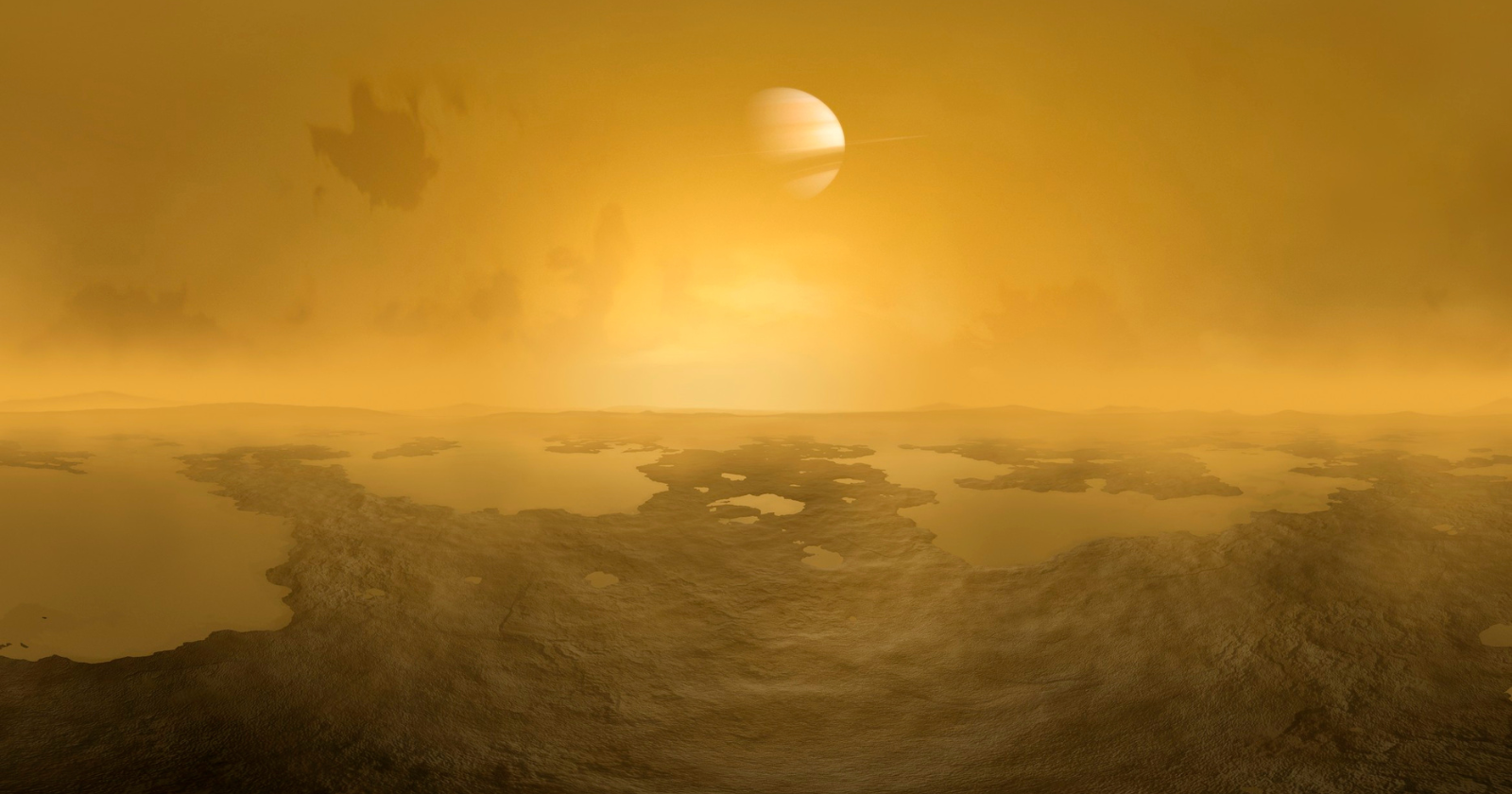
There is a 400-kilometre river system near the north pole of Titan that drains into a sea larger than Lake Superior.
That sentence sounds almost ordinary until you change the materials. The river is probably carrying methane mixed with ethane. The land around it is largely water ice, frozen so hard that it plays the role of rock. The sea is Ligeia Mare, one of the great hydrocarbon reservoirs hidden beneath Titan’s orange haze.
NASA called this network Titan’s “Nile-like river valley” when Cassini imaged it in 2012. The comparison was about its scale and form, not its exact length: at more than 400 kilometres, it is immense for a river seen on another world, but much shorter than the Nile itself.
What interests me now is what happens where rivers like this meet Titan’s lakes and seas. On Earth, a large sediment-carrying river usually announces its arrival with a delta. The current slows, sediment falls out, the shoreline advances and the river divides into distributary channels.
On Titan, that familiar ending is almost entirely missing.
A 2025 paper in the Journal of Geophysical Research: Planets, led by Brown University planetary scientist Samuel Birch, identified just two probable deltas among the large mapped rivers that terminate at Titan’s coastlines. That works out to roughly 1.3 per cent. Rivers of comparable size on Earth nearly always form one.
The number is striking, but the honest version is narrower than saying 98.7 per cent of every river on Titan lacks a delta. Cassini did not map every channel at perfect resolution, and “probable” matters when the landscape is being interpreted through radar. This is a count of large, observable coastal rivers in the available data.
Even with those limits, the result leaves a real problem. Titan appears to possess the rain, flowing liquid, erodible ground and sediment transport needed to make deltas. So where did they go?
Titan copies the water cycle, then changes every ingredient
I wrote recently about how Titan can have rain, rivers and lakes without liquid water at the surface. The short answer is temperature. At about minus 179 degrees Celsius, water is structural ice while methane and ethane can remain liquid.
Titan’s thick nitrogen atmosphere supports clouds, weather and rainfall. Methane evaporates from lakes and seas, condenses in the atmosphere and returns to the ground, where it can run through channels and collect again. NASA describes Titan as the only place besides Earth known to have stable liquids on its surface and an Earth-like cycle of liquid moving between ground and sky.
The visual resemblance can tempt us into treating Titan as a cold copy of Earth. It is not. Its gravity is about one-seventh of ours. Its rivers are less dense than water. Its sediment may include grains of water ice and complex organic material rather than familiar quartz, clay and silt. Rain can be separated by long dry intervals, while each Titan season lasts more than seven Earth years.
Yet the basic mechanics of a delta do not require warm water. A river erodes material and carries it downhill. When it enters a standing body of liquid, its flow spreads and loses speed. Grains that the current could keep moving upstream begin to settle. Given enough supply and a shoreline that remains in roughly the same place, a deposit grows outward.
This is why the missing deltas are more than a curious visual detail. They suggest that one of those apparently simple stages is behaving very differently.
The obvious answer was that Cassini simply could not see them
For years, that was a reasonable possibility.
Titan’s surface is hidden in visible light by a dense photochemical haze. Cassini got around it with synthetic aperture radar, sending radio waves through the atmosphere and measuring the returning signal. Smooth liquid generally appeared dark because it reflected little energy back towards the spacecraft. Rough ground returned more signal and appeared brighter.
The images changed our understanding of Titan, but they were not photographs. Depending on the observing mode, Cassini’s radar resolution ranged from roughly 350 metres to 1.7 kilometres. A feature had to be large enough and return a sufficiently distinct radar signal to stand out.
There was another complication. Titan’s hydrocarbon liquids are relatively transparent to Cassini’s microwave signal. In shallow water, the radar could pass through the surface and bounce from the bottom. What looks like a shoreline in a radar image can therefore be a mixture of signals from dry land, liquid surface and submerged terrain.
That creates an uncomfortable question. Were the deltas absent from Titan, or only absent from the picture Cassini made?
The Brown team made Earth look like Titan
Birch and his colleagues approached that question in a way I find unusually satisfying: they gave Cassini a test it could fail.
The team started with coastlines whose shapes and underwater topography are already known on Earth. They then built a numerical model to produce synthetic radar images, replacing the radar behaviour of terrestrial water with the properties expected for Titan’s methane-rich liquids.
In other words, they did not merely ask what Titan’s coast looked like. They asked what the Gulf Coast, the Mississippi delta and other familiar landscapes would look like if Cassini flew over them under Titan-like imaging conditions.
Large coastal forms survived the translation. Multi-kilometre deltas, barrier islands and related features remained recognisable when there was enough contrast between the land and the sea floor. A Mississippi-scale delta should not quietly disappear because of the radar alone.
That does not mean Cassini could reveal every small deposit or settle every ambiguous outline. The model itself depends on assumptions about radar scattering and the properties of materials nobody has sampled directly at a Titan shoreline. But it weakens the simplest explanation. If large deltas were common at the mouths of Titan’s large mapped rivers, the researchers concluded, at least some more of them should be visible.
When the team returned to the Titan data with that test in hand, it found only two probable examples, both near the south pole. The major northern seas, despite receiving extensive river networks, remained conspicuously short of delta-shaped deposits.
The rivers appear capable of moving sediment
Perhaps Titan’s rivers are visually impressive but geologically weak. If they carry almost no sediment, there would be little material from which to build a delta.
That explanation has also become harder to maintain.
In 2023, Birch and colleagues published a separate method for estimating river flow from channel width and slope. They tested it against 491 rivers on Earth, then applied it to channels on Mars and Titan. For two Titan rivers where suitable measurements were available, the inferred flows were comparable with some of Earth’s largest rivers. The river that appeared to have a delta may have carried a discharge comparable to the Mississippi.
The same analysis suggested that both rivers should be able to transport sediment. Titan’s lower gravity, the density of its liquids and the uncertain composition of its grains all change the calculation, but they do not obviously switch erosion and deposition off.
There is physical evidence for transport as well. The Huygens probe photographed rounded water-ice pebbles after landing in 2005. Cassini mapped branching valleys, canyon systems and alluvial fans. Whatever the exact rhythm of the rainfall, liquid has cut into the ground and moved material across it.
One river measurement cannot stand in for every drainage basin on a moon larger than Mercury. Titan may have sediment-rich rivers in some regions and sediment-starved ones elsewhere. Still, the data make “the rivers carry nothing” an incomplete answer.
A delta may be built, moved and erased
The first explanation the 2025 paper raises is not a failure to form deltas, but a failure to preserve them in one place.
A delta needs time and a relatively stable meeting point between river and sea. If Titan’s sea levels rise and fall substantially, the shoreline migrates. A river that deposited sediment at one level may later discharge kilometres inland or offshore from that position. Repeated changes could spread sediment across a broad zone rather than allow one prominent fan to accumulate.
Titan gives several reasons to take that possibility seriously. Methane moves between the atmosphere, surface reservoirs and perhaps porous ground. Its polar liquids respond to seasons lasting years, while longer-term orbital and climate cycles may shift material between north and south. The northern hemisphere now holds the great majority of the large visible seas, whereas the two probable deltas are in the south.
The new mapping also revealed what appear to be channels beneath current sea level. Some may record rivers cut when the seas stood lower. Pits of uncertain origin appear on lake and sea floors too. The coastline may therefore be only the latest position in a landscape with a complicated history of filling, draining and submergence.
That possibility connects Titan’s surface liquids to a larger theme I explored in an earlier article about moons that hide oceans beneath ice. Titan may contain a deep saltwater ocean as well as methane seas above. The two liquid systems are chemically and physically separate, and the buried ocean does not directly explain the deltas. But together they make the same point: a label like “ocean world” tells us remarkably little about where a liquid is, how it moves or what history its boundary records.
Winds and tides may be dismantling the evidence
Even if sea level stays still, a river is not the only force working at its mouth.
On Earth, the shape of a delta reflects a contest. River flow pushes sediment outward. Waves move it along the coast. Tides pull water and particles backwards and forwards through channels. The Mississippi produces a protruding, river-dominated delta; other coasts redistribute sediment into smoother shorelines, spits and barrier islands.
Titan has winds and tides. Saturn’s gravity deforms the liquid surfaces, and Titan’s thick atmosphere can transfer momentum to lakes and seas. If coastal currents rework sediment faster than a river can concentrate it, the material may be present without making a classic fan-shaped delta.
The chemistry adds further uncertainty. A cold river of one methane-ethane-nitrogen mixture may meet a sea of another. Their relative density, temperature and dissolved material could determine whether the incoming flow spreads over the surface, mixes through the water column or plunges along the bottom. Each path would deliver sediment differently.
Researchers do not yet have direct measurements of that encounter. No instrument has watched rainwater move through a Titan river mouth, sampled its grains or placed a current meter in a sea. Sea-level change, tides, winds and material properties are therefore competing hypotheses, and more than one may be operating at once.
The honest conclusion of the paper is not that it solved the missing-delta problem. It showed that the problem is probably real.
Cassini left us a map with the crucial detail unresolved
Cassini acquired the 400-kilometre river image during its 86th close Titan fly-by in September 2012. The channel appears dark along its length, consistent with a smooth liquid surface, and runs into Ligeia Mare. Its relative straightness suggests that faults may have guided its route.
It is extraordinary that we can discuss the mouth of an alien river at all. It is also frustrating that the decisive evidence sits below the resolution and coverage of a spacecraft that no longer exists.
As I described in my article about Cassini’s deliberate plunge into Saturn, the mission ended in 2017 while the spacecraft was still scientifically useful. Its dwindling manoeuvring propellant meant operators could no longer guarantee that it would avoid Titan or Enceladus indefinitely. Protecting those worlds required destroying the machine that had revealed them.
NASA’s Dragonfly rotorcraft will explore Titan’s equatorial dunes and the Selk impact structure in the 2030s. It will examine surface chemistry and geology in far greater detail than Cassini could. But it is not a boat, polar aircraft or global radar orbiter, and it is not being sent to trace the mouths of northern rivers.
Solving the delta problem properly may require a future mission able to map Titan’s coasts at much higher resolution, measure elevations and sea-floor depths, and watch the same shoreline through seasonal change. A lander or floating probe could test the composition, currents and sediment directly. Until then, researchers are extracting more information from Cassini by improving the questions asked of old data.
The missing shape may tell us more than a familiar one would
When I first read that Titan had almost no deltas, I assumed it was a technical footnote. Radar is difficult, alien landscapes are incomplete and sometimes the feature is simply too small to see.
The more interesting possibility is that the absence is itself a record.
A preserved delta would collect the history of one drainage basin in one place. It could contain layers from storms, climate shifts and changing organic chemistry. The lack of that archive may instead say that Titan’s shores move too much, its coastal currents work too efficiently, its sediment behaves unexpectedly or its present seas occupy a relatively temporary configuration.
We do not yet know which reading is right. The two probable southern deltas may prove especially important because they offer a comparison: what is different about their rivers, sediments, basins or sea-level history that allowed deposits to survive there?
Titan keeps producing this particular kind of surprise. From a distance, it offers an almost reassuring collection of terrestrial nouns: clouds, rain, rivers, lakes, seas and coastlines. Then one piece refuses to behave as the noun implies.
A river can run for hundreds of kilometres across frozen water and carry liquid natural gas into a polar sea. Apparently, even that is easier for nature to arrange than the delta we assumed would be waiting at the end.