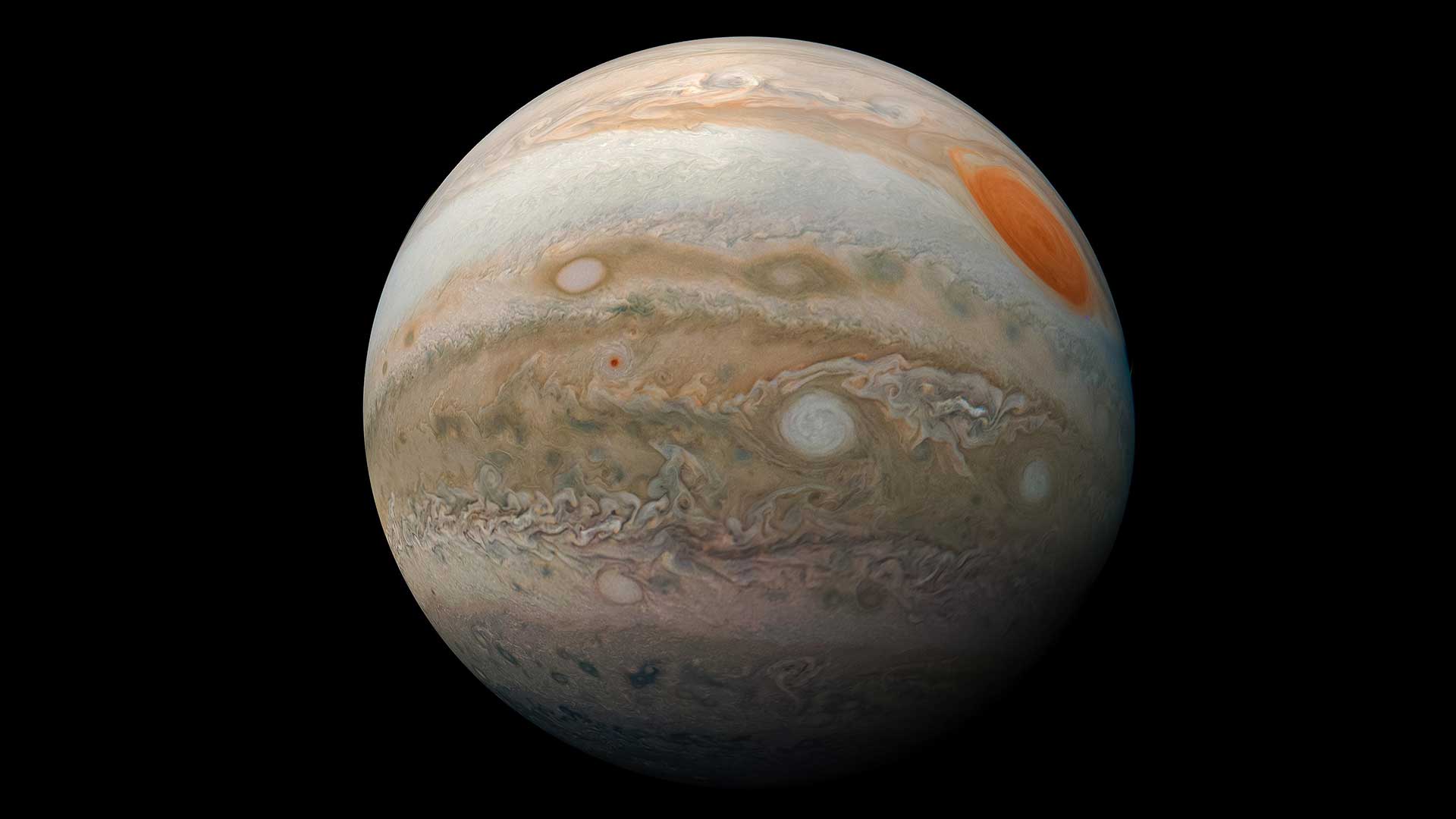
Every image of Jupiter appears to show a surface. There is a clean circular edge, a striped face, white clouds and rust-coloured belts. It looks like a place, in the same sense that Mars or Earth is a place, and it is natural to imagine that somewhere beneath the weather there must be ground.
There is not.
A spacecraft descending into Jupiter would never strike a crust, bounce off a plain or disappear in a conventional impact. It would enter an atmosphere that became progressively denser, hotter and less like anything we encounter at ground level on Earth. The hydrogen around it would stop behaving like an ordinary gas, but it would not present a shoreline. Deeper still, the hydrogen would become an electrically conducting fluid called metallic hydrogen.
Long before a probe reached that region, pressure and heat would have destroyed its structure. Its metals, ceramics and electronics would eventually melt, vapourise or dissolve into the surrounding fluid. Even the planet’s central region may not offer a solid floor. Measurements from NASA’s Juno mission favour a core that is extended and diluted, with heavy material mixed into hydrogen rather than separated by a clean boundary.
The strange part of falling into Jupiter is not simply that the planet would crush you. It is that familiar categories would fail one after another on the way down: sky and ground, atmosphere and ocean, gas and liquid, even metal and fluid.
Jupiter’s surface is a number, not a place
When planetary scientists give Jupiter a radius, they still need to say where the planet begins. The convention is usually the one-bar pressure level, where the atmospheric pressure is approximately the sea-level pressure on Earth. This is a useful reference for measuring altitude, gravity and the planet’s shape, but it is not a material surface.
In fact, a 2026 analysis in Nature Astronomy used Juno radio-occultation measurements to refine the shape of this one-bar level. The authors calculated an equatorial radius of 71,488 kilometres and a polar radius of 66,842 kilometres, each with an uncertainty of about 400 metres. Jupiter spins so rapidly that it bulges conspicuously at the equator.
That is an extraordinarily precise measurement of an imaginary reference surface.
At the one-bar level there is still gas beneath a descending vehicle. The familiar white, orange and brown features are cloud systems suspended in an atmosphere dominated by molecular hydrogen and helium. NASA describes probable layers of ammonia ice, ammonium hydrosulphide and water cloud spanning roughly 71 kilometres, although the exact structure varies with location and weather.
The edge we see from space is produced by light scattering from these clouds and hazes. It is no more solid than the top of a storm seen from orbit above Earth. The difference is that Earth eventually supplies an ocean or continent. Jupiter does not.
One probe has already begun the fall
On 7 December 1995, NASA’s Galileo atmospheric probe became the first machine to enter the atmosphere of an outer planet. It arrived at about 170,000 kilometres per hour. During two minutes of aerodynamic braking, it experienced deceleration of up to 230 times Earth’s gravity and temperatures around its heat shield described by NASA as twice the temperature of the Sun’s visible surface.
It survived.
After shedding its heat shield and opening a parachute, the probe descended through about 200 kilometres of atmosphere. It measured winds, temperature, pressure, lightning, sunlight and chemical composition while transmitting its findings to the Galileo orbiter overhead. The mission’s final NASA press kit records that high temperatures silenced the transmitters 58 minutes into the descent.
The last measurements came from a pressure around 22 to 23 bars, roughly 22 times terrestrial sea-level pressure, and a depth about 120 kilometres below the reference level. That sounds deep until it is set against a planet nearly 140,000 kilometres wide.
Galileo had sampled only the uppermost skin. Later work with Juno suggested that the probe had also entered an unusually dry meteorological region, which is why its surprisingly low water measurement could not simply be applied to the whole planet. A 2020 JPL account of the comparison explains that Juno’s microwave radiometer could sense to pressures of about 33 bars from orbit, deeper than Galileo’s final reading but still nowhere near the metallic interior.
It is common to read that Galileo was crushed at 22 bars. The surviving record is more specific: heat silenced its transmitters. What happened after radio contact ended was not observed. The probe continued downward, its parachute eventually failing as the temperature rose, and the pressure and heat would ultimately have destroyed it. But there was no recorded moment when it struck Jupiter.
The gas does not meet an ocean
On Earth, a descending aircraft passes through air and reaches a boundary. Below that boundary may be water or rock, substances far denser than the atmosphere. Jupiter offers no comparable discontinuity.
Hydrogen has a critical temperature above which its gas and liquid phases can no longer be separated by an ordinary boiling line. Jupiter’s interior is far hotter than that critical temperature. As pressure climbs, the molecular hydrogen becomes a supercritical fluid. Its density rises continuously and it takes on increasingly liquid-like behaviour, but there is no depth at which a probe splashes into a hydrogen sea.
This is why illustrations that divide Jupiter into an atmosphere and a liquid-hydrogen layer should be read as maps of physical regimes, not as drawings of hard boundaries. NASA’s guide to gas-giant interiors puts it plainly: beneath the clouds, the atmosphere becomes denser and warmer and transforms from gas to liquid without a sharp boundary.
The word “gas” in gas giant can therefore mislead. It describes composition and planetary class, not the behaviour of every part of the planet. Most of Jupiter’s mass is not floating around as a thin, breathable-looking gas. It is compressed into a dense, hot fluid by the weight of everything above it.
I touched on the same distinction in my earlier article asking how Saturn can contain 95 Earth masses and still have a lower average density than water. Low average density does not mean a giant planet is insubstantial all the way through. Self-gravity creates pressures and states of matter that a simple label such as “gas” cannot convey.
Metallic hydrogen is not a solid metal shell
Going deeper changes more than density.
Ordinary hydrogen consists of molecules made from pairs of atoms. Under pressures of millions of times Earth’s atmospheric pressure, those molecular arrangements are disrupted and electrons become mobile across the material. The hydrogen begins to conduct electricity in a metal-like way.
The name metallic hydrogen can create the wrong mental picture. It is not a hard, silver floor hiding below the weather. Under Jovian conditions it is expected to be a hot, dense, electrically conducting fluid. “Metallic” describes how electrons move and how the material conducts, not whether a spacecraft could stand on it.
The transition itself is an active area of high-pressure physics. The exact pressure and character of the molecular-to-metallic change depend on temperature and on the behaviour of the hydrogen-helium mixture, which cannot be measured directly inside Jupiter. Laboratory compression experiments, quantum calculations and the planet’s gravity and magnetic fields all constrain the models, but they do not turn the interior into a set of perfectly known shells.
Many simplified accounts place the metallic region at pressures of roughly one to several megabars. One megabar is one million bars. The important scale comparison is not whether the transition begins at a particular neat depth, but that Galileo’s last 22-bar measurement was tens of thousands of times lower in pressure.
This conducting hydrogen is central to Jupiter’s identity. Convection in the fluid, combined with the planet’s rapid rotation, sustains electrical currents. Those currents generate Jupiter’s enormous magnetic field. NASA’s current Jupiter overview describes the metallic-hydrogen region as a planetary dynamo, rather than a buried piece of solid metal.
In other words, the material that would eventually surround a hypothetical indestructible probe is also helping to produce the radiation environment that makes reaching Jupiter difficult in the first place.
A descending spacecraft would not fall at the same speed forever
“Falling into Jupiter” suggests an object accelerating through empty space until it hits something. The real motion would be more complicated.
A probe would arrive at tremendous speed, as Galileo did, and lose most of that speed through violent aerodynamic drag. Once under a parachute, or after its parachute failed, it would descend through a fluid whose density was constantly increasing. Drag would rise. Depending on the probe’s changing density and shape, it might sink slowly, tumble, or approach a level of neutral buoyancy for a time.
No real spacecraft could remain intact long enough for those late stages to matter. Seals would fail. Pressure vessels would deform. Electronic components would stop operating as temperatures moved far beyond their design range. Structural metals would weaken and melt. At greater depth, the distinction between a broken spacecraft and its chemical constituents would disappear as material mixed with the surrounding hydrogen-helium fluid.
Pressure alone is not the full explanation. A pressure vessel fails when the difference between pressure outside and inside exceeds what its structure can bear. If every cavity were somehow allowed to equalise, crushing could be delayed, but that would expose the contents directly to the hot, chemically unusual fluid. An object protected by impossible materials would still face temperatures that rise to thousands and eventually tens of thousands of degrees.
There is also no straight tunnel through the planet. A freely falling object loses its initial motion to drag, while Jupiter’s rotation, winds and convection carry it sideways. Long before it could approach the centre, it would cease to exist as an engineered object.
Even the core may not be a floor
For decades, a common textbook model showed Jupiter with a small, compact core of rock and ice beneath layers of metallic and molecular hydrogen. The word “core” quietly invited another surface: perhaps, after surviving everything else, a sufficiently strong machine would finally reach solid material.
Juno made that picture harder to defend. The spacecraft does not see the core. Instead, tiny changes in Juno’s speed as it passes over Jupiter reveal variations in the planet’s gravity field. Interior models are then tested against those measurements.
The models increasingly favour a dilute or fuzzy core, an extended region enriched in elements heavier than hydrogen and helium. A 2019 study in Nature described structure models in which ten to a few tens of Earth masses of heavy elements are spread through a region reaching nearly halfway out from Jupiter’s centre. The paper proposed a giant impact early in Jupiter’s history as one possible way to create that structure.
That impact scenario is not settled fact, and neither is a single interior profile. A 2024 review in AGU Advances emphasised how much depends on the equation of state used for hydrogen and helium, the assumed temperature profile and the distribution of heavy elements. Some acceptable models retain a small compact component near the centre. What has weakened is the old confidence in a clean boundary between a rocky ball and the fluid above it.
So “there is no surface anywhere on Jupiter” needs one qualification. The deepest interior remains indirectly inferred, and models can contain concentrated central material. What we can say with confidence is that Jupiter has no accessible solid surface, no known crust and no demonstrated core boundary that would function as ground. Whatever heavy material lies near the centre exists under tens of millions of bars and temperatures comparable to the surfaces of stars. Calling it a landing site would empty the phrase of meaning.
Why Jupiter’s moons are worlds and Jupiter is not
The contrast with Jupiter’s moons is revealing. Europa has a solid ice shell, even though the ocean below it may contain more than twice the water in all Earth’s oceans. In my earlier look at the new estimate of Europa’s 29-kilometre ice thickness, the central difficulty was how to reach an ocean through a very real barrier.
On Jupiter, the problem is the opposite. There is no barrier to reach because there is no planetary surface. A probe can enter, as Galileo proved, but it cannot arrive.
This also explains why a spacecraft ending at a gas giant is described as plunging into its atmosphere. When Cassini was deliberately sent into Saturn in 2017 to protect Enceladus, it transmitted through the upper atmosphere until aerodynamic forces broke its control. It did not leave a crater. Its material became part of Saturn.
A probe sent deeper into Jupiter would meet the same kind of ending on a harsher scale. First it would become a meteor, then a parachuting laboratory, then wreckage, then droplets, vapour and dissolved atoms. At no point would a landing leg touch down. There would be no impact site for a later mission to photograph.
Jupiter is a planet without a place to stand. Its apparent surface is weather, its interior is a continuum, its metal is liquid and its possible core is blurred into the matter around it. A descending spacecraft would not find the bottom. Jupiter would simply remove the distinction between the spacecraft and the planet.