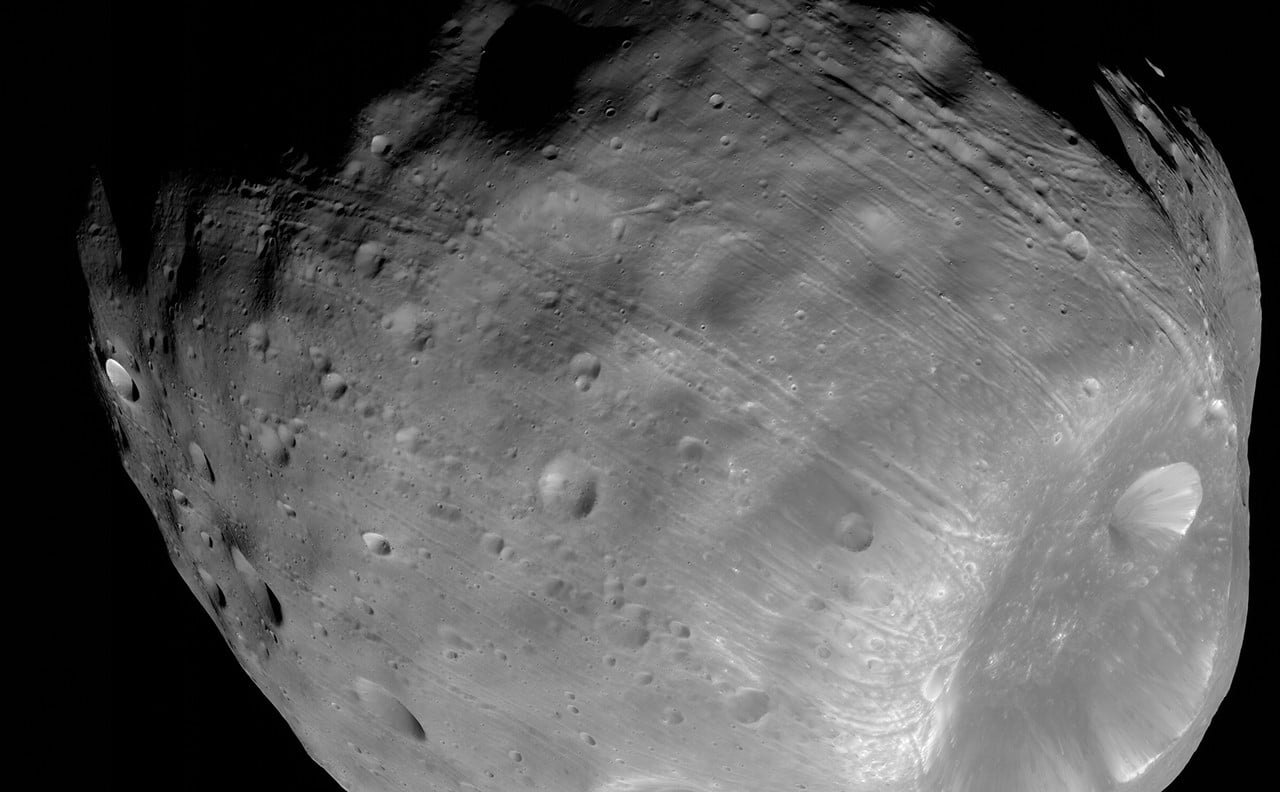
On 5 September 2024, Curiosity photographed a pairing that no human being has ever watched with unaided eyes. Earth was sinking towards the western horizon of Mars while Phobos, the planet’s larger moon, was rising nearby.
The two objects were moving in opposite directions across the Martian sky. Earth was setting for the familiar reason: Mars was rotating eastward, carrying the rover away from the view. Phobos was rising in the west because it was moving eastward around Mars faster than the surface beneath it could turn.
That small moon completes one orbit in 7 hours and 39.2 minutes. A Martian solar day, or sol, lasts about 24 hours and 39 minutes. Phobos therefore circles Mars a little more than 3.2 times per sol, and an observer on the surface sees it cross the sky from west to east rather than east to west.
The result is often accompanied by a stronger claim: that Phobos is the only known moon whose orbital period is shorter than its planet’s day. That part is not correct. Several small moons of the giant planets also orbit inside their planets’ synchronous distances. Phobos is remarkable for other reasons, including being the closest known moon to the surface of its planet, but it is not alone in winning this particular race.
The direction of moonrise is a race between two angular speeds
There is nothing intrinsically east-to-west about the movement of a moon across a sky. What an observer sees depends on two motions at once: the rotation of the planet and the orbital motion of the moon.
Earth turns once relative to the stars in just under 24 hours. Our Moon takes about 27.3 days to complete an orbit in the same general direction. The ground therefore turns much faster than the Moon moves around Earth. We are carried towards the eastern horizon first, see the Moon rise there, and later rotate away from it as it sets in the west.
Phobos reverses the order. Mars rotates eastward, and Phobos also travels eastward, but the moon moves around the planet more than three times while Mars turns once. It overtakes the ground. To a stationary observer, Phobos arrives from behind in the west, passes overhead towards the east and disappears beyond the eastern horizon.
NASA gives the relevant periods as 7 hours 39.2 minutes for Phobos and 24 hours 37.4 minutes for the Martian rotation used on that resource page. Small differences appear depending on whether a day is measured relative to the stars or the Sun, but none affects the direction of the apparent motion.
This is the same reason planetary time can produce apparently contradictory statements. In my earlier article on Venus’s day, year and four-day cloud circulation, four clocks described four different motions. Phobos adds another clock: the rate at which an orbiting object gains on the rotating ground below it.
Three orbits do not produce three full passages for one observer
“Three times a day” needs careful handling. Phobos completes just over three orbits in a sol when its motion is measured against distant space. A person on Mars is not standing in distant space. They are being carried eastward by the planet while Phobos is moving eastward above them.
The moon has to make up the ground that the observer gains during each circuit. The resulting interval between equivalent positions in the local sky is about 11 hours and 6 minutes. That is why NASA describes Phobos as rising and setting roughly twice per Martian day, even though it completes more than three orbits.
A passage is fast. Phobos can move from western rise to eastern set in a little over four hours, depending on the observer’s location and the geometry of the orbit. Its apparent motion would be obvious over the course of an evening rather than requiring observations on successive nights.
It is also not visible from everywhere. Phobos travels only about 6,000 kilometres above the Martian surface and follows an orbit close to the equatorial plane. Because Mars itself curves sharply away beneath such a low orbit, the moon is below the horizon for much of the planet at any one time. NASA notes that it can be seen from less than a third of the surface at an instant, and high northern and southern latitudes never get the dramatic overhead passage imagined in many illustrations.
Where it is visible, Phobos appears about one-third as wide as Earth’s Moon does in our sky. It is physically tiny, with a mean diameter of roughly 22 kilometres, but proximity gives it a visible disc. Deimos, Mars’s smaller and more distant moon, looks more like a bright star.
Synchronous orbit is the dividing line
There is a particular altitude where a moon on a circular, equatorial orbit would take exactly as long to circle Mars as Mars takes to rotate. This is the synchronous orbit. A satellite placed there would remain above approximately the same longitude, just as a geostationary communications satellite appears fixed above Earth.
For Mars, the synchronous distance is about 20,400 kilometres from the planet’s centre, or roughly 17,000 kilometres above the mean surface. Phobos orbits at only about 9,400 kilometres from the centre. It is deep inside the dividing line.
Deimos sits outside it. Deimos takes a little over 30 hours to orbit, so Mars turns faster than the moon travels. It follows the more familiar pattern, rising in the east and setting in the west, although its slow progress relative to the surface can keep it above the horizon for a long time.
The synchronous boundary turns an odd sky fact into a general rule. Inside the boundary, an orbiting body moves ahead of the surface. Outside it, the surface moves ahead of the orbiting body. At the boundary, the two remain aligned.
I explored another version of this distinction in my article about Mercury’s three-to-two spin-orbit resonance and double sunrise. On Mercury, the apparent reversal of the Sun happens near perihelion because the planet’s changing orbital speed briefly overtakes part of its rotation. At Mars, Phobos performs the overtaking on every circuit.
The same race that reverses the sky is pulling Phobos down
The west-to-east passage is not merely a visual curiosity. It tells us which way angular momentum is being transferred through tides.
A moon raises a tidal deformation in its planet. If the planet rotates faster than the moon orbits, the deformation is carried slightly ahead of the moon and exerts a forward gravitational pull. The moon gains orbital angular momentum and moves outward. This is happening in the Earth-Moon system, where laser ranging shows our Moon slowly receding.
Phobos produces the opposite arrangement. It moves faster than Mars rotates, so the tidal response of Mars falls behind the moon. The resulting torque removes angular momentum from the orbit. Phobos moves inward, and a lower orbit makes it travel faster still.
NASA estimates that Phobos approaches Mars by about 1.8 metres per century. That is imperceptible on a human timescale, but the orbit is measured precisely enough for the long trend to be clear. The rate also contains information about how Mars deforms and dissipates energy internally. A 2019 Nature study used Phobos’s orbital evolution to constrain the rheology and thermal history of Mars, turning a moon’s changing position into a probe of the planet beneath it.
The final outcome is measured in tens of millions of years, not by a precise appointment. Phobos may strike Mars, or tidal forces may pull it apart first and create a temporary ring. The answer depends partly on the moon’s internal strength and structure, which are not yet known well enough.
Phobos is not the only moon inside the line
The claim that Phobos is unique in orbiting faster than its planet rotates is easy to disprove with Jupiter. Metis completes an orbit in about 7.1 hours while Jupiter turns in about 9.9 hours. NASA explicitly describes Metis and neighbouring Adrastea as orbiting inside Jupiter’s synchronous radius. Both are expected to lose altitude over time.
Neptune’s innermost moons provide other examples. Naiad circles Neptune in roughly 7 hours and 6 minutes, well inside Neptune’s approximately 16-hour rotation. It too occupies a decaying orbit.
What makes Phobos especially useful is not exclusivity but accessibility and scale. It is considerably larger than many inner ring moons, it has been repeatedly photographed by spacecraft at Mars, and its orbit can be tracked against a rocky planet whose tidal response scientists want to understand. Its rapid passage has even allowed Mars landers and rovers to observe brief transits across the Sun.
Phobos also sits in a system simple enough to make the contrast clear. Mars has one moon inside the synchronous boundary and one outside it. Phobos spirals inward; Deimos moves very slowly outward. The two moons occupy opposite sides of the same dynamical rule.
A sample could tell us how this temporary arrangement began
The future of Phobos follows from its current orbit, but its origin remains less certain. Its dark surface resembles primitive asteroids, which encouraged the idea that Mars captured it. Yet the nearly circular, equatorial orbits of both Phobos and Deimos are difficult to produce through simple capture.
An alternative is that a large impact on early Mars threw debris into orbit. Material in a disc could have assembled into moons, perhaps through more than one cycle in which an inner moon moved towards Mars, broke into a ring and formed another moon. A Nature Geoscience model proposed an ongoing ring-moon cycle, but orbital models do not yet select one history beyond dispute.
JAXA’s Martian Moons eXploration mission is intended to bring direct evidence to that argument. According to the current MMX mission schedule, the spacecraft is planned for launch in Japanese fiscal year 2026. It will observe both moons, deploy the IDEFIX rover on Phobos, collect more than 10 grams of material and return the sample to Earth in fiscal year 2031.
In my recent article on Ingenuity’s 72 flights through the Martian atmosphere, the most interesting shift was from proving a possibility to accumulating operational evidence. MMX faces a different environment, but a related transition. Phobos has been inferred through spectra, images, orbital tracking and brief flybys. A returned sample would let laboratories test whether its minerals point towards Mars, an asteroid-like source, or a more complicated mixture.
The moon’s west-to-east journey is therefore more than an unusual view awaiting future visitors. It is the visible consequence of Phobos being on the wrong side of the synchronous boundary. That one fact explains why it laps the Martian surface, why it crosses the sky in the unfamiliar direction and why its orbit is slowly running out.