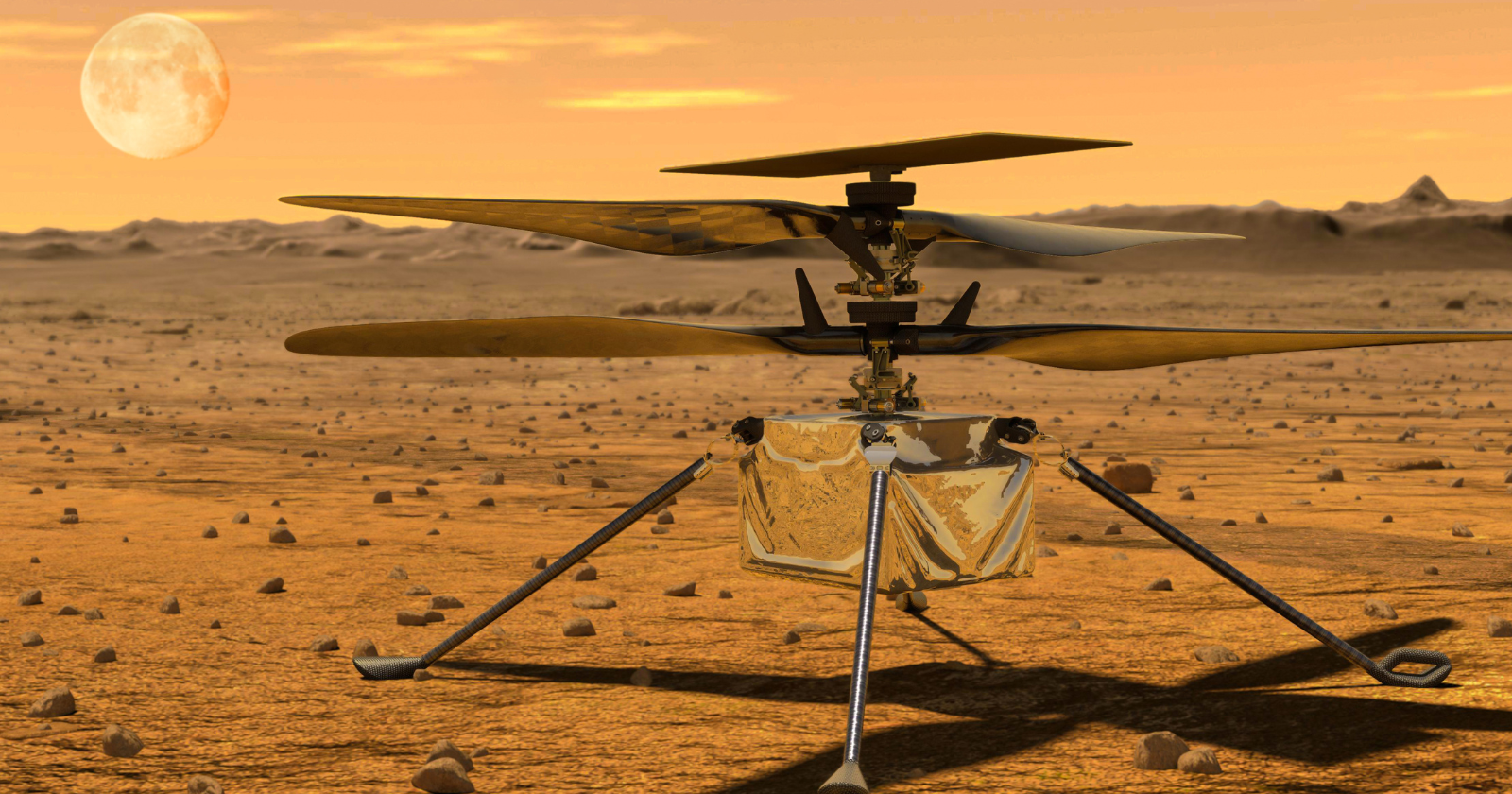
Ingenuity’s flying career ended on 18 January 2024, but the machine did not simply switch off.
After its 72nd flight ended in a hard landing on a sand ripple, NASA engineers found that the helicopter’s computers, battery, solar panel, cameras and temperature sensors still worked. They gave it a final software patch and left it with a new routine: wake each Martian day, inspect itself, photograph the ground and record temperatures.
There is an important distinction here. Ingenuity is no longer sending live weather reports to Earth. Perseverance was its only radio relay, and the rover has continued driving. Whatever Ingenuity records now remains in memory, waiting for a rover, aircraft or astronaut that may never visit.
That quiet afterlife is arguably stranger than the original plan. A helicopter built for five flights over 30 Martian days may spend years as an unattended environmental recorder beside its own broken blade.
Flying at Mars meant finding lift in almost no air
At the surface of Mars, the atmosphere is less than one per cent as dense as Earth’s. Lower Martian gravity helps, but not enough to make flight straightforward. A rotor still needs molecules to push downwards, and Mars provides very few of them.
Ingenuity solved the problem by being exceptionally light. It had a mass of 1.8 kilograms, a body roughly the size of a tissue box and two counter-rotating rotors spanning about 1.2 metres. The blades normally turned at around 2,400 revolutions per minute, far faster than those of a full-sized helicopter on Earth.
The vehicle also had to fly by itself. A radio command takes minutes to travel between Earth and Mars, so no pilot could react to a gust, a drift or an obstacle in real time. Ingenuity used an inertial sensor, laser altimeter and downward-looking navigation camera to estimate its motion and hold a planned route.
Its first flight on 19 April 2021 lasted 39.1 seconds. It rose three metres, hovered, turned and landed. The Wright brothers’ first powered flight had lasted 12 seconds. On Mars, the modest hover was enough to answer the central question.
Five flights became an aircraft operations programme
NASA had defined Ingenuity as a technology demonstration. It carried no dedicated science instrument, and the success of Perseverance’s main mission did not depend on it. If it failed during deployment or its first flight, the rover was meant to drive away.
Instead, Ingenuity completed the five-flight demonstration and remained healthy. NASA extended its role into an operations demonstration. The helicopter began scouting terrain ahead of Perseverance, photographing possible routes and landing zones that rover planners could not see from ground level.
I previously wrote about how a five-flight machine built partly from mobile-phone technology reached Flight 72. Across almost three years it travelled about 17 kilometres, spent 128.8 minutes in the air, climbed as high as 24 metres and reached 10 metres per second.
Those numbers matter less as records than as operating experience. Ingenuity encountered dust storms, winter nights cold enough to force repeated electrical brownouts, terrain that blocked its radio link and a changing atmosphere that required faster rotor speeds. A demonstration of possibility became a long test of reliability.
The final flight failed because the ground looked too empty
Flight 72 was not meant to travel anywhere. Ingenuity had made an emergency landing during Flight 71, so the next sortie was planned as a short vertical hop to check its systems and establish its position.
The helicopter climbed 12 metres, hovered and began descending. Around 20 seconds after take-off, its navigation system could no longer identify enough surface features to track. The ground below was a field of steep, visually repetitive sand ripples with little texture for the camera to follow.
NASA and AeroVironment later conducted what the agency called the first aircraft accident investigation on another world. There was no flight recorder to retrieve and no eyewitness. The conclusion was therefore a most likely sequence, not a frame-by-frame certainty.
Without reliable visual velocity estimates, Ingenuity appears to have reached the ground with substantial horizontal motion. The hard impact on the sloping ripple made the aircraft pitch and roll. Loads on the still-spinning rotors snapped all four blades roughly a third of the way from their tips, and a large section of one blade later separated completely.
This is more precise than saying that one rotor tip simply clipped the sand. A surface strike may have been part of the event, but the available data support a navigation failure followed by a hard, fast touchdown and destructive rotor loads.
Grounded did not mean electrically dead
Perseverance re-established communication with Ingenuity two days after the accident. The helicopter remained upright, its solar panel still charged its six lithium-ion batteries, and most of its electronics behaved normally. It did not understand, in any human sense, that it could no longer fly.
For a period, Ingenuity sent avionics and temperature data to the rover about once a week. Engineers used that link to test systems and install a final software update. On 16 April 2024, the project team gathered for its last formal downlink shift.
The patch changed the helicopter from a damaged aircraft into a stationary testbed. NASA said Ingenuity would wake daily, run its flight computer, check the solar panel, batteries and electronic equipment, take a colour photograph of the surface and read temperature sensors throughout the vehicle.
Calling this a weather station needs a qualification. Ingenuity does not measure wind, pressure and humidity as Perseverance’s dedicated MEDA instrument was designed to do. Its temperature readings and daily pictures can nevertheless reveal thermal cycles, dust deposition and changes in the local surface environment.
The data can be recorded even when nobody can hear it
Ingenuity never had a direct radio link to Earth. Every instruction and every returned image travelled through a base station on Perseverance. Once the rover drove beyond communication range, the helicopter could continue its daily routine but could no longer deliver the results.
NASA estimated that its onboard memory could store about 20 years of daily data. That is capacity, not a prediction that the hardware will survive for two decades. Dust may gradually reduce solar output. Repeated cold cycles may damage batteries, solder joints or other components. A single electrical failure could stop the experiment without anyone on Earth knowing when it happened.
The arrangement resembles a sealed field notebook. The pages may still be filling, but the notebook is lying on another planet. Recovering it would require a future machine to reach the site NASA nicknamed Valinor Hills, establish a compatible radio link or physically retrieve the data.
This makes Ingenuity’s final experiment unlike ordinary planetary science. There is no scheduled downlink and no guaranteed result. The value exists only if someone returns.
Its successors will be designed as aircraft, not demonstrations
Ingenuity’s 72 flights changed the questions engineers could ask. Before April 2021, a Mars helicopter had to prove that controlled flight was possible. Afterward, designers could concentrate on payload, navigation, range and scientific use.
NASA has studied larger Mars rotorcraft able to carry instruments and navigate terrain beyond the capability of Ingenuity’s simple camera system. The lesson from Flight 72 is especially direct: future aircraft need better ways to estimate motion over smooth sand, not merely stronger blades.
The influence extends beyond Mars. In an earlier article, I looked at the much larger Dragonfly rotorcraft being developed for Saturn’s moon Titan. Titan offers denser air and weaker gravity, but its aircraft inherits the broader confidence that autonomous powered flight can become a serious method of planetary exploration.
Ingenuity also belongs beside MOXIE’s experiment in making oxygen from the Martian atmosphere. Neither device was the main scientific purpose of Perseverance. Both were built to prove a future capability in the place where it would one day be needed.
A machine can outlive the definition of its mission
Ingenuity’s official mission ended when damaged rotors made another flight impossible. The aircraft, however, still had power, computation, memory and sensors. Engineers found a final use for what remained.
That does not mean we know it is operating today. With Perseverance gone, there is no live status report. The most accurate statement is that Ingenuity was programmed to continue recording, and that its memory was designed to hold the result long after communication ended.
Its story consequently has two endings. The first is visible: a hard landing, four broken blades and a small aircraft stranded on a sand ripple. The second is hidden inside its electronics: a daily wake-up, a photograph, a set of temperatures and another entry stored for an unknown reader.
The helicopter that proved flight was possible on Mars may now be proving something quieter about machines left behind. A mission can stop moving, stop speaking and still continue to observe.