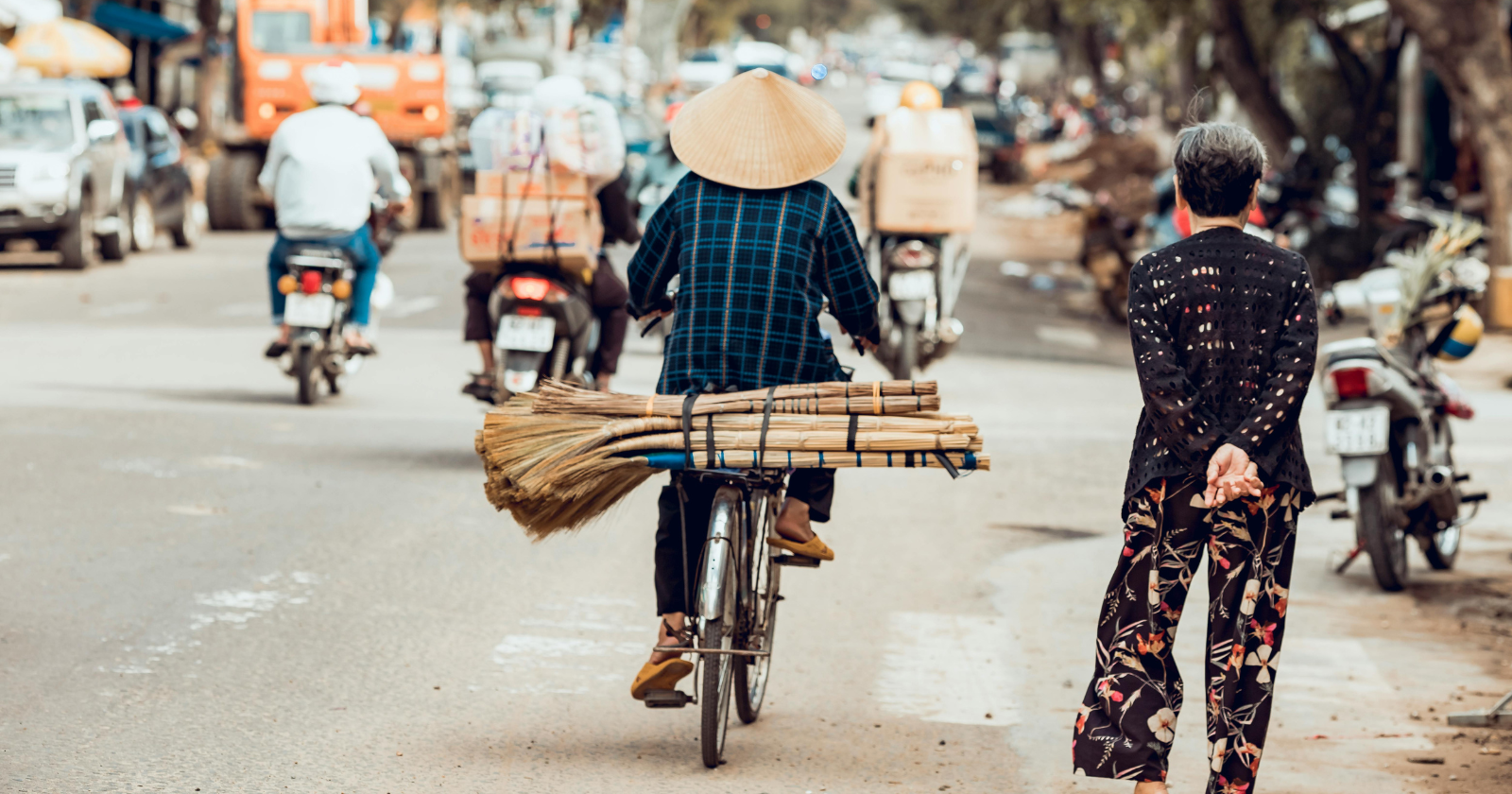
In 1986, Vietnam was one of the poorest places on earth.
It had come through decades of war and was still rationing basic goods to its people. Inflation in the early 1980s was running at about 400 percent, according to the IMF’s account of the period. The country was isolated, its economy centrally planned, and by most measures it was going nowhere. So the Communist Party made a bet that looked close to heresy for a one-party socialist state: it decided to let markets in.
That bet was called Doi Moi, which translates roughly as “renovation.” What followed over the next thirty-odd years is one of the reasons economists still argue about how poverty actually ends.
The reforms touched the ground people stood on.
The reform process dismantled collective farming and gave households rights to land, while opening the country to private business and foreign investment.
Vietnam went from struggling to feed itself to becoming one of the world’s major rice exporters. And the growth wasn’t a one-off spike. Income per person grew by about 5.6 percent a year on average between 1990 and 2017, according to the IMF, a run that trailed only China’s over that period.
This is where the story gets hard to believe. Extreme poverty, measured at the World Bank’s international line, dropped from 45 percent in 1992 to less than 1 percent in 2022, according to the OECD’s 2025 survey.
Between 1993 and 2014, Vietnam’s poverty rate fell from almost 60 percent to 14 percent; 40 million people climbed out of poverty. That is a change most countries would be pleased to manage over a century, compressed into roughly one working lifetime.
The gains weren’t just numbers on a chart. According to the World Bank, electricity access rose from 14 percent in 1993 to over 99 percent in 2018. The Bank also records that infant mortality fell from 32.6 to 12.1 deaths per 1,000 live births between 1993 and 2023, while life expectancy rose from 70.5 to 74.5 years between 1990 and 2023. GDP per person went from under $700 in 1986 to nearly $4,500 in 2023. Those are the kinds of numbers that describe a different daily life, not just a different statistic.
Plenty of countries have tried market reforms and stalled, so the interesting question is what Vietnam did differently.
As far as I can tell, it did several things at once and kept doing them. It freed up farming first, which put money straight into the hands of the rural majority. It pushed hard on exports, so growth was pulled along by global demand rather than propped up at home. And it kept extending the unglamorous basics, health care and schools and electricity, so ordinary people could turn growth into better lives.
The World Bank calls it “a remarkable development success story.” The OECD’s view lands in a similar place. Its 2025 survey, in a chapter by Patrick Lenain, says that “Viet Nam has almost eradicated extreme poverty over the past decades with the help of sustained economic growth and social protection policies.”
What the world hasn’t yet reckoned with
The escape from extreme poverty is real, but it isn’t the whole picture. The same OECD survey finds that at a higher benchmark of $6.85 a day, 19.7 percent of Vietnamese were still below the line in 2022. That is nearly one in five people who have climbed out of destitution but perhaps remain a bad harvest, a health shock, or a flood away from falling back.
Vietnam also faces an aging population, a large informal workforce without full social protections, and serious exposure to climate risk.
There’s also the uneven map underneath the headline. The World Bank’s earlier work flagged that poverty among ethnic minorities stayed high even as the national average collapsed. Averages hide people, and some communities did not ride the same curve as the country as a whole.
What stays with me is the human arithmetic. Someone born in a Vietnamese village in the late 1980s could reasonably have expected a life of subsistence farming and rationed goods. That same person, now in their thirties, likely has electricity, a longer life expectancy, and perhaps a middle class lifestyle. And it happened to tens of millions of specific people inside a single generation. The open question is whether the conditions that made it possible, the timing, the reforms, the steady investment, can be repeated somewhere else, or whether Vietnam caught a combination that doesn’t come around often.