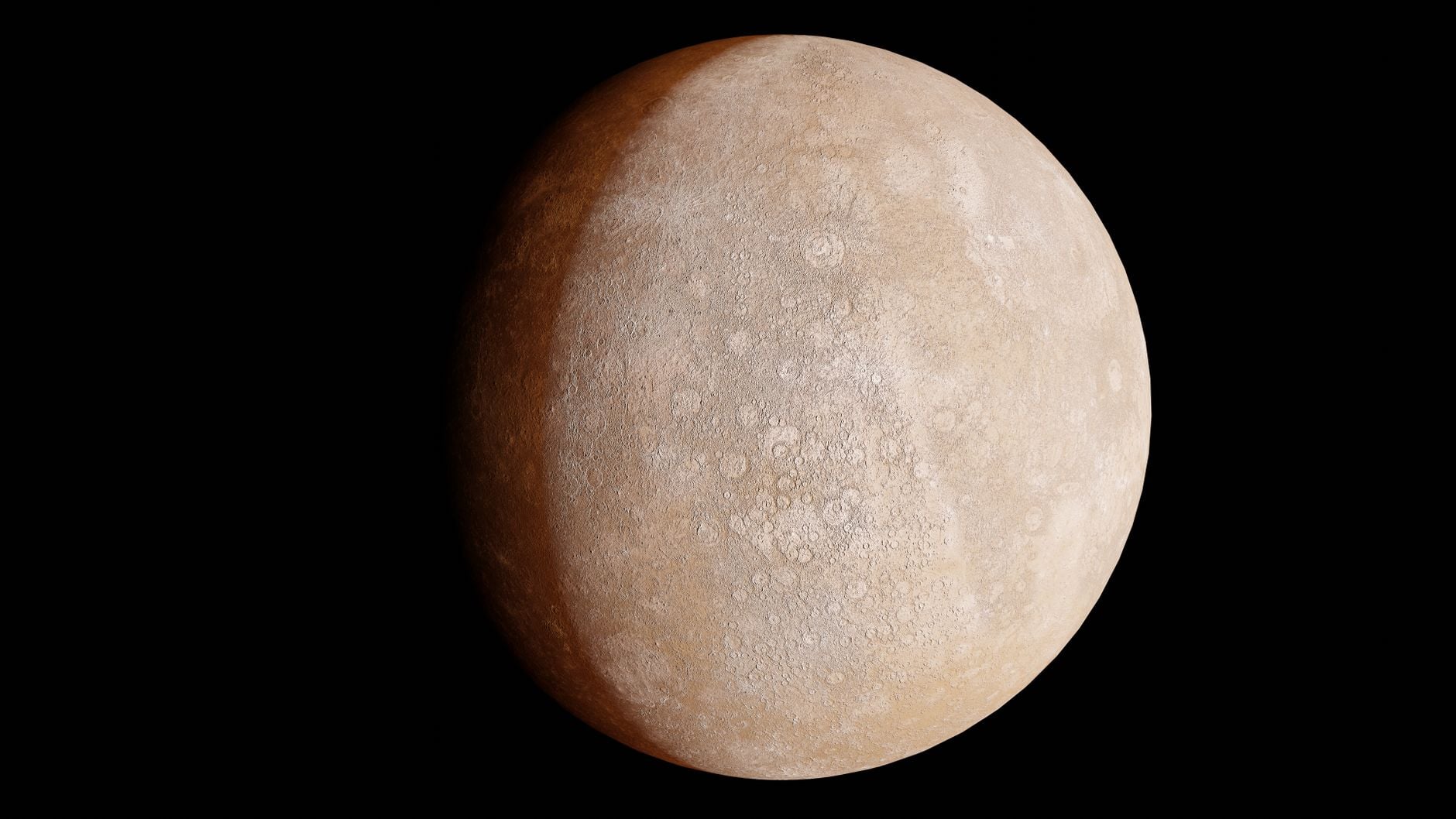
Imagine standing on Mercury before dawn.
There is almost no atmosphere to soften the darkness. The ground is a hard field of craters and broken rock. Above it, the sky remains black even as the eastern horizon begins to glow.
Then the Sun appears. From Mercury it looks more than three times as large in the sky as it does from Earth, and the light can be seven times brighter. Yet it does not climb with the familiar steadiness of an earthly sunrise. It moves painfully slowly, loses speed, and stops.
From certain longitudes, the Sun then sinks backwards below the horizon. Days later it changes direction again and rises for a second time.
Nothing has pushed Mercury into reverse. The planet has continued rotating the same way. The effect comes from two motions competing in the observer’s sky: Mercury’s slow spin and its changing speed around a strongly elliptical orbit.
The result is one of the strangest days on any planet, and it begins with a distinction hidden inside the word “day”.
Mercury has a 59-day rotation and a 176-day day
On Earth, the time required to turn once relative to the distant stars and the time from one noon to the next are close enough that we rarely distinguish them in ordinary conversation. Mercury makes that shortcut impossible.
The planet completes one rotation relative to the stars in about 58.6 Earth days. It completes an orbit of the Sun in about 88 Earth days. Those two periods are locked in a ratio: Mercury turns three times for every two orbits.
Now follow one point on the surface. After one Mercury year, the planet has made one and a half rotations. The opposite side faces the Sun. Only after a second orbit, when Mercury has completed three rotations, does the original point return to the same position in the solar cycle.
That is why NASA gives Mercury’s solar day as 176 Earth days. A solar day means the interval from one local noon to the next, or one complete cycle of daylight and darkness. It lasts exactly two Mercurian years in the ideal 3:2 resonance.
This phrasing can sound contradictory. Mercury does not take two years to turn once. It turns once in two-thirds of a year. But while it turns, it is also travelling around the Sun, so the surface needs three rotations and two orbits to bring the Sun back to the same place in the sky.
I recently wrote about how a day on Venus lasts longer than its year while its clouds circle the planet in four days. Mercury reaches a similarly strange result by a different route. Venus rotates slowly backwards. Mercury rotates forwards, but its spin has become caught in a precise relationship with its orbit.
The 3:2 resonance is a tidal compromise, not a coincidence
Mercury formed spinning faster than it does now. Over immense spans of time, the Sun’s gravity raised tides in the young planet and those tides dissipated energy. The spin slowed.
If Mercury travelled on a nearly circular orbit and had a perfectly even mass distribution, it might have ended with the same face always pointing at the Sun, much as the Moon keeps one face towards Earth. That is called synchronous rotation, or a 1:1 resonance.
Mercury’s orbit is not close to circular. Its distance from the Sun changes from about 70 million kilometres at aphelion, its farthest point, to 47 million kilometres at perihelion, its nearest. Its orbital eccentricity is about 0.206, greater than that of any other planet.
The strength and timing of the solar torque therefore change markedly during each orbit. Mercury is also not perfectly symmetrical. Its equator is slightly elongated, giving the Sun a small gravitational handle on the planet’s orientation.
Near perihelion, when Mercury is closest and the torque is strongest, its long equatorial axis tends to align with the Sun. In the stable 3:2 spin-orbit state described by rotational models, that alignment repeats in a consistent way. The planet is not randomly spinning at roughly the right speed. Its shape, eccentric orbit and solar tides keep the motions coupled.
“Exactly” still needs a small caveat. Mercury rocks back and forth by tiny amounts around the average resonance. These oscillations are called librations. They are far too small to create the double sunrise, but they are scientifically valuable because their size contains information about what is happening beneath the crust.
The part that interests me is that the apparently simple statement “three turns for two orbits” is really a surviving record of Mercury’s history. The present spin tells us that the planet lost rotational energy, crossed possible resonances and settled into this one.
The Sun reverses because Mercury briefly orbits faster than it spins
To understand the backward Sun, imagine subtracting Mercury’s orbital motion from its rotation.
Rotation carries a point on the surface eastward and normally makes the Sun drift westward across the sky. At the same time, Mercury’s movement along its orbit changes the direction from which the Sun appears. The apparent solar motion is the difference between those two angular rates.
For most of the orbit, Mercury’s rotation wins. The Sun creeps in the expected direction. But planets move faster when they are closer to the Sun. As Mercury approaches perihelion, its orbital angular speed rises until it matches the spin rate. To an observer on the surface, the Sun stops moving.
Closer to perihelion, the orbital motion becomes faster than the rotation. The subtraction changes sign. The Sun appears to move backwards. After Mercury passes perihelion and begins to slow, the rates match again, the Sun pauses for a second time, and its ordinary motion resumes.
The sequence looks different depending on where the observer stands. At a longitude where this loop happens near dawn, the Sun can rise briefly, set, and rise again. At another longitude the same reversal occurs around dusk, producing a double sunset. From much of the dayside, the Sun would simply trace a small backward loop without touching the horizon.
The Sun would also change visibly during the event. Mercury’s distance from it varies so much that the solar disc appears roughly one and a half times wider at perihelion than at aphelion. The stalled and reversing Sun is therefore near its largest and most intense.
This is not the apparent retrograde motion we sometimes see when tracking a planet against the background stars from Earth. In that case, the changing viewpoints of two orbiting planets create a loop. On Mercury, the Sun’s reversal is a local daily effect produced by the competition between the planet’s own spin and its variable orbital speed.
A sunrise would take days, and daylight would last for months
It is easy to describe the double sunrise as if it were a quick celestial trick. It would be nothing like one.
A full solar day lasts 176 Earth days, so a broad estimate gives nearly 88 Earth days of daylight followed by nearly 88 days of darkness near the equator. The reversal near perihelion complicates the exact timing at some longitudes, but the scale remains the same. The Sun would crawl rather than sweep.
Mercury has only a tenuous exosphere, not an atmosphere capable of scattering daylight around the sky. There would be no blue dome and little familiar twilight. Sunlit ground would be harshly illuminated beneath a black sky, while unlit terrain remained in deep shadow.
The thermal consequences are severe. Sunlit surface temperatures can reach about 430 degrees Celsius. During the long night they can fall to around minus 180 degrees. The planet does not have enough atmosphere to move substantial heat from day to night, so rotation turns geography into a prolonged heating and cooling experiment.
Yet even this picture varies with location. Mercury’s spin axis is almost upright, which keeps the Sun close to the horizon at the poles. Deep crater floors there can remain permanently shadowed.
That geometry is why, as I explored in my previous article on Mercury’s billions of tonnes of polar ice, frozen water can survive on the planet closest to the Sun. The 176-day solar cycle creates extreme heat over much of the surface, but it cannot deliver sunlight around the rim of the right polar crater.
Mercury is often reduced to a single identity: the hot planet beside the Sun. Its rotation makes that description inadequate. There are places with repeated dawns, longitudes that receive especially intense perihelion heat, and polar hollows where the Sun never rises at all.
For decades, astronomers thought Mercury kept one face towards the Sun
The 3:2 resonance was not obvious from Earth. Mercury never moves far from the Sun in our sky, so it is difficult to observe through a telescope. The best viewing opportunities also tend to repeat at similar points in Mercury’s orbit. Surface markings appeared in familiar orientations, encouraging the belief that the rotation period matched the 88-day year.
That interpretation survived into the twentieth century. Then radio astronomy supplied a different kind of clock.
In April 1965, Gordon Pettengill and Rolf Dyce transmitted radar pulses towards Mercury from the Arecibo Ionospheric Observatory in Puerto Rico. Different parts of a rotating planet’s surface return echoes with slightly different Doppler shifts. By analysing the reflected signal, the researchers could infer the spin without following a faint surface marking through the glare.
Their report in Nature overturned the old picture. The measured rotation was about 59 days, not 88. Mercury was not keeping one hemisphere permanently in daylight and the other in night.
The Italian mathematician and engineer Giuseppe Colombo recognised that the new period was close to two-thirds of the orbital period and helped explain the 3:2 resonance. Colombo later showed NASA how a Venus gravity assist could allow Mariner 10 to make repeated Mercury flybys. Europe and Japan’s current BepiColombo mission carries his nickname.
There is something pleasing about that chain. A radar echo revealed the strange rotation. The person who helped explain it then worked out how a spacecraft could revisit the planet. A later mission was named for him and is now approaching Mercury to measure it in greater detail.
Mercury’s imperfect clock can reveal its interior
A rigid Mercury and a Mercury with a liquid outer core do not respond to the Sun’s repeated torque in quite the same way.
The tiny forced librations change if the rocky mantle can move somewhat independently of the core. Earth-based radar measurements, MESSENGER images, laser altimetry and gravity data have allowed scientists to measure those deviations from uniform rotation. The results support a large core that remains at least partly molten beneath the silicate shell.
In other words, scientists can learn about metal thousands of kilometres below the surface by watching landmarks shift by tiny angles over an 88-day orbit. A detailed review of Mercury’s internal structure describes the resonance and librations as central tools for separating the motion of the mantle from that of the core.
BepiColombo should extend that work. As of July 2026, the ESA and JAXA spacecraft is in its arrival phase. Its solar-electric propulsion system completed its final thrust arc on 15 June, ending an eight-year cruise. ESA plans Mercury orbit insertion for 21 November 2026, followed by deployment and orbit-lowering operations into 2027.
The mission’s observations will refine Mercury’s gravity, rotation, surface and internal structure. It will not make the double sunrise more real than it already is, but it may tell us more precisely why the planet settled into this resonance and what its small departures from perfect clockwork reveal.
From the surface, the result would be visual: a huge Sun rises into a black sky, stops, retreats and returns.
From orbit, the same phenomenon is a measurement of tidal history, orbital mechanics and a hidden liquid core.
Mercury’s day lasts two of its years because spin and orbit have become coupled. The moment when the Sun turns around is where that elegant ratio meets the untidy reality of an elliptical orbit.