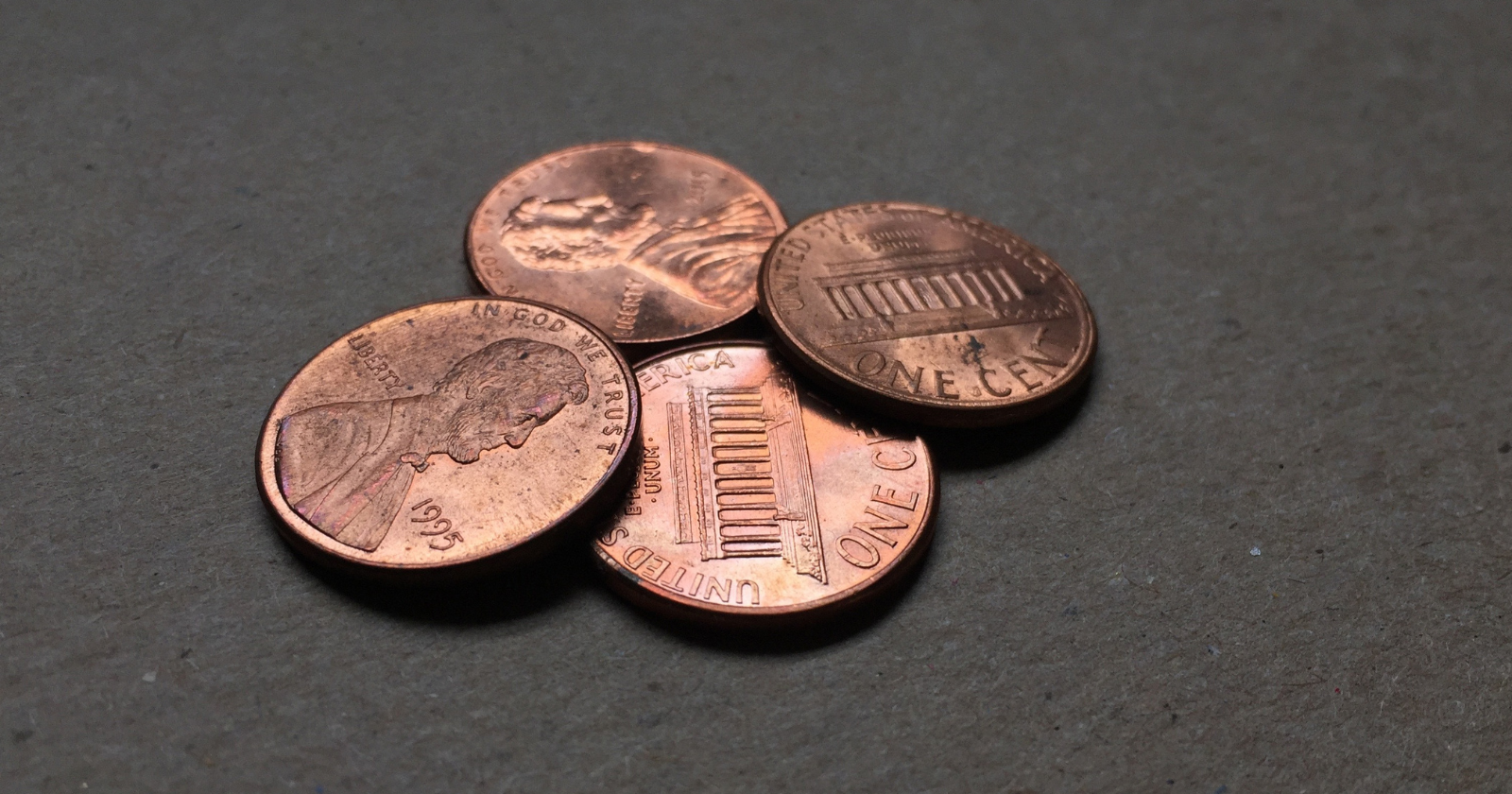
Ask most people how much it costs to make a penny and you’ll get a shrug, or a guess of about one cent. That feels right. A coin worth a cent should cost roughly a cent to produce. Why would a government lose money stamping out its own smallest coin?
Well, for nearly two decades, it did exactly that. By the end, the gap between what a penny was worth and what it cost had grown wide enough that keeping it alive stopped making sense.
What the numbers actually showed
In 2024, according to a U.S. Mint’s 2024 Annual Report, a single penny cost 3.69 cents to produce and distribute, close to four times its face value. The same brief says Treasury lost about $85.3 million on the penny in 2024.
The cost was also climbing fast. Coin News reported that the unit cost jumped 20.2 percent in 2024, from 3.07 cents to 3.69.
President Trump put it bluntly in a February 2025 post, writing that pennies had “literally cost us more than 2 cents” each and calling that wasteful. His number was low, since the latest figure was 3.69 cents, but the direction was right.
Why it took so long to pull the plug
If the math was that lopsided, why didn’t anyone act sooner?
Economists had been making the case for years. Wake Forest’s Robert Whaples has argued for scrapping the penny for two decades, partly on the grounds of wasted time. Whaples argues that “on average, Americans earn about one cent every two seconds,” so “if it takes you longer than two seconds to use your penny, it’s using up time that is more valuable than the coin itself.” It is an illustration rather than a hard measurement, but the point lands.
The stickiest objection was the fear of a hidden “rounding tax”: the worry that cash totals rounded to the nearest nickel would quietly cost shoppers more. Using cash-register data from an East Coast convenience-store chain, Whaples concluded that “rounding up and rounding down to the nearest nickel essentially balances out, having a negligible impact on consumers.” A newer Richmond Fed analysis, using nationally representative 2023 payment-diary data, found a small net cost instead: about $6.06 million a year. By 2024, however, cash accounted for only about 16 percent of payments recorded by participants in a Federal Reserve study.
So if not the economics, what held it up?
Whaples suggests that nostalgia was part of the reason, citing shiny new pennies, gumball machines and Abraham Lincoln’s face on the coin. Sentiment was doing work that arithmetic could not undo.
November 12, 2025: the last strike
The end came as ceremony. On November 12, 2025, the U.S. Mint held a ceremonial strike at its Philadelphia facility, where U.S. Treasurer Brandon Beach struck the final circulating one-cent coin, ending a 232-year run. It followed Trump’s February instruction to Treasury to stop production and Treasury’s May order for its final batch of penny blanks.
The Mint framed the moment warmly. Acting Mint Director Kristie McNally said, “Today the Mint celebrates 232 years of penny manufacturing. While general production concludes today, the penny’s legacy lives on.” The tone fits a country that found this harder to do than the balance sheet suggested it should be.
What disappears with it, and what doesn’t
Ending production is not the same as ending the penny. The Treasury says roughly 114 billion pennies still exist, hundreds for every American. Many likely sit in jars or disappear into couch cushions, but they remain legal tender. The country has simply stopped adding new circulating pennies to the pile.
The savings are real but modest. The Treasury projects immediate savings of about $56 million a year in material costs. There is a catch, though. The Richmond Fed warns that ending the penny could increase demand for the nickel, which cost 13.8 cents to make in 2024, more than double its face value.