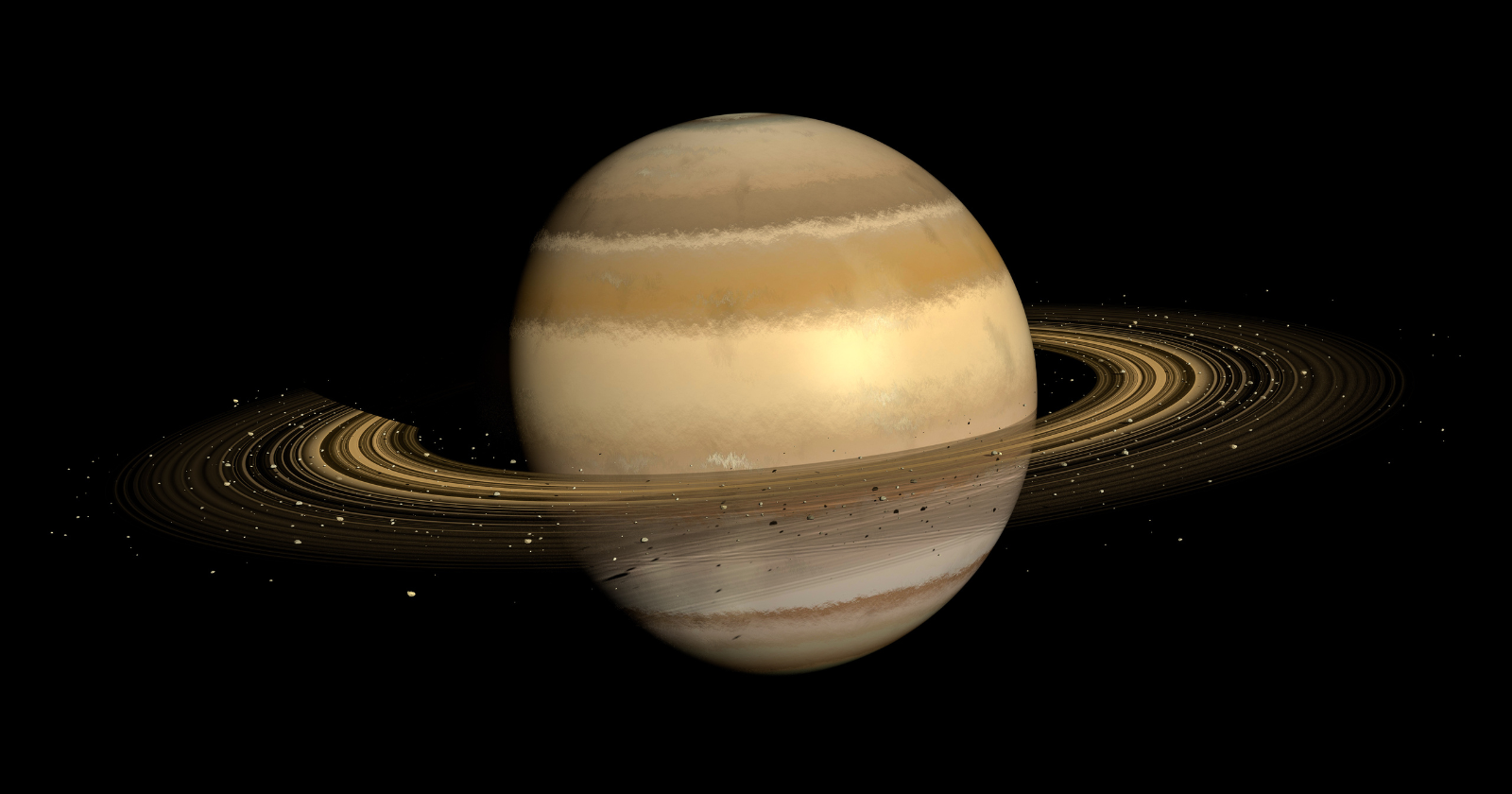
Saturn is not light. Its mass is about 568 trillion trillion kilograms, equivalent to roughly 95 Earths. It holds enough matter to dominate a system of rings and moons, and its gravity at the level conventionally treated as its “surface” is slightly stronger than the gravity beneath our feet.
Yet Saturn’s average density is only about 0.69 grams per cubic centimetre. Fresh water is close to 1. In the strict comparison that produces the famous claim, Saturn is less dense than water.
The apparent contradiction disappears once mass and density are separated. Saturn has 95 times Earth’s mass, but that material occupies about 764 times Earth’s volume. It is not small in mass. It is extraordinarily large for the amount of mass it contains.
That is the short answer to how a planet can be both immensely heavy and light enough, on average, to float. The longer answer reaches into how giant planets form, how hydrogen behaves under crushing pressure, and why Saturn is less dense than Jupiter even though both worlds are made from much the same ingredients.
Ninety-five Earths spread through 764 Earth volumes
Density is simply mass divided by volume. Earth’s average density is about 5.51 grams per cubic centimetre. The planetary parameters maintained by NASA’s Jet Propulsion Laboratory define bulk density using a planet’s mass and the volume calculated from its mean radius. If we scale Earth’s density by Saturn’s ratios, the arithmetic is revealing: 95 divided by 764, multiplied by 5.51, gives about 0.69.
The number is an average across the entire planet. It combines relatively rarefied upper atmosphere, increasingly compressed hydrogen and helium at depth, and a much denser interior containing rock, ice and metals. It does not mean that every part of Saturn is lighter than water.
Saturn was built from the lightest available material
Those two elements still account for nearly all of Saturn. Hydrogen is the lightest element, while helium is the second lightest. Earth, by contrast, lost most of its primordial hydrogen and helium and is dominated by oxygen, silicon, magnesium and iron bound into rock and metal. NASA’s current Saturn overview identifies this hydrogen-helium composition as the basic reason for the planet’s unusually low density.
The difference is why Saturn can be 95 times more massive than Earth without being anything like 95 times denser. It added mass by surrounding its heavier beginnings with an immense envelope of light material.
The Saturn system repeatedly overturns the properties we associate with familiar substances. In my earlier article about Titan’s rain, rivers and lakes, the liquid was methane and ethane rather than water. I have also written about the growing list of moons thought to conceal oceans, including worlds around Saturn whose water remains buried beneath frozen shells. Whether a material is a gas, liquid or solid depends on its temperature and pressure, not only on what the material is.
Saturn itself takes that lesson to an extreme. Hydrogen begins in its outer atmosphere as a gas. Deeper down, rising pressure packs it into a dense fluid. At still greater pressure, electrons become mobile and hydrogen takes on metallic properties, helping to generate the planet’s magnetic field. There is no solid surface and no clean boundary where the sky ends and an ocean begins.
Why Jupiter does not float
Jupiter provides the useful comparison. It is also made mostly from hydrogen and helium, and its diameter is only about 20 per cent greater than Saturn’s. But Jupiter contains more than three times as much mass.
That added matter does not make Jupiter proportionally larger. It strengthens the planet’s gravity and compresses its hydrogen-helium interior. Jupiter’s average density is therefore about 1.33 grams per cubic centimetre, nearly twice Saturn’s and comfortably above the density of water.
Saturn occupies a particular position on that relationship. It gathered enough gas to become a giant, but not enough for self-compression to raise its bulk density above water. Its low density is not evidence that its gravity is weak. NASA’s Cassini mission reference guide gives Saturn 764 Earth volumes and 95 Earth masses, while the JPL parameters put its equatorial gravitational acceleration at about 1.07 times Earth’s.
A low average hides a compressed interior
Calling Saturn a gas giant can make it sound like a uniformly airy sphere. It is nothing of the kind. Almost all of its mass lies beneath the visible clouds, where pressure turns familiar elements into unfamiliar states.
There may not even be a compact, sharply bounded core. Researchers have used waves in Saturn’s rings as a form of planetary seismology. Oscillations inside the planet disturb its gravitational field, which in turn creates patterns in the rings. A 2021 analysis in Nature Astronomy combined those patterns with Cassini’s gravity measurements and inferred a diffuse core-envelope transition extending to about 60 per cent of Saturn’s radius. The region may contain roughly 17 Earth masses of ice and rock mixed gradually into the hydrogen and helium around it.
A dense inner region can still coexist with an average density below water because so much of Saturn’s volume lies farther out. Total mass divided by total volume decides the figure.
The bathtub is where the analogy fails
If Saturn were a rigid, sealed object that retained its present volume, Archimedes’ principle says it could displace its own weight of water before becoming fully submerged. At an average density around 69 per cent of fresh water’s, roughly 69 per cent of its volume would need to sit below the waterline in that impossible idealisation.
Real Saturn has no hull. It is a self-gravitating fluid body with no surface on which an ocean could press. An expanse of water large enough to receive a planet more than 116,000 kilometres across would also be a massive, self-gravitating world. The two bodies would deform each other, fall together and mix under pressures that would transform the water itself.
So Saturn would not arrive with its rings neatly level and bob like a beach ball. The floating claim is a comparison between two average densities, not a physically achievable experiment.
Its usefulness survives that caveat. The number condenses Saturn’s history and composition into one ratio. It tells us that the planet grew enormous by retaining hydrogen and helium, that its volume expanded much faster than its mass relative to Earth, and that it remained below the point at which gravity compressed those light elements as strongly as Jupiter does.
That is what I find most interesting about the familiar Saturn fact. The planet is not “light” in any ordinary sense. It is 95 Earth masses organised into a world so large that every cubic metre, averaged from cloud top to core, contains less matter than a cubic metre of water. Saturn does not evade gravity. Its size, shape and interior are the result of gravity acting on the lightest material the young Solar System had to offer.