Tuvalu leases its internet suffix, .tv, to a commercial registry operator, and the payments come back as a budget line worth more than A$10 million a year. Among the revenues the government raises on its own account, only tuna licences and taxation bring in more.
Nobody in Tuvalu designed the asset, chose it, or bid for it.
How Tuvalu came to hold the letters
Country code top level domains are not awarded on merit or sold at auction. They follow ISO 3166-1, the international standard that assigns each country a two-letter code, and the code for Tuvalu is TV. When the domain name system was extended to national suffixes, Tuvalu received the string that matched its entry, in the same mechanical way France received .fr and Kenya received .ke.
The IANA delegation record for .tv gives a registration date of 18 March 1996 and lists Tuvalu’s Ministry of Transport, Energy, Communications and Innovations as the sponsoring organisation, with GoDaddy Registry as the technical contact. For the first few years the suffix did close to nothing. Tuvalu had barely any internet infrastructure of its own, and almost nobody in the country was using it.
What changed was demand from outside. “TV” reads as television in every market that matters commercially, and by the late 1990s people wanting to put video on the web were willing to pay for a suffix that said so.
What the budget line actually says
The figure usually quoted is around ten million dollars a year. The government’s own accounts support the general size of it, with two qualifications: the line is not labelled “.tv”, and it is not denominated in US dollars.
In the 2024-2025 national budget, presented to Parliament on 24 June 2024 by the Minister of Finance and Economic Development, Panapasi Nelesone, total revenue was projected at A$93.0 million. Of that, A$39.0 million came from fishing licences, A$12.7 million from taxation, and A$10.87 million from a category called commercial contracts. Development partner budget support accounted for a further A$24.5 million.
That A$10.87 million is not the domain alone. The budget’s revenue policy section describes the figure as the expected return on sovereign rents, naming dotTV first, then upper airspace fees and the ship registry. The domain’s weight within the line shows up in the explanation of its growth: the Ministry of Finance records an increase of A$1.79 million, or 19.8 per cent, on the 2023 estimated actual, and attributes that rise specifically to the transition of the ccTLD to GoDaddy in late 2022.
Read the same category across years and the shape is clear: A$5.89 million actual in 2022, A$9.08 million estimated actual in 2023, A$10.87 million budgeted for 2024-2025, with forward projections of A$11.36 million and A$11.87 million.
One further detail from the budget explains why the number moves. Domain receipts are paid in US dollars while Tuvalu budgets in Australian ones. The Ministry of Finance groups dotTV with fishing licence fees, the Taiwan grant, the ship registry and multilateral grants as US-denominated revenues that together make up roughly 70 per cent of total revenue, and in the 2024 half year those lines came in about 4 per cent above the revised budget on currency movement alone. A strong year for the .tv line can therefore mean a weak year for the Australian dollar rather than a busy year for streaming.
Three deals, not one
The arrangement has been renegotiated twice, and each time on better terms.
The first attempt, a licensing agreement signed in August 1998 with a Toronto company, promised a US$50 million upfront payment that was not delivered. Idealab, a California venture firm, took over the obligation in 1999 through the newly formed .tv Corporation International, with quarterly payments to the government beginning in January 2000. Reporting at the time credited that first tranche with covering the cost of joining the United Nations, which Tuvalu did on 5 September 2000 as the organisation’s 189th member.
VeriSign acquired the .tv Corporation at the end of 2001. Its payments to Tuvalu were not flat across the two decades that followed: they began at roughly US$2.2 million a year, structured as US$550,000 quarterly plus a share of revenue above a threshold, and reporting by The World put the figure at around US$5 million by the end of the contract. Tuvalu pressed for better terms during that period, and PINA reported ongoing tension between the government and VeriSign in the lead-up to the tender.
That contract expired in 2021. The Pacific Islands News Association reported in December 2021 that the Ministry of Finance had run a competitive tender and selected GoDaddy Registry, and that the contract value was not disclosed. It has stayed that way since, which leaves the budget line as the only public measure, and that roughly doubled.
The asset rests on a listing
The revenue depends on Tuvalu remaining on a list it does not control.
IANA’s page on qualifying top-level domain strings sets out how a string becomes eligible for delegation, tying the creation of a new two-letter ccTLD to the country or territory being listed in ISO 3166-1. The page states that IANA does not decide what counts as a country and defers to the ISO 3166 Maintenance Agency. It does not set out what would happen to an existing alpha-2 delegation if a listing were to change, and we have not seen a published ICANN or IANA position on that question.
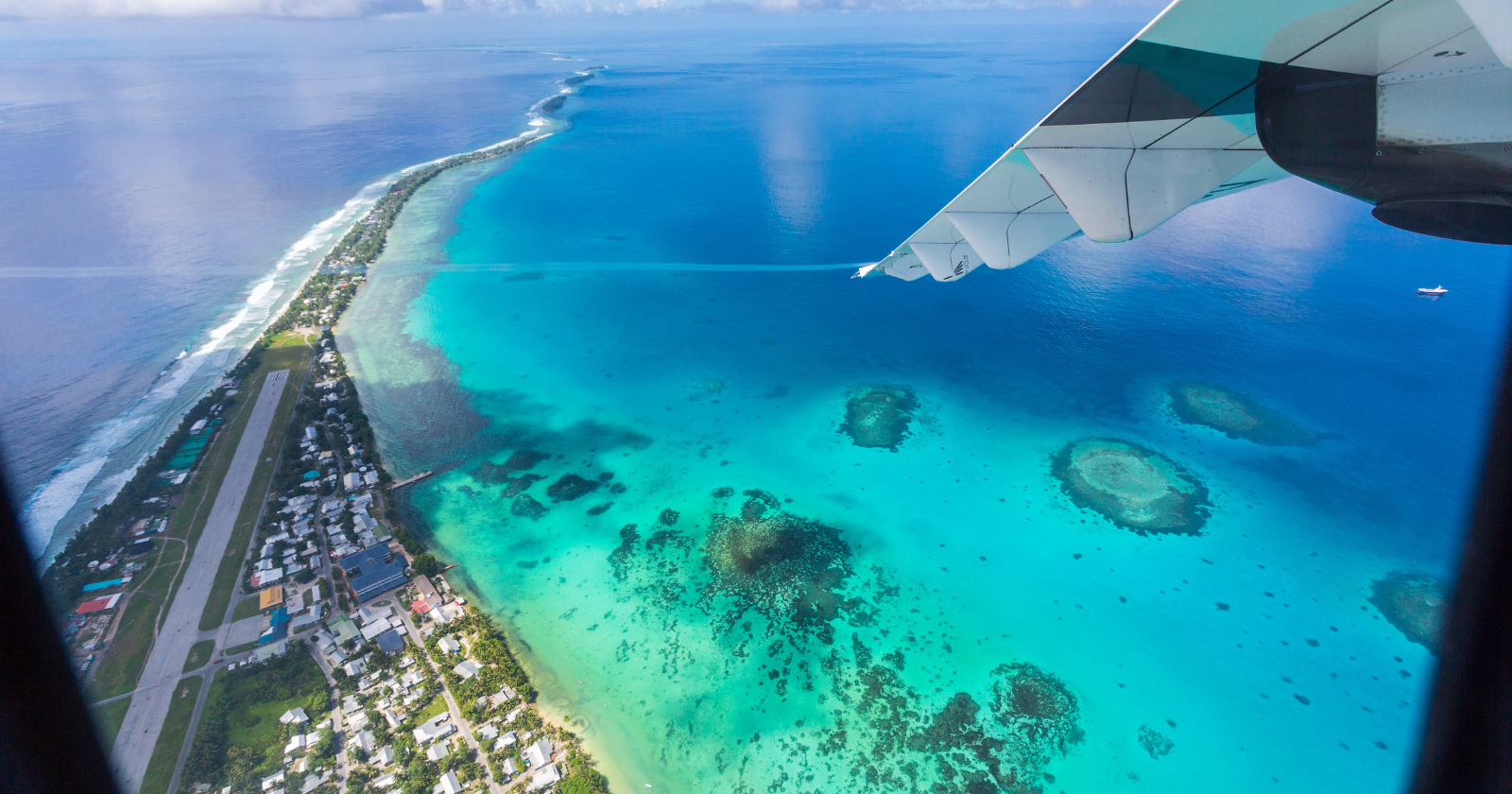
Tuvalu’s highest point is a few metres above sea level, and the government has spent recent years securing its status in writing. It amended its constitution in 2023 to declare that statehood continues even if the physical territory is lost. Australia then went further: Article 2 of the Falepili Union treaty text, signed on 9 November 2023 and in force from 28 August 2024, records that Tuvalu’s statehood and sovereignty will continue and its rights and duties be maintained notwithstanding climate-related sea level rise.
Whether a bilateral treaty commitment carries through to a root zone entry is untested. Treat the link between the two as an open question.
What to watch
With the GoDaddy terms unpublished, the clearest available indicator of what the domain earns remains the commercial contracts line in each year’s budget, together with how far the Ministry of Finance continues to attribute movement in it to dotTV rather than to the airspace and shipping rents bundled alongside.