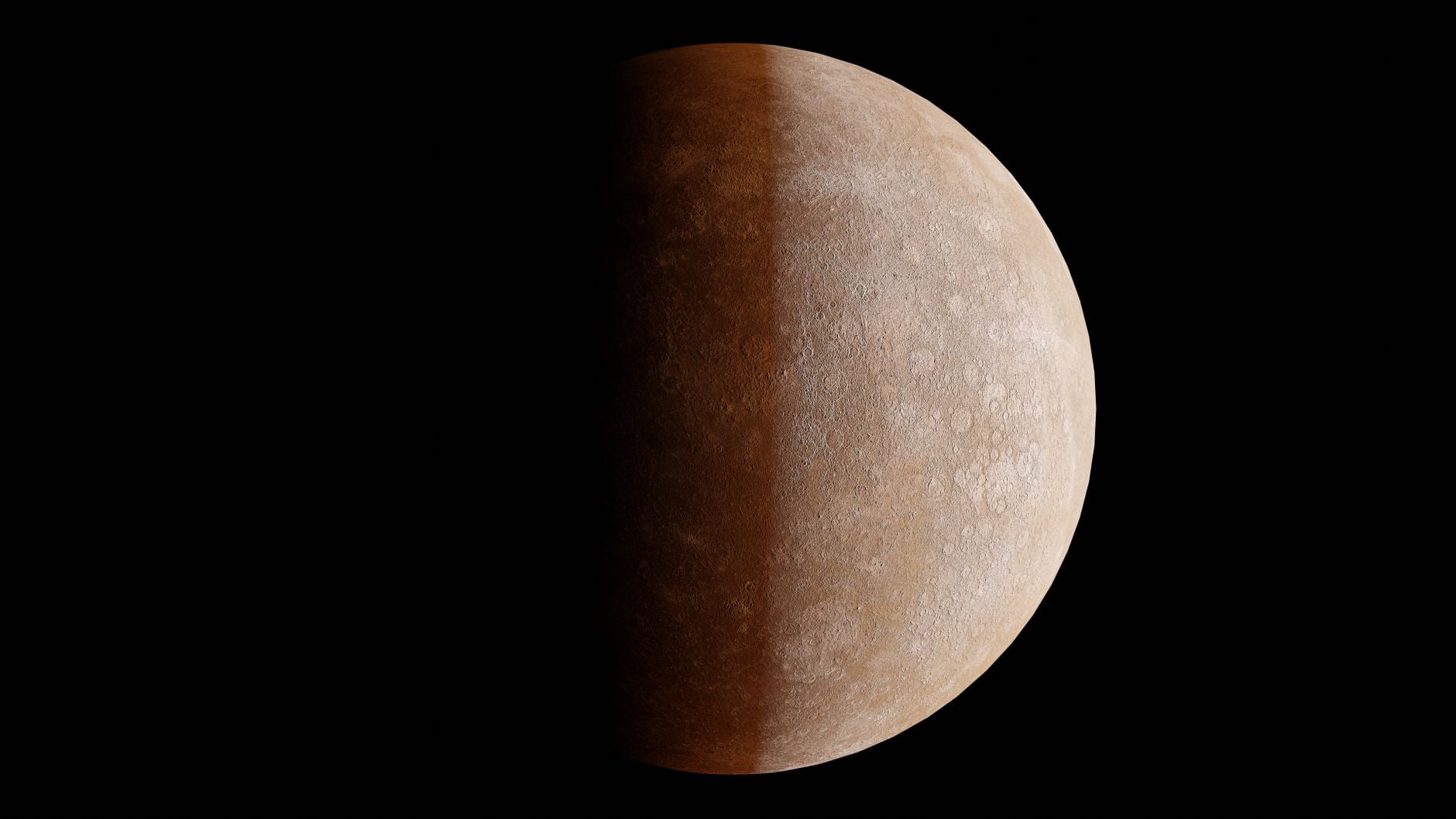
Mercury is the closest planet to the Sun. On its hottest daytime terrain, the temperature can reach about 430 degrees Celsius. Yet near its poles, billions of tonnes of water ice sit inside craters and survive year after year.
That sounds like a contradiction only if we imagine a planet as having one temperature.
It does not. A surface becomes hot because energy reaches it. On Mercury, a small patch of ground can remain without direct sunlight for immense spans of time. If that patch lies deep inside the right polar crater, almost none of the heat roasting the equator can reach it either.
When I wrote recently about Mercury’s permanently shadowed crater floors, I focused on the remarkable geometry that allows them to exist. The equally surprising question is one of scale: how can a planet this close to the Sun preserve not just a trace of frost, but a reservoir whose estimated mass begins in the tens of billions of tonnes?
A planet does not have one surface temperature
The familiar 430-degree figure is real, but it describes the hottest sunlit parts of Mercury rather than the entire planet. According to NASA’s Mercury overview, daytime temperatures can reach 430 degrees Celsius, while the nightside can fall to about minus 180 degrees.
The reason for that enormous swing is that Mercury has almost no atmosphere. Its extremely thin exosphere cannot carry heat around the planet in the way Earth’s atmosphere and oceans do. Sunlit ground absorbs intense radiation; ground in darkness loses heat to space.
At the poles, Mercury’s orientation creates an even more extreme version of that separation. The planet’s rotational axis is tilted by only a tiny fraction of a degree, so the Sun always stays close to the polar horizon. The rims of deep impact craters can therefore block direct sunlight from their floors in every season.
Standing on one of those floors, if standing there were possible, you would not see the Sun rise. The blazing terrain elsewhere on Mercury would make little difference. There is no thick air to blow warmth into the crater and no ocean to circulate it there. Some of the coldest surfaces remain below roughly 100 kelvin, or minus 173 degrees Celsius, despite being less than 70 million kilometres from the Sun.
This is the first part of the answer: distance determines how much sunlight is available, but geometry determines whether a particular surface receives it.
The ice is trapped by cold, not protected by distance
Scientists call these places cold traps. A water molecule that reaches one can freeze onto the surface. At sufficiently low temperatures, it may remain there for geological spans of time.
Strictly speaking, saying the ice never melts misses the main danger. Mercury has no air pressure capable of sustaining ordinary liquid water on the surface. If the ice becomes warm enough, it is more likely to pass directly from solid to vapour through sublimation.
In the coldest locations, exposed ice can remain stable. In slightly warmer parts of the permanent shadow, ice can survive when buried beneath a dark insulating layer of soil and carbon-rich material. Thermal modelling reported through NASA’s technical archive found that deposits less than half a metre below the surface could persist for more than a billion years under the right conditions.
That thin cover matters because Mercury’s surface is not thermally uniform even inside a crater. Sunlit walls can scatter a little light or radiate heat towards the floor. A few centimetres of dry, porous regolith can sharply reduce how much of that energy reaches the ice below.
It is a useful inversion of another story I have explored. On distant icy moons, oceans can remain liquid because gravitational flexing supplies heat where sunlight cannot. Mercury’s polar ice survives for almost the opposite reason: very little energy reaches it at all.
MESSENGER had to prove the bright patches were water
The first major clue did not come from a camera. In the early 1990s, Earth-based radar observations found unusually reflective patches near Mercury’s poles. Water ice reflects radar strongly, but radar brightness by itself was not proof. Other materials, rough surfaces or unusual mineral deposits might conceivably have produced a similar signal.
NASA’s MESSENGER spacecraft turned the case into a much stronger one. It mapped where the radar-bright regions sat, measured temperatures, detected hydrogen with its neutron spectrometer and used laser reflections to distinguish bright exposed deposits from darker covered ones. As NASA’s MESSENGER mission summary explains, these independent measurements converged on the same conclusion: Mercury’s permanently shaded polar regions contain water ice.
The neutron measurements also gave scientists a way to estimate how much was present. A 2013 analysis led by planetary scientist David Lawrence inferred a total water mass of roughly 20 billion to one trillion metric tonnes, depending on assumptions about the thickness, purity and extent of the deposits. The published range spans a factor of about 50, which is why any single neat figure should be treated cautiously.
Even the low end is enormous. Twenty billion tonnes is about the mass of several billion large African elephants. The upper end is fifty times greater.
The range is wide because MESSENGER did not drill into the deposits or measure every patch directly. Its neutron instrument detected hydrogen across broad areas, while radar mapped reflectivity rather than depth. Researchers had to infer the three-dimensional reservoir from signals gathered above the surface.
Permanent shadow is necessary, but it is not enough
If cold were the entire story, every sufficiently dark crater floor should contain a similar deposit. They do not.
A study comparing MESSENGER topography with radar maps found that all the large radar-bright deposits lay in areas of persistent shadow, but only about 43 to 46 per cent of the mapped shadow hosted radar-bright material. The shadow survey therefore revealed an important asymmetry: permanent darkness can preserve ice, but it cannot create or deliver it.
The water had to come from somewhere. Comets and water-rich asteroids may have supplied some of it through impacts. Chemical reactions involving hydrogen from the solar wind and oxygen-bearing minerals may have produced another share. Large impacts could also have released water already held in Mercury’s crust.
A 2026 modelling study examined what happens when a volatile-rich object strikes Mercury. It found that an impact can briefly create a water-bearing atmosphere and transport a significant share of the water towards polar cold traps before that temporary atmosphere escapes or collapses. This does not prove that one particular impact built today’s deposits, but it shows that delivery across the planet is physically plausible.
The patchiness may therefore preserve a history. One crater may have been favourably placed when a water-rich impact occurred; another may have lost an older deposit when later debris disturbed its insulating cover. What looks like a static sheet of ice could be the surviving record of many episodes of delivery, burial and erosion.
A frozen archive, not a hidden ocean
Mercury’s ice should not be confused with a buried sea. The deposits are probably sheets and patches mixed with or covered by regolith. There is no good evidence of a liquid reservoir beneath them, and the planet’s polar craters are not being presented as habitable environments.
That distinguishes Mercury from worlds such as Enceladus, where salts, molecular hydrogen and phosphorus point towards an active ocean interacting with rock. Mercury’s scientific value lies elsewhere. Its ice may preserve a sample of the volatile material delivered to the inner Solar System, protected in a natural freezer for hundreds of millions or perhaps billions of years.
There are still basic questions MESSENGER could not settle. How deep do individual deposits run? How pure are they? What is the dark covering material? Did most of the water arrive in one era or accumulate through many impacts?
Europe and Japan’s BepiColombo mission should sharpen that picture after it enters Mercury orbit. The current ESA mission schedule puts orbital arrival in November 2026, with the main science phase due to begin in April 2027. Its two orbiters will observe Mercury with instruments that complement MESSENGER’s data, including new measurements of the surface, composition and polar environment.
The apparent paradox of Mercury’s ice rests on a very human shortcut. We hear that a planet is close to the Sun and imagine heat reaching everywhere. But heat is not an identity a planet possesses. It is energy moving into, through and out of particular places.
On Mercury’s sunlit equator, that energy is punishing. A few thousand kilometres away, at the bottom of the right crater, the Sun never clears the rim. With no atmosphere to carry the furnace into the shadows, billions of tonnes of ice can remain almost next door.