I had never noticed how completely I equated weather with water until I began reading about Titan.
Rain means water. A river is flowing water. A lake is a depression filled with water. The association feels less like a scientific fact than part of the definition.
Saturn’s largest moon breaks that definition while preserving nearly everything else.
Titan has clouds, precipitation, branching channels, flood plains, lakes and seas. Liquid evaporates from the surface, returns to the atmosphere and falls again. It is the only world besides Earth known to have stable bodies of liquid on its surface.
Yet the liquid doing most of that work is methane and ethane.
The title’s “not a single drop” should not be read as a chemical assay of every Titan lake. No probe has sampled one directly, and trace water in every possible setting cannot be ruled out. The careful claim is that Titan’s observed surface lakes and seas are dominated by liquid hydrocarbons, while water at the surface is frozen hard enough to behave like rock.
The reason comes down to a combination of distance, temperature and atmosphere. Titan receives about one hundredth as much sunlight as Earth, but it has a thick nitrogen sky capable of supporting weather. At roughly minus 179 degrees Celsius, methane can occupy the role that water fills here.
Water is Titan’s rock
Titan travels around the Sun with Saturn at an average distance of about 1.4 billion kilometres, or 9.5 astronomical units.
NASA’s Titan facts page puts the consequence plainly: sunlight takes about 80 minutes to reach the moon and is roughly 100 times fainter there than at Earth.
The surface temperature sits near minus 179 degrees Celsius. At that temperature, familiar materials exchange roles.
Water is not merely frozen in the way a pond freezes during winter. It forms the solid crust, pebbles and much of the bedrock. Methane, which is a gas under ordinary conditions on Earth, can condense into liquid. Ethane can remain liquid too.
Titan also has the atmosphere needed to make a climate rather than a vacuum-driven freeze. It is about 95 per cent nitrogen and roughly 5 per cent methane near the surface, with a surface pressure around 60 per cent higher than Earth’s.
Methane’s melting point is close to Titan’s average surface temperature, so local temperature, pressure and composition matter. This is not a uniformly wet moon. The polar regions contain the large lakes and seas, while broad equatorial areas are dry enough to support enormous dunes.
The deeper lesson is that “liquid” is not a substance. It is a physical state. Change the temperature and pressure far enough, and the material that runs downhill changes with them.
Huygens saw river country beneath the haze
Before the Cassini-Huygens mission reached Saturn in 2004, Titan’s surface was hidden behind an orange photochemical haze.
Cassini could penetrate that haze with radar and selected infrared wavelengths. The European Space Agency’s Huygens probe went further, descending through the atmosphere and landing on 14 January 2005.
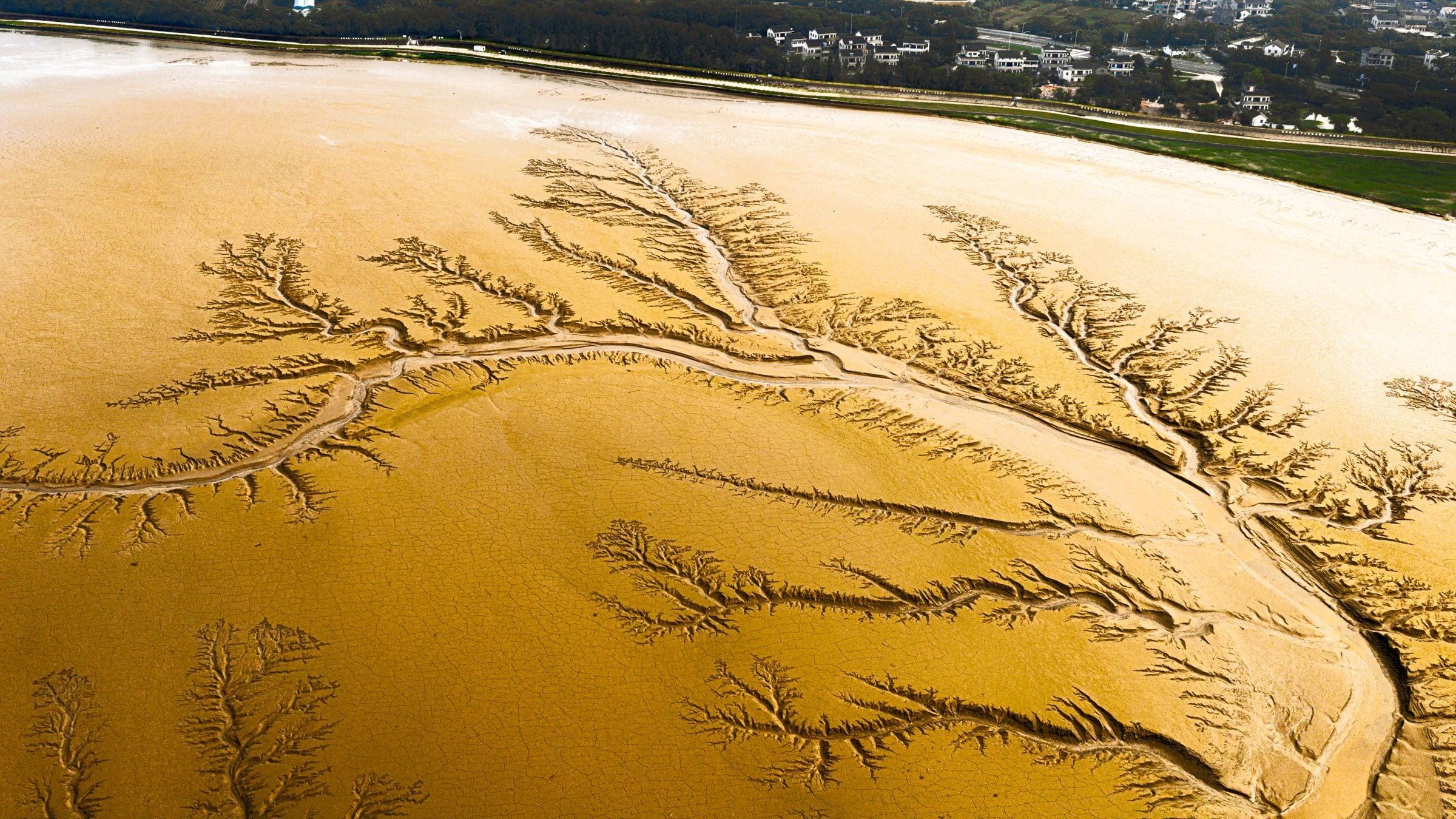
During its two-and-a-half-hour descent, Huygens photographed bright highlands cut by branching channels leading towards dark lowlands. The pattern looked like drainage networks, river systems and flood plains.
ESA’s account of the Huygens surface results describes channels merging around apparent islands and into lakebed-like terrain. The shapes indicate erosion and transport by flowing liquid.
The landing site itself was not a standing lake. Huygens came down on a damp, sandy surface scattered with rounded pebbles whose spectra were consistent with dirty water ice.
That image is worth holding for a moment. The “rocks” were water. The liquid that had rounded and moved them was probably methane.
Heat from the probe caused methane to boil out of the nearby surface material. Combined with the channels and deposits, that measurement supported a landscape periodically wetted by hydrocarbon rain and floods.
Some channels may be dry for long intervals. Titan’s rain does not have to resemble a daily terrestrial shower. Its climate operates through long seasons, and each season lasts more than seven Earth years.
The methane cycle resembles Earth’s water cycle without copying it
The broad sequence is familiar. Methane evaporates from seas and damp ground, rises through the atmosphere, condenses into clouds, falls as rain, runs downhill and collects in lakes or returns underground.
NASA’s Cassini overview of Titan describes lakes and seas of methane and ethane replenished by hydrocarbon clouds.
The resemblance has limits.
Earth’s oceans create an enormous, connected surface reservoir. Titan’s largest seas cluster around the north pole, with fewer major bodies in the south. The equatorial regions are dominated by dry organic dunes and channels that may record occasional storms rather than constant flow.
Methane and ethane also play different parts. Methane is more volatile and drives much of the active atmosphere-surface exchange. Ethane is produced when sunlight and energetic particles alter atmospheric methane, and it can accumulate in surface liquids over time.
Cassini found the large northern seas to be methane-rich. Ontario Lacus in the south appeared closer to an even mixture of methane and ethane.
Some liquid soaks into porous ground or moves through a hydrocarbon version of groundwater. Some lakes appear and disappear with the seasons. Other basins remain filled.
So calling this a methane hydrological cycle is useful, but it should not suggest a perfect scale model of Earth. Titan has its own geography, seasonal timing, underground storage and atmospheric chemistry.
Cassini found seas through radar and reflected sunlight
The first strong evidence for present lakes came from dark, smooth patches in Cassini radar images near Titan’s poles.
Radar is valuable because a flat liquid surface returns little signal to the spacecraft and therefore appears dark. Shore-like outlines, connected channels, islands and changing liquid levels strengthened the interpretation.
Later observations caught sunlight reflecting from a northern sea. That glint was an unusually direct sign of a smooth liquid surface beneath the haze.
On Cassini’s final Titan flyby in 2017, its radar measured small northern lakes that were more than 100 metres deep and perched on hills and plateaus.
NASA’s report on Titan’s lake measurements says Cassini mapped more than 1.6 million square kilometres of lakes and seas. The smaller northern lakes were filled mostly with methane, while some may drain into subsurface reservoirs or evaporate as seasons change.
The landscape again looks familiar before the chemistry makes it strange. Some deep depressions may resemble karst lakes on Earth, where water dissolves limestone and causes the ground to collapse. On Titan, liquid hydrocarbons may dissolve solid organics in water-ice bedrock.
The physics of erosion, drainage and collapse can therefore produce recognisable landforms from unfamiliar materials.
Titan has water, just not in its surface weather
The absence of liquid water from Titan’s visible rivers and lakes does not make Titan waterless.
Water ice forms much of the outer crust. Beneath it, Cassini gravity measurements and radio data from Huygens support the presence of a global internal ocean, probably containing water mixed with salts and ammonia.
NASA places the top of that ocean roughly 55 to 80 kilometres below the icy ground, although Titan’s exact internal structure remains uncertain.
This gives Titan two profoundly different liquid environments. The surface has methane and ethane exposed to a nitrogen atmosphere. Far below, it may have a water-rich ocean sealed away from sunlight.
In my earlier article about icy moons expanding the habitable zone, Titan appeared as one of several worlds showing why surface sunlight is not the only way to maintain a liquid environment. Internal heat, chemistry and the properties of an ice shell can matter just as much.
Titan is especially useful because it places both ideas in one body. Water may be liquid deep inside while being structural rock at the surface. Methane is liquid above while being continually broken apart and rebuilt in the atmosphere.
Neither environment has yielded evidence of life.
Researchers discuss the subsurface ocean as a possible setting for life as we know it and the hydrocarbon lakes as a place to test ideas about chemistry unlike terrestrial biology. These are questions, not detections.
The methane should not still be there forever
Titan’s weather contains a second puzzle. Sunlight is faint at Saturn, but it is not absent.
Ultraviolet photons and energetic particles break methane molecules apart high in the atmosphere. The fragments react with nitrogen and with one another, producing ethane and a wide range of more complex carbon-rich molecules.
Some of those products create Titan’s orange haze. Heavier material settles to the ground and helps form dark grains that accumulate in equatorial dune fields.
If methane is continually destroyed, the current atmospheric supply cannot simply sit unchanged over geological time. Something must replenish it.
Possible sources include methane stored in the crust or interior and released through cryovolcanic or other geological processes. The Cassini-Huygens evidence has not settled which mechanism dominates or whether replenishment happens continuously.
I find this part of Titan more revealing than the easy Earth comparison. A complete cycle requires not only rain and evaporation, but also an explanation for why its working fluid remains available.
Titan’s methane weather may be a long-lived system, a system renewed in episodes, or a temporary phase in the moon’s history. The landscape records activity, but it does not give us the full timetable.
Enceladus shows how different two Saturnian moons can be
Saturn’s moon Enceladus offers an almost inverse arrangement.
Its surface is water ice, and fractures at the south pole eject material linked to a subsurface saltwater ocean. Cassini could fly through those plumes and analyse ice grains without landing.
In my earlier piece on Enceladus’s ocean chemistry, I looked at the sodium salts, molecular hydrogen and phosphorus found in that material.
Titan gives a spacecraft easier access to complex surface organics but much harder access to its internal water. Enceladus sends ocean material into space but lacks Titan’s thick atmosphere and surface hydrocarbon cycle.
They orbit the same planet and are both classed as icy moons, yet the scientific questions and accessible samples are completely different.
This is why the label “ocean world” can hide as much as it reveals. The location of the liquid, the material it contains and the route by which we can sample it matter more than the category alone.
Dragonfly will explore the dry side of Titan’s cycle
NASA’s Dragonfly mission is designed to take advantage of Titan’s thick air and low gravity by flying a nuclear-powered rotorcraft between sites.
In an earlier article, I wrote about why Dragonfly is so different from the small Ingenuity helicopter flown on Mars. It is a much larger mobile laboratory built to travel kilometres between landings.
NASA’s current mission schedule lists launch no earlier than July 2028 and arrival in late 2034.
Dragonfly is not being sent to float on a methane sea. Its planned exploration region includes organic-rich dunes and Selk impact crater, where an ancient impact may have mixed liquid water with surface organics for a limited period.
The mission will analyse surface materials, investigate how far prebiotic chemistry has progressed and study environmental habitability. It is not a mission to announce whether Titan has life.
That distinction suits Titan. The moon is valuable partly because it runs familiar planetary processes with a different chemical toolkit. Understanding that chemistry properly comes before turning it into a biological claim.
The rain is real even when the water is not
Titan’s rivers and lakes are not metaphors. They are landforms and liquid bodies shaped by gravity, weather and time.
The surprise lies in how little those processes care about our everyday associations. A river needs a fluid moving downhill. A cloud needs a vapour that can condense. Rain needs droplets heavy enough to fall. None of those definitions requires water.
At Earth’s temperature and pressure, water is the abundant substance that moves easily among ice, liquid and vapour. At Titan’s temperature and pressure, methane can perform much of that work while water becomes geology.
From 1.4 billion kilometres away, the moon therefore looks less like an exception to physics than a demonstration of it.
The same rules that give Earth oceans give Titan methane rain. The ingredients changed. The cycle remained.