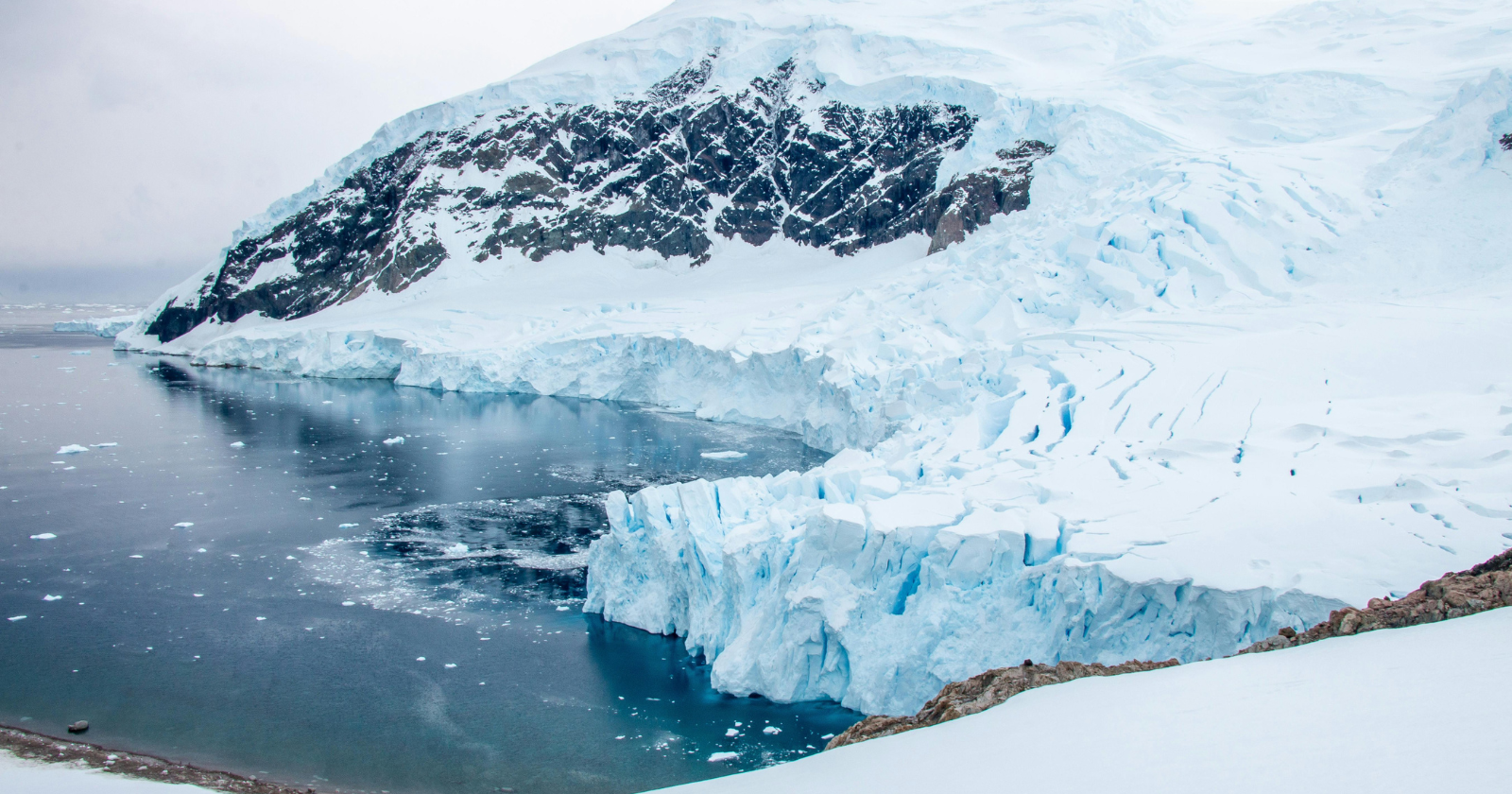
In January 2025, an international drilling team at Little Dome C in East Antarctica reached the rock beneath the ice sheet. The hole was 2,800 metres deep. Inside the recovered core was a continuous climate record extending back at least 1.2 million years.
The detail I keep returning to is the air.
Snow fell on the Antarctic plateau long before our species appeared. More snow buried it, the crystals compacted, and open spaces slowly closed into bubbles. Those bubbles now hold samples of an atmosphere from a world in which Earth’s ice ages followed a different rhythm.
This is not a metaphorical record reconstructed only from fossils or a computer model. The gases are physical samples that can be extracted and measured.
The European Commission-funded project, called Beyond EPICA–Oldest Ice, was coordinated by Carlo Barbante at Italy’s National Research Council. It was built around a question that the previous generation of Antarctic cores could approach but not cross: why did the planet’s glacial cycles change so sharply around one million years ago?
A 2.8-kilometre core through time
Little Dome C lies about 35 kilometres from Concordia Station, high on the East Antarctic Plateau. Radar surveys and ice-flow models were used to find a place where very old layers appeared to have survived without being overturned or melted by heat from below.
The work took more than 200 drilling and processing days across four Antarctic seasons. The camp stood 3,200 metres above sea level, with an average summer temperature of about minus 35 degrees Celsius. The drill repeatedly cut cylinders of ice, brought them to the surface and descended again.
The previous EPICA core from Dome C carried a continuous atmospheric record back about 800,000 years. Beyond EPICA extends that archive by at least another 400,000 years. Project measurements placed the ice covering the interval from 800,000 to 1.2 million years ago between depths of roughly 2,426 and 2,490 metres, close to where the site models predicted it would be.
Near the bottom, pressure and ice flow have squeezed enormous spans of time into a small vertical distance.
The bubbles are real air, with one qualification
Fresh snow is porous. For years after it falls, air can still move through the connected spaces between grains. Burial turns that snow into a denser intermediate material called firn. Only deeper down do the pores close and isolate bubbles from the atmosphere.
The air is therefore younger than the ice surrounding it. A study of East Antarctic core chronology found that this difference can reach several thousand years in slowly accumulating glacial ice. Researchers model and measure that offset when aligning the gas record with temperature and dust signals in the solid ice.
So the phrase “air from 1.2 million years ago” needs an uncertainty attached. It is still ancient atmosphere rather than an indirect chemical stand-in.
Laboratories can crush an ice sample in a vacuum or melt it in a sealed system, then measure carbon dioxide, methane and other gases released from the bubbles. Ratios of oxygen and hydrogen isotopes reflect past temperatures, while dust, sea salt and volcanic material record changes in winds, dryness, ocean conditions and eruptions.
That combination is what makes an ice core unusually useful. Temperature indicators and atmosphere samples are preserved in the same physical sequence.
The target is a change in Earth’s ice-age rhythm
Before roughly one million years ago, major glacial cycles tended to follow a period of about 41,000 years, matching changes in the tilt of Earth’s axis. During the Mid-Pleistocene Transition, the dominant spacing stretched towards roughly 100,000 years, and ice sheets became larger and longer-lived.
Earth’s orbital variations continued, but there was no comparably simple orbital switch to explain the new rhythm. Proposed explanations involve carbon dioxide, ocean circulation, changing conditions beneath northern ice sheets and other feedbacks. More than one process may have been involved.
The older EPICA core did not reach far enough back to provide a direct greenhouse-gas record across the whole transition. Marine sediments extend much further in time, but their atmospheric carbon dioxide estimates are indirect. Beyond EPICA should let researchers compare ancient air with temperature and ice-volume records through the transition itself.
That does not mean one core will settle the cause on its own. It provides a missing measurement that competing explanations must now match.
The oldest-looking ice is not always the cleanest record
Reaching bedrock makes for a clear finishing line, but the oldest continuous sequence is not necessarily the ice touching the rock.
According to the National Research Council’s drilling announcement, the lowest 210 metres are heavily deformed and may contain ice that was mixed or refrozen. Some of it could be older than the continuous 1.2-million-year record, perhaps much older, but its layers may no longer sit in chronological order.
This distinction separates Beyond EPICA from discoveries of isolated ancient ice elsewhere in Antarctica. Ice fragments several million years old can preserve valuable snapshots. A continuous core is different: it lets researchers follow changes from one climate state into the next without large missing intervals.
Dating the deepest layers is also more difficult than counting visible annual bands. The team is combining ice-flow calculations, chemical correlations and isotope measurements. During laboratory processing in 2025, gas recovered from the melting system was collected for krypton-81 dating, an independent radioactive clock suited to very old ice.
The core had to remain at minus 50 degrees
Finishing the hole was only the first half of the operation. The core travelled north aboard the Italian icebreaker Laura Bassi in specialised containers kept at about minus 50 degrees Celsius. Warming or cracking could damage the archive before it reached a laboratory.
Sections were then divided among European research groups. In Cambridge, a British Antarctic Survey-led team spent seven weeks slowly melting and analysing 190 metres from the lower core. Other laboratories received matching pieces for greenhouse-gas measurements, dust, isotopes and additional dating work.
By October 2025, the British Antarctic Survey reported that the melted sequence contained an unbroken series of climate cycles reaching at least 1.2 million years. Preliminary results presented in 2026 extended the record across the Mid-Pleistocene Transition, but the full analyses and chronology were still being assembled.
I find there is something clarifying about the scale of the exercise. A decade of surveys, four drilling seasons and a refrigerated voyage were needed to reach air bubbles smaller than a fingernail.
Inside them is no forecast of the future. There is, instead, a direct test of how greenhouse gases and temperature moved together when Earth’s climate system reorganised itself long before industrial emissions began.