
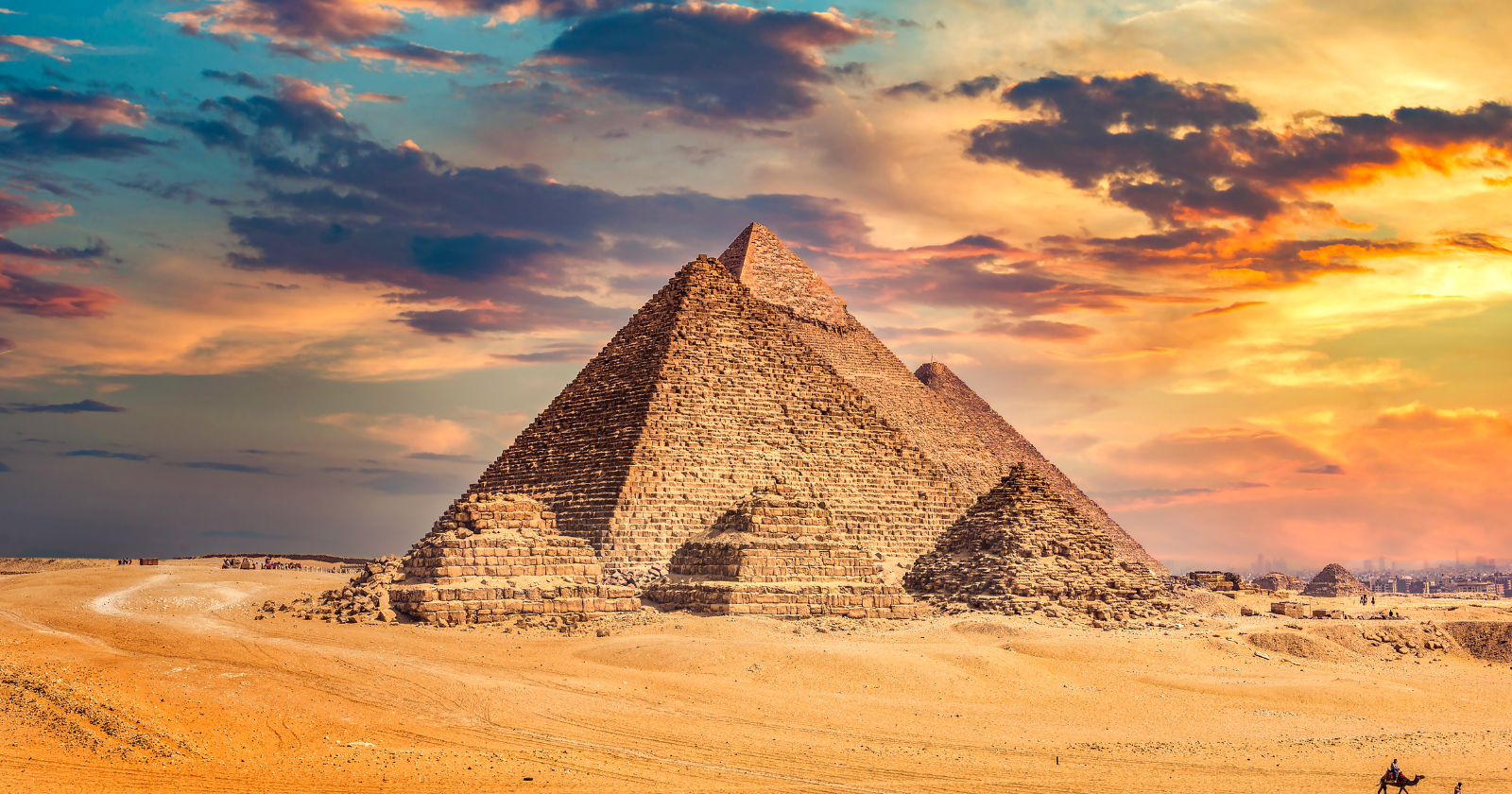
The claim is familiar enough to have its own television franchise: the pyramids of Giza were too large, too precise, and too old to have been built by human hands, so someone from elsewhere must have helped. The idea was popularised by Erich von Däniken’s 1968 book Chariots of the Gods? and kept alive by decades of cable programming.
What it has always lacked is an artefact.
Giza, meanwhile, is one of the most thoroughly excavated construction sites in the world, and almost everything the diggers have pulled from the sand points the same way: towards a workforce of ordinary Egyptians, fed, housed, injured, treated, named, and buried within sight of the monuments they raised.
The city that housed the builders
Since 1988, the archaeologist Mark Lehner and his team at Ancient Egypt Research Associates have been excavating a settlement south of the Sphinx known as Heit el-Ghurab, the Wall of the Crow. What they uncovered reads less like a labour camp than a planned town.
The site includes long galleries that appear to have served as barracks for a rotating labour force, alongside bakeries, storerooms, a copper workshop, and administrative buildings. Radiocarbon dates place it in the reigns of Khufu, Khafre, and Menkaure, the three kings whose pyramids stand on the plateau. The refuse tells its own story. The workers ate bread in quantity, and they ate meat: cattle, sheep, and goat, brought in from estates across Egypt. Feeding people at that scale, on that diet, is the mark of a state keeping a workforce it valued.
What the bones record
West of the town lies a cemetery for the workers themselves, excavated from 1990 under Zahi Hawass. The skeletons carry the signature of hard physical labour: compressed vertebrae, worn joints, the arthritis of people who moved heavy stone for a living. Many also carry fractures of the arm and lower leg that had healed.
In Hawass’s account of the cemetery, most of those breaks had knitted back into good alignment, which means they were set, most likely with splints. Two workers had survived amputations, one of a leg and one of an arm, the bone ends smoothed by years of subsequent life. Their injuries were treated, and when they died they were buried with grave goods in tombs of their own, the ordinary funerary care of people who belonged somewhere.
Names in red paint
Then there is the graffiti. High inside the Great Pyramid, in the cramped relieving chambers above the King’s Chamber, the builders left marks never meant to be seen: crew names daubed in red paint. The men were organised into gangs, subdivided into smaller units the Greeks later called phyles, and the gangs gave themselves names.
One well-attested example reads as the Friends of Khufu. Another, tied to the third pyramid, translates roughly as the Drunkards of Menkaure. They have the ring of in-jokes, scrawled where only the next crew would ever see them, the kind of thing work gangs leave behind anywhere. The marks were dismissed for a time as modern forgeries, though they match the crew-naming conventions recorded across other Old Kingdom sites, which would be hard to invent after the fact.
A logbook from the harbour
The most direct evidence is also the most recent. In 2013, a French mission led by Pierre Tallet and Gregory Marouard, working at the Red Sea port of Wadi al-Jarf, uncovered the oldest inscribed papyri yet found in Egypt. Among them was the daily logbook of an inspector named Merer.
Merer’s diary, described by Tallet and Marouard in the journal Near Eastern Archaeology, records the work of a crew of roughly two hundred men during the final years of Khufu’s reign. Their task was to ferry white limestone by boat from the quarries at Tura to the Giza construction site, logged day by day like a shipping manifest. Here, in the builders’ own hand, is the pyramid being clad in stone, moved by named men on a schedule. Reporting on the Red Sea Scrolls has noted that the accounts even track the bread and beer issued to the crews.
What the evidence settles, and what it does not
Weigh all of this against the alien hypothesis, and the imbalance is stark.
The slave story, often traced to Herodotus writing more than two thousand years after the fact and later hardened by Hollywood, does not survive the cemetery. The alien story does not survive the logbook.
The record does leave real questions open. The exact methods used to raise and place the blocks are still argued over, and the ramp systems proposed by different scholars remain competing models rather than settled fact. That genuine uncertainty is worth keeping. It is also the gap into which the alien theory tends to pour itself, treating a solved question about who with an open question about how.
The more interesting point, in our reading, is what the extraterrestrial version quietly removes. It takes the largest coordinated project of the ancient world, a feat of logistics, provisioning, and administration sustained across three reigns, and hands the credit to no one. The people who did the work left their bakeries, their broken and mended bones, their gang names, and their inspector’s diary. The evidence has their names on it.