Nearly every country on the map runs a carbon deficit. It burns, builds and drives more than its land can soak back up, and the remainder accumulates in the atmosphere.
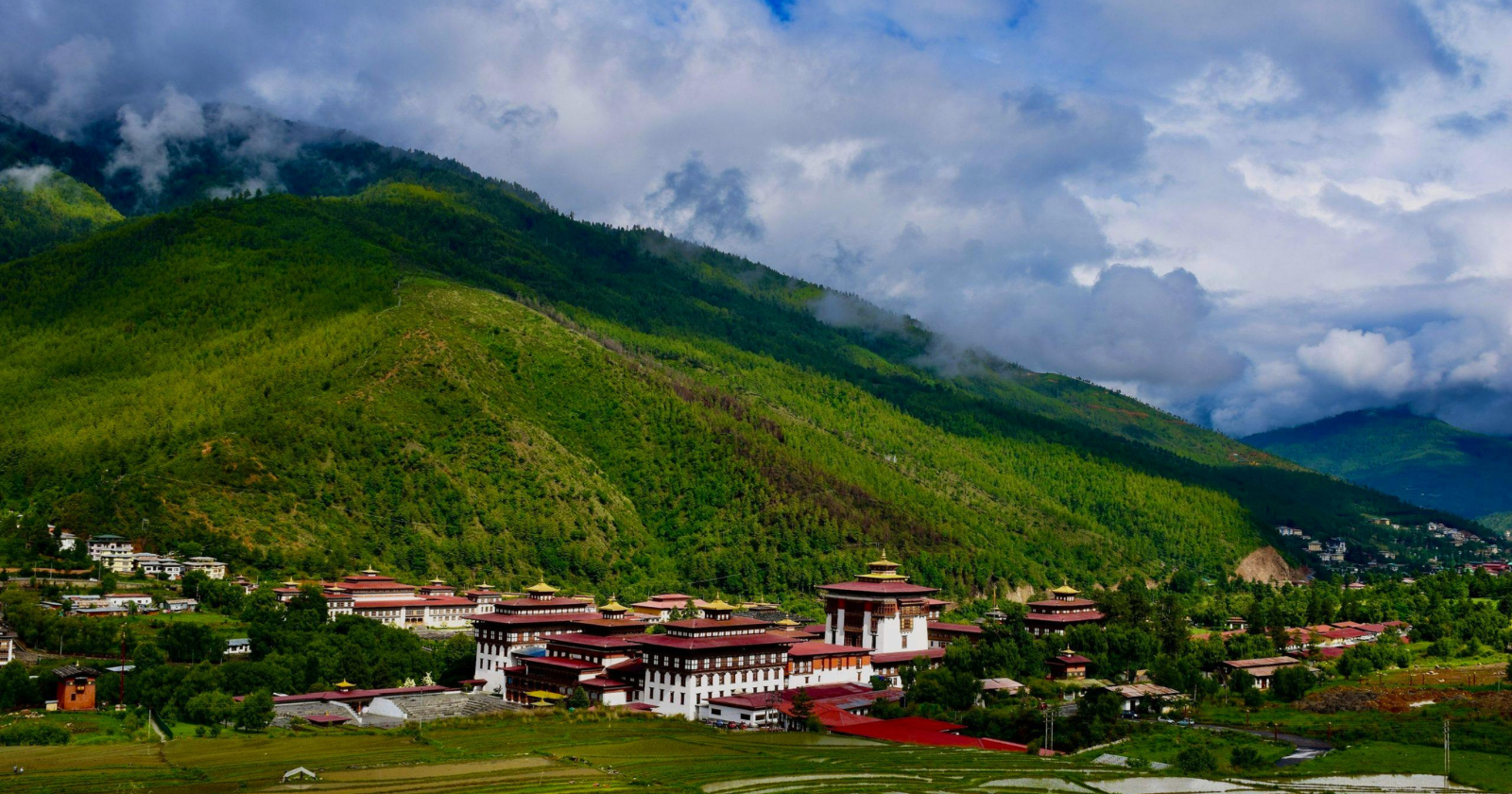
Then there is Bhutan, a small kingdom in the eastern Himalayas between China and India, with a population under a million. It runs the ledger the other way. Its forests and other land-based sinks remove more greenhouse gases than the whole economy emits.
That’s unusual enough to pause on. So is the reason behind it. It is less about a single technological breakthrough than a decades-old decision to define national success in a way most governments would find unusual.
What carbon-negative actually means
Carbon neutral means that emissions are balanced by removals, producing net emissions of zero. Carbon negative goes further: removals exceed emissions. When Tshering Tobgay, then Bhutan’s prime minister, spoke at TED in 2016, he put it directly: “Bhutan is not carbon neutral. Bhutan is carbon negative.”
The gap is large. Bhutan’s latest national inventory reported 1.74 million tonnes of greenhouse-gas emissions in 2022, excluding land use, against 11.45 million tonnes of removals by forests and other land uses. That left net emissions of about minus 9.71 million tonnes of carbon-dioxide equivalent. Bhutan’s official climate pledge calls this carbon neutrality because its emissions do not exceed its sinks, although the balance is clearly net negative.
Bhutan is not alone, but the club is tiny. Carbon Brief identified three net-negative countries: Bhutan alongside Suriname and Panama. The exact list can vary with the accounting method and year used, particularly because estimates of land-sector removals are periodically revised.
The forest that does the heavy lifting
The whole thing rests largely on trees. More than 70% of Bhutan’s land is forested, and that cover is what turns a small economy into a net absorber. The World Bank says forests stretch across 72.3% of the country, forming what it calls a “carbon bank.” Bhutan is mountainous, thinly populated and has a much smaller industrial base than its larger neighbours. Its emissions are therefore low relative to the scale of its forests and other land-based sinks.
Part of this is geography and history, and part of it is a choice. The geography gave Bhutan the forest. The choice was to keep it.
Most countries treat forest cover as a target they can adjust. Bhutan wrote it into law as a floor that cannot be crossed. Article 5 of the constitution requires that a minimum of 60% of Bhutan’s total land remain under forest cover.
Gross National Happiness: the framework behind the policy
The forest rule does not stand on its own. It grows out of a way of measuring progress that Bhutan adopted long before climate targets became common.
Tobgay recalled that in the 1970s the fourth king declared Gross National Happiness more important than Gross National Product. The concept was introduced in 1972 and later enshrined in Bhutan’s 2008 constitution.
Gross National Happiness, or GNH, examines psychological wellbeing, health, education, time use, cultural diversity, good governance, community vitality, ecological diversity and living standards.
And it is not merely a slogan: Bhutan conducts detailed national surveys and produces an index. The 2022 GNH Index was 0.781, up from 0.756 in 2015. The survey classified 48.1% of people as extensively or deeply happy, while 93.6% enjoyed sufficiency in at least half of the measured conditions.
When ecological resilience is one of the things on which progress is judged, protecting the forest stops looking only like a cost and becomes part of the goal.
What the rest of the world might take from this
Bhutan should not be treated as a template without acknowledging the parts that do not travel. Its forest cover, small population, limited industrial base and constitutional protections fit together in a particular place with a particular history.
A large industrial economy cannot simply borrow the arithmetic.
There is also the question of whether Bhutan can hold the line as its economy grows. A 2023 modelling study found that, without additional mitigation, emissions could exceed the country’s assumed forest sink between 2037 and 2050 under several growth scenarios. It concluded that electrifying transport and industry would be central to preserving the balance.
What does carry across is smaller and more useful than the whole model. Nancy Harris of Global Forest Watch offered a reminder: “In the near term, forests are super-important. So is reducing fossil fuel emissions.” Bhutan did not plant its way out of a large footprint. It kept the footprint relatively small and the forest large, and wrote that priority into its rules.
The transferable lesson is not about copying Bhutan’s result. It is about deciding what counts as success first, then letting policy follow. The forest floor is in the constitution because a measure broader than GDP was allowed to shape the scoreboard. Whether larger, richer countries would make the same trade is the harder question.