

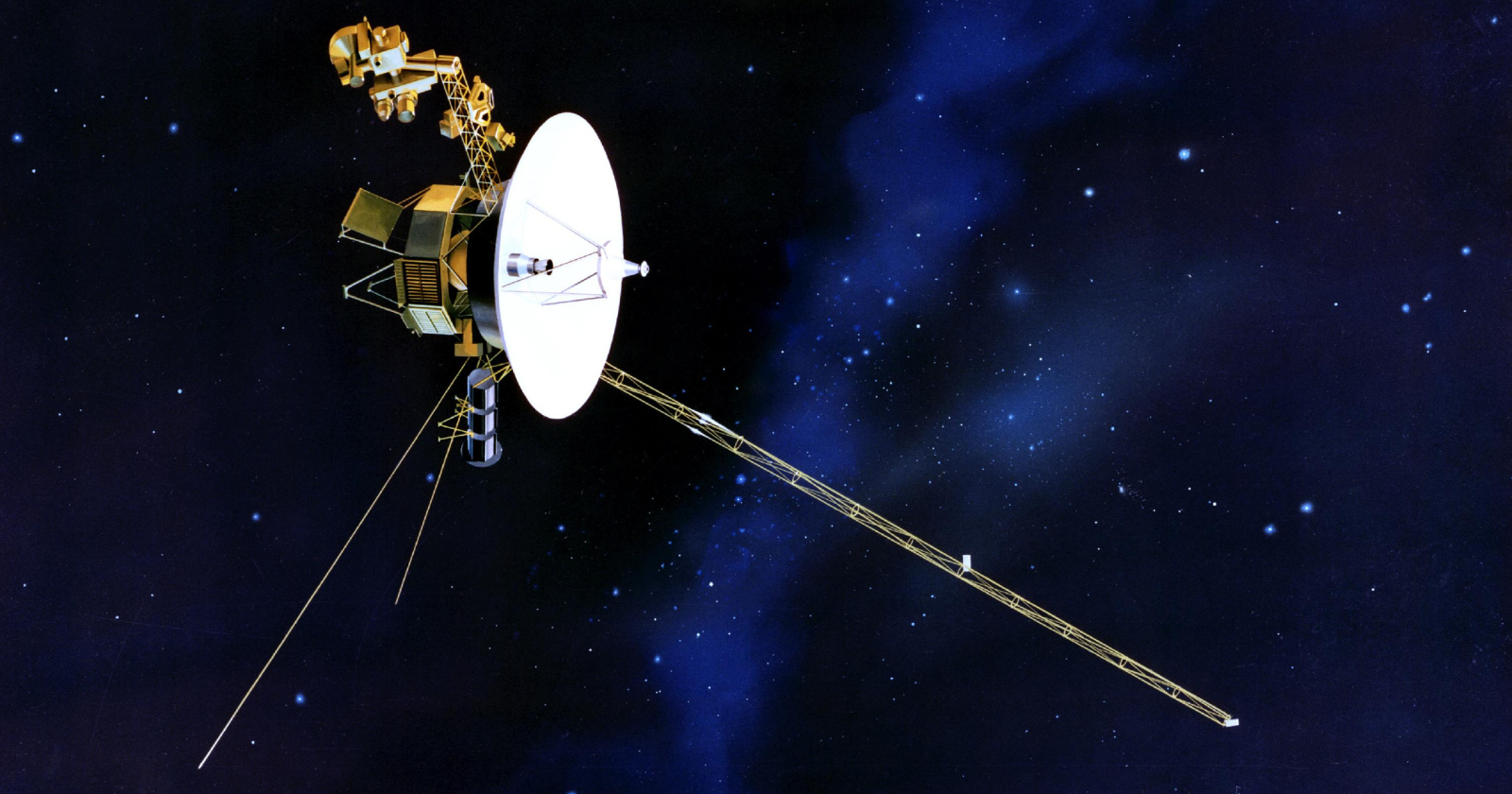
The answer begins with a correction. Voyager 1 is beyond one important reach of the Sun, but not beyond every reach of it.
NASA says Voyager 1 crossed into interstellar space in August 2012, meaning it passed outside the heliosphere, the bubble of solar wind and magnetic fields blown outward by the Sun. It has not left the Sun’s gravity behind. NASA’s Voyager FAQ notes that, by that broader definition, the spacecraft will not pass beyond the Oort Cloud for tens of thousands of years. But it is already operating in a region no other working spacecraft reached before it: interstellar space, outside the heliopause.
That is what makes the machine so strange. Nearly half a century after launch, Voyager 1 is still returning science from beyond the Sun’s wind using computers so small, in modern terms, that the comparison has become almost comic.
NASA’s Voyager FAQ describes three kinds of computers aboard each spacecraft, with two of each kind. Together, the six machines hold about 32,000 words of memory, which NASA’s own calculation puts at roughly 68 kilobytes. The same FAQ says a typical Voyager instruction takes about 80 microseconds, or around 8,000 instructions per second.
For scale, NXP describes a modern automotive secure element intended for next-generation smart key fobs as offering up to 400 kilobytes of user memory. The analogy is not perfect, because a spacecraft computer and a car key chip do different jobs under very different conditions. But it makes the central point plain enough: Voyager is not surviving because it is computationally powerful. It is surviving because it was built to be understandable, redundant, commandable and conservative.
Small computers, strict jobs
The six onboard computers do not behave like a single modern laptop waiting for apps to run. They are specialised machines with narrow responsibilities.
NASA’s FAQ identifies the Computer Command System as the part that receives instructions from Earth and watches for faults. The Flight Data System gathers and formats science and engineering data. The Attitude and Articulation Control System keeps the spacecraft pointed correctly. The software is assembly-like, interrupt driven, and sparse by current standards. That sparseness is a weakness if judged by ordinary consumer electronics. For Voyager, it is part of the reason the mission can still be nursed along.
When something goes wrong, engineers are not trying to manage a sprawling modern software stack. They are dealing with an old, idiosyncratic, but finite system whose habits have been studied for decades. The spacecraft has little memory and little speed, but it also has little unnecessary complexity.
That matters because Voyager 1 is too far away for hands-on troubleshooting to mean anything immediate. NASA reported in April 2026 that commands sent to shut down one of Voyager 1’s science instruments would take about 23 hours to reach the spacecraft. A reply takes roughly as long to come back. Every action is therefore planned less like a keyboard command and more like a small expedition into uncertainty.
The spacecraft is being made smaller from Earth
Voyager 1 did not survive by staying unchanged. It survived because NASA’s team has spent decades turning pieces of it off.
The spacecraft was launched on 5 September 1977 to fly past Jupiter and Saturn. Its main planetary mission ended long ago. Its cameras were shut down after the 1990 Solar System Family Portrait. Instruments built for planetary flybys were powered off. Heaters were disabled. Backup systems were rationed. The operating spacecraft that remains in 2026 is not the full 1977 machine. It is the carefully reduced version that can still do something useful.
The pressure behind those choices is power. Voyager 1 runs on radioisotope thermoelectric generators, which convert heat from decaying plutonium into electricity. NASA says each Voyager’s power system loses about 4 watts of output each year. At the beginning, that decline was manageable. After almost 50 years, the margin is thin enough that one instrument can decide the future of the mission.
In April 2026, engineers at NASA’s Jet Propulsion Laboratory shut down Voyager 1’s Low-Energy Charged Particles experiment to conserve power. NASA said the instrument had operated almost continuously since 1977, measuring ions, electrons and cosmic rays, and had provided important data about the interstellar medium. But keeping it on had become harder to justify when the spacecraft still needed power for the systems that let it remain alive at all.
After that shutdown, NASA said Voyager 1 still had two operating science instruments: one listening to plasma waves and one measuring magnetic fields. That is the present shape of the mission. Two instruments, an old radio, fading plutonium power and an Earth-pointed antenna.
Pointing is everything
The most important thing Voyager 1 does, mechanically, is not move forward. Its outward motion is mostly inherited from the launch and planetary gravity assists. What it must still do actively is point.
The high-gain antenna has to face Earth with enough precision for the Deep Space Network to hear the signal. The spacecraft uses small hydrazine thrusters for attitude control, not as a main engine pushing it through interstellar space. NASA’s 2025 account of the mission’s revived roll thrusters described how those thrusters help Voyager pivot and keep its antenna aimed at Earth.
That pointing requirement is why the limited computers still matter. They do not need to simulate worlds or process images. They need to accept commands, execute stored routines, respond to faults, time events, format telemetry, and coordinate the spacecraft’s attitude. In that sense Voyager’s intelligence is procedural rather than expansive. It does not think broadly. It obeys carefully.
Even the science return is shaped by restraint. The spacecraft is not sending photographs. It is sending measurements: magnetic fields, plasma wave data, engineering health, signs of the charged-particle environment beyond the heliosphere. NASA describes the Voyagers as the only spacecraft operating outside that solar-wind bubble, which means these sparse measurements have a value out of proportion to the power and bandwidth behind them.
The ground system is part of the spacecraft now
There is another reason Voyager can still operate with so little onboard computing. Much of the intelligence is on Earth.
Engineers write command sequences, test them, think through timing, and send them through the Deep Space Network. The spacecraft does not need to improvise like a modern autonomous probe. It needs to preserve enough commandability for humans to keep simplifying it without losing it. The mission is therefore not only an old spacecraft story. It is also a continuity story: documents, people, ground software, institutional memory and careful operations all wrapped around a machine launched in the 1970s.
That continuity is becoming harder, not because the spacecraft is suddenly obsolete, but because every remaining watt and every remaining subsystem now matters. NASA’s FAQ says the two Voyagers could remain within Deep Space Network range until around 2036, depending on how much power they retain to transmit. That is not a promise of science until then. It is a boundary condition: the spacecraft might be hearable for several more years after its science return narrows further.
So the answer to the question is not that Voyager somehow has hidden modern capability. It does not. It has less memory than devices we barely think of as computers, and it runs at a pace that would be absurd inside almost anything built now.
It still sends back science because its job has been reduced to the few things only it can do. Stay alive. Stay pointed. Measure what no nearby instrument can measure. Use a radio link so slow and distant that patience becomes part of the hardware.
Voyager 1 is not a powerful computer in deep space. It is a disciplined old instrument, repeatedly pared down, kept just warm enough and just awake enough to describe a region that Earth has never otherwise touched.