
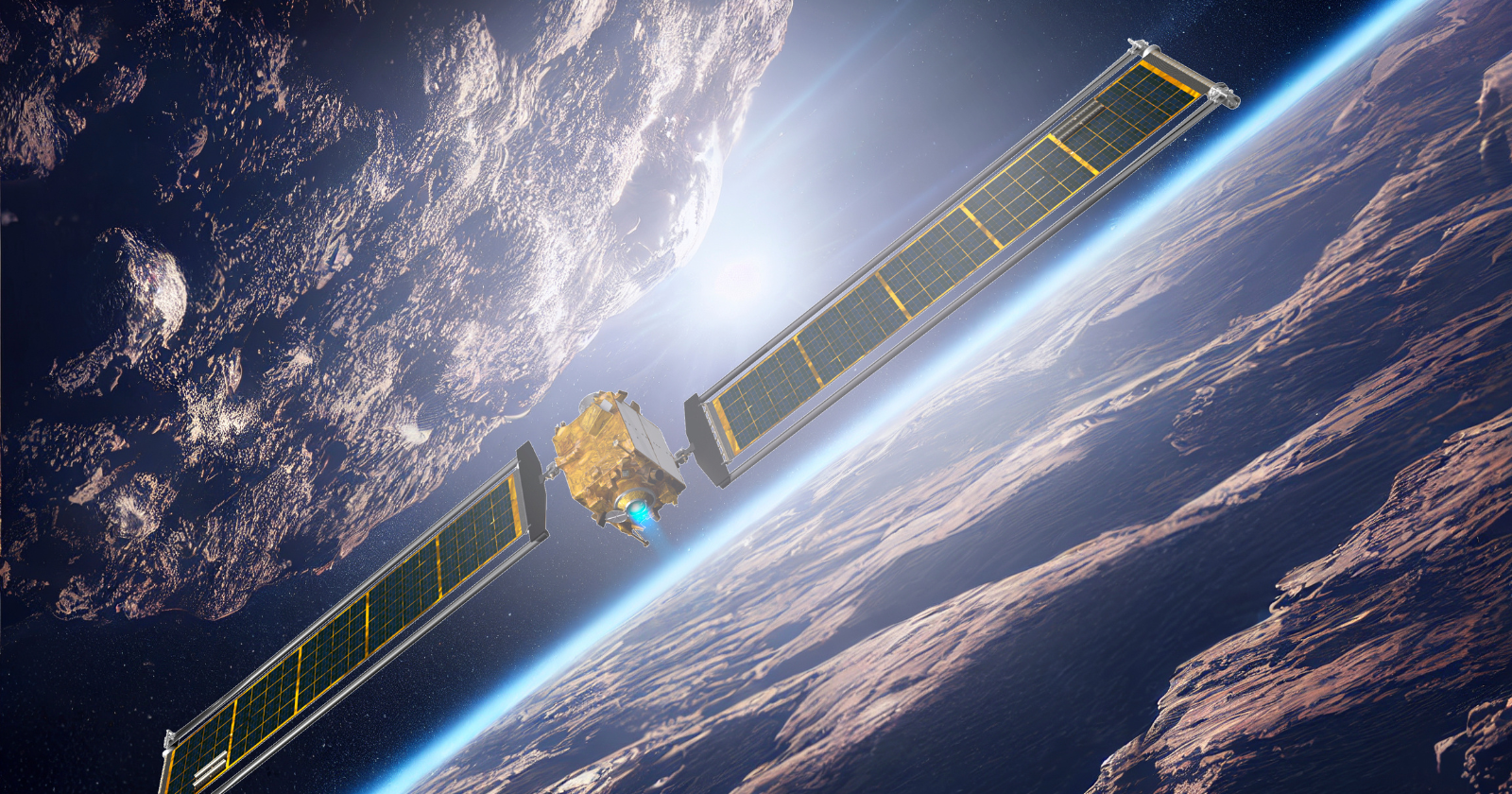
NASA crashed DART into an asteroid because the agency wanted to test a simple idea before anyone needed it in an emergency: if a hazardous asteroid were ever found on a collision course with Earth, could a spacecraft change its path by hitting it?
The target was Dimorphos, a small asteroid moonlet orbiting a larger asteroid called Didymos. Neither body threatened Earth. That was the point. NASA chose a safe binary asteroid system so the experiment could be measured without creating a new danger.
On September 26, 2022, the Double Asteroid Redirection Test, or DART, struck Dimorphos while the asteroid pair was about 11 million kilometres from Earth. NASA described the impact as the agency’s first attempt to move an asteroid in space, and the first full-scale demonstration of a planetary-defense technique called kinetic impact.
Why hit an asteroid at all?
The principle behind DART was not exotic. A fast-moving spacecraft carries momentum. If it slams into an asteroid, it can transfer some of that momentum and slightly change the asteroid’s motion. Given enough warning time, even a small change can make the difference between an impact and a miss.
That last phrase is the key: enough warning time. DART was not meant to prove that any asteroid can be stopped at the last moment. It was meant to test whether a kinetic impactor could make a measurable change in a real asteroid’s orbit, under real spaceflight conditions, with a spacecraft guiding itself into a small target at high speed.
NASA’s planetary-defense page explains the result plainly: DART’s hypervelocity impact altered Dimorphos’ orbit around Didymos, making it the first time humans deliberately changed the motion of a celestial object.
The Didymos-Dimorphos system was ideal because Dimorphos orbited Didymos every 11 hours and 55 minutes before impact. Astronomers could measure that period from Earth by watching small dips in brightness as the two bodies passed in front of or behind each other. If DART worked, the clock would change.
The final minutes
DART was not piloted by a person with a joystick. In the final approach, the spacecraft used its camera and autonomous navigation system to distinguish Didymos from Dimorphos and steer toward the smaller body.
NASA’s impact announcement says the 570-kilogram spacecraft guided itself through the final 90,000 kilometres of space before deliberately crashing into Dimorphos at about 22,530 kilometres per hour. Its camera, DRACO, returned increasingly detailed images until the transmission stopped at impact.
That ending was expected. DART was built to be destroyed. Its success condition was not survival, but contact.
The impact was confirmed at 7:14 p.m. EDT on September 26, 2022, from mission control at the Johns Hopkins Applied Physics Laboratory. A small Italian Space Agency CubeSat, LICIACube, had separated from DART days earlier and flew past the asteroid system to photograph the aftermath. Those images showed material streaming away from Dimorphos almost immediately after the collision.
What happened when it hit?
Dimorphos did not explode. It was not split in two. The effect was subtler and more useful: its orbit around Didymos shortened.
Before impact, Dimorphos took 11 hours and 55 minutes to circle Didymos. Two weeks after the crash, NASA announced that the orbit had shortened by 32 minutes, to 11 hours and 23 minutes, with an uncertainty of about plus or minus two minutes. NASA’s minimum definition of success had been a change of 73 seconds or more.
Later analysis sharpened the picture. In 2024, a JPL-led study reported that Dimorphos’ orbit had settled at 11 hours, 22 minutes and 3 seconds, or 33 minutes and 15 seconds shorter than before impact. NASA’s summary of that work says DART changed not only the asteroid’s motion, but also its shape, from something like a flattened ball into a more elongated form.
That matters because it shows DART did not simply nudge a rigid rock. Dimorphos appears to be a loose rubble-pile object, a body made of material held together by weak gravity rather than a single solid block. The impact rearranged it.
The debris did part of the work
One of the most important lessons came from the ejecta, the material blasted off the asteroid. When rock and dust flew away from Dimorphos, that escaping material carried momentum with it. The recoil pushed the asteroid in the opposite direction, increasing the effect of the spacecraft’s impact.
NASA compares this to air streaming out of a balloon. The spacecraft delivered the hit, but the debris plume helped amplify it. In a 2023 analysis, NASA said DART data validated kinetic impact as a planetary-defense method, reporting that the impact altered Dimorphos’ orbit by about 33 minutes and that ejecta played a major role in the result.
A 2026 NASA report on later research added another small but telling measurement: DART did not only change Dimorphos’ motion around Didymos. Because the two asteroids are gravitationally linked, the impact also changed the Didymos-Dimorphos pair’s orbit around the Sun by about 0.15 seconds over its 770-day period. The agency described that as the first measurable change by a human-made object to the path of a celestial body around the Sun.
That solar-orbit change is tiny. It is not the part that would save Earth in a real scenario. But it shows how precisely the aftermath can now be measured.
What DART proved, and what it did not
DART proved that a spacecraft can autonomously hit a small asteroid and measurably change its motion. It also showed that the structure of the target matters. A loose rubble pile may respond differently from a dense metallic asteroid or a solid monolith. The amount of debris thrown off can change the size of the deflection.
It did not prove that any asteroid can be easily moved. The size, composition, spin, orbit and warning time would all matter. A kinetic impactor is one tool, not a universal answer.
That is why follow-up matters. The European Space Agency’s Hera mission is designed to visit the Didymos-Dimorphos system and inspect the aftermath directly, including the changed shape, mass and crater or disturbed region left by DART. Ground-based telescopes showed the orbital change; Hera is meant to help explain the physical details behind it.
The useful answer to the title question is therefore simple, but not simplistic. NASA crashed DART into Dimorphos to test whether a spacecraft could alter an asteroid’s path before such a technique was needed for a real hazard. When it hit, the spacecraft destroyed itself, blasted debris into space, shortened Dimorphos’ orbit by more than half an hour, changed the asteroid’s shape, and turned planetary defense from a calculation into a demonstrated experiment.
It was not an asteroid rescue mission. It was a rehearsal, carried out 11 million kilometres away, against a harmless target, so that if a dangerous target is ever found, the first test will not be happening under panic.
