
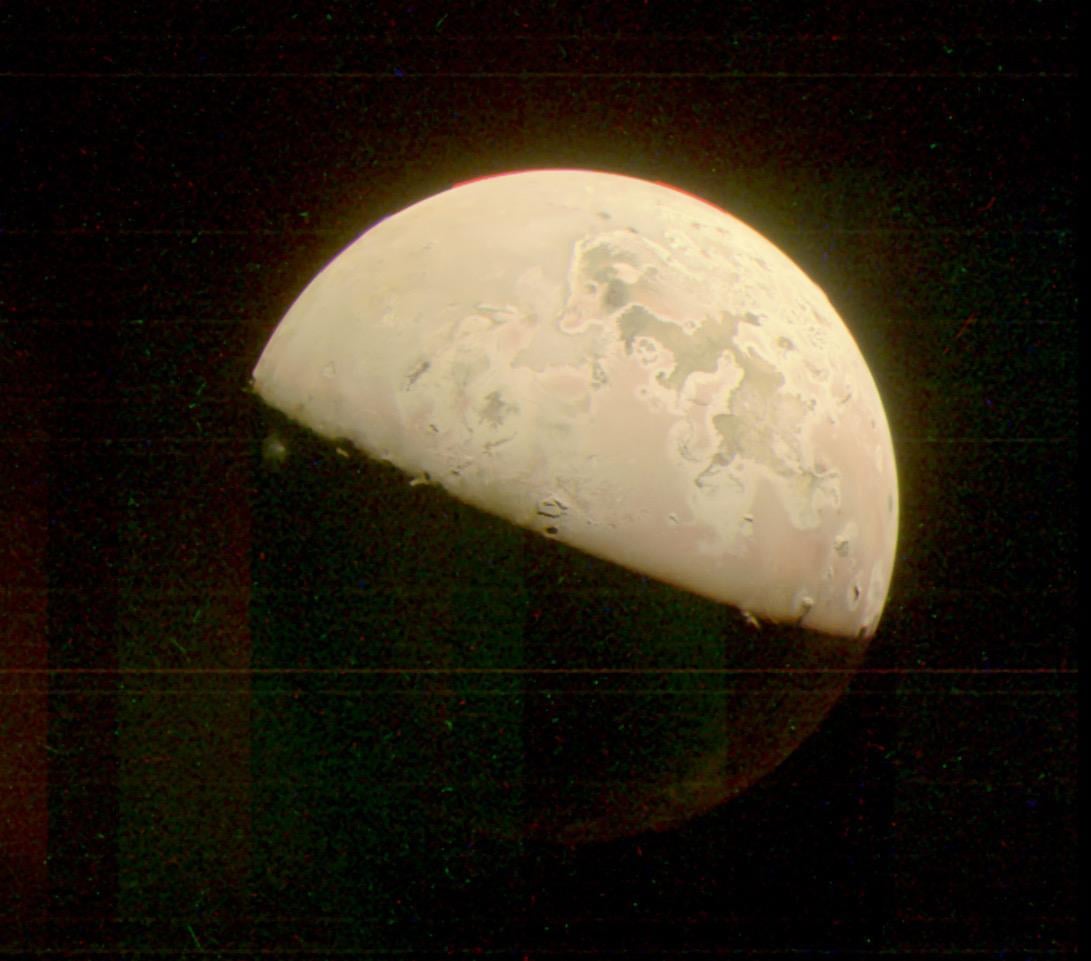
When Voyager 1 flew past Jupiter in March 1979, scientists expected its moon Io to be cold, battered and geologically quiet. Instead, the spacecraft photographed a world with no obvious impact craters, a surface stained yellow, orange, red and black, and something enormous rising beyond its edge.
That strange crescent was the first volcanic plume ever seen beyond Earth. It revealed a moon so violently active that its surface is continually repainted by lava and sulphur-rich fallout.
NASA now estimates that Io is home to roughly 400 volcanoes. Some eruptions throw gas and particles hundreds of kilometres above the surface, and the faint outer material from one plume has been detected about 500 kilometres high.
The anomaly appeared after Voyager’s encounter
Voyager 1 made its closest approach to Io on 5 March 1979. Three days later, navigation engineer Linda Morabito was processing an optical-navigation image taken after the encounter. She increased its contrast to reveal background stars, allowing engineers to refine the spacecraft’s position.
The enhanced image showed a bright, curved feature extending far beyond Io’s limb. Morabito first investigated whether it could be another moon behind Io. She also consulted colleagues familiar with the camera and possible imaging artifacts. Neither explanation survived examination.
The feature was connected to a dark surface region later named Pele. It was an umbrella-shaped cloud of material rising roughly 260 to 300 kilometres above Io. Voyager project scientist Ed Stone later recalled the plume as his favourite discovery of the mission, because it provided the first direct evidence of an active volcano anywhere beyond Earth.
Voyager had photographed an erupting world
Once researchers knew what to seek, they returned to Voyager’s earlier pictures and found more plumes. Nine were identified in the first spacecraft’s observations. When Voyager 2 arrived four months later, several remained active, demonstrating that Io’s eruptions were not a single brief event.
The discovery had in fact been anticipated. Just before Voyager arrived, researchers calculated that Jupiter’s gravity could generate enough heat inside Io to support widespread volcanism. The images supplied spectacular confirmation, but the mechanism was unlike the heat driving most volcanoes on Earth.
Today, NASA describes Io as the most volcanically active body in the solar system, with an estimated 400 volcanoes. Not all are erupting at once, and researchers use thermal hot spots, lava flows, surface changes and plumes to determine which centres are active.
Jupiter kneads the moon from within
Io travels around Jupiter in a slightly elliptical orbit. Its orbital resonance with the moons Europa and Ganymede prevents that path from becoming circular. As Io moves nearer to and farther from Jupiter, the giant planet’s gravitational pull changes.
The result is relentless tidal flexing. Io’s solid body rises and falls by as much as about 100 metres, generating friction and heat inside the moon. Rock melts, magma rises and the stored energy escapes through lava lakes, fountains, flows and explosive plumes.
The process is powerful enough to erase the usual record of impacts. Craters are buried beneath fresh volcanic material, leaving a surface that is geologically young even though Io itself formed billions of years ago. Sulphur and sulphur dioxide help produce its striking colours, while much of the hot lava is molten silicate rock.
Its plumes can dwarf terrestrial eruptions
Io’s low gravity and extremely thin atmosphere allow erupted material to climb far higher than volcanic debris on Earth. A typical Prometheus-type plume may rise tens or hundreds of kilometres, while rarer giant eruptions can reach much farther.
In 2001, Galileo observed a previously unknown volcano whose bright inner plume rose about 150 kilometres. Fainter outer material was visible at roughly 500 kilometres, the greatest plume height documented on Io. That is farther above the ground than the International Space Station’s typical altitude above Earth.
The material does not simply disappear. Gas and particles follow enormous ballistic arcs before falling back, creating circular deposits that can extend across hundreds or even more than a thousand kilometres. Some material escapes Io altogether and feeds a torus of charged particles around Jupiter, connecting the moon’s volcanoes to the planet’s vast magnetosphere.
Modern spacecraft are still revising the explanation
Galileo, Cassini, New Horizons and Juno have all watched Io change. In 2007, New Horizons photographed the Tvashtar plume rising about 290 kilometres, revealing filaments that looked like a gigantic fountain frozen against space.
Juno’s close passes have now allowed researchers to measure how Io deforms under Jupiter’s pull. The results challenge the long-standing idea that a single shallow global magma ocean feeds the volcanoes. A 2024 study based on Juno’s gravity measurements found that Io behaves more like a mostly solid body, favouring separate local or regional magma sources.
That leaves Io no less extreme. It means hundreds of volcanic systems may be operating across a moon only slightly larger than our own. The plume that looked like a stray object or possible image artifact in 1979 was not an error at all. It was the first visible sign of an entire world being continuously squeezed, melted and rebuilt by Jupiter’s gravity.
