
Most missions searching for extraterrestrial life are imagined as quests for a positive result: a cell, a biological molecule or a chemical pattern that cannot be explained without metabolism. At Enceladus, however, a sufficiently rigorous failure to find life could change astrobiology almost as profoundly.
Saturn’s small icy moon appears to have much of the equipment usually placed on life’s requirements list. It has a global ocean of liquid water, contact between that water and a rocky core, internal heat, chemical energy, phosphorus and an increasingly varied inventory of organic compounds.
If a mission sensitive enough to detect plausible biology repeatedly sampled that system and still found nothing, scientists would have something rare: a potentially habitable environment that may never have become inhabited. That would suggest that assembling ingredients and assembling a living system are very different achievements.
Enceladus has crossed the habitability threshold
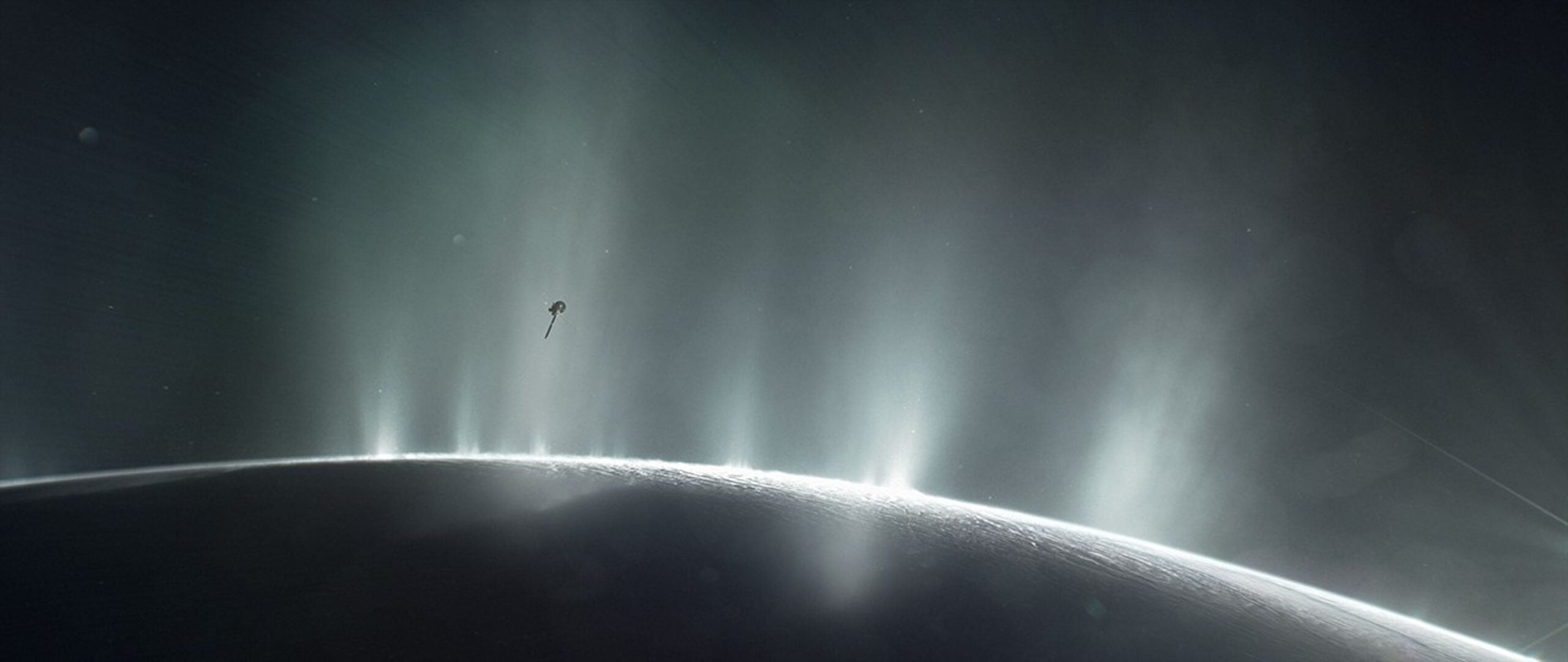
Cassini transformed Enceladus from an obscure ice ball into one of the solar system’s leading astrobiology targets. The spacecraft found jets erupting through fractures near the south pole and showed that they connect to a global salty ocean beneath the crust. NASA’s summary of the Cassini evidence also describes silica particles that point to hot water interacting with rock, consistent with hydrothermal activity on the seafloor.
Molecular hydrogen in the plume provides a possible energy source for microorganisms. Carbon-bearing compounds supply chemical feedstock. In 2023, researchers detected phosphates in salt-rich ice grains, and NASA reported that phosphorus was present at unexpectedly high concentrations. Phosphorus is essential to DNA, cell membranes and energy transfer in terrestrial organisms.
A 2025 reanalysis of grains collected directly from the plume added fresh evidence for complex organic chemistry. The European Space Agency said the compounds were present in particles only minutes removed from the ocean, making space weathering an unlikely explanation for their formation.
Habitability and habitation are different claims
None of those discoveries demonstrates life. Water is not biology. Organic molecules are simply carbon-based chemistry and can form without organisms. Hydrogen is usable energy, not evidence that anything is using it. Even an environment containing every familiar ingredient may lack the sequence of events needed to produce a self-replicating, evolving system.
Earth offers only one known example of life’s origin. Because life appeared relatively early here, it is tempting to conclude that biology readily emerges when conditions permit. But scientists cannot tell how much that observation reflects a common process and how much it reflects selection: observers can only arise on a world where life succeeded.
Enceladus could provide a second experiment conducted by nature. If its ocean has remained warm, chemically active and connected to rock for a substantial period, yet is sterile, the result would weaken the simplest claim that suitable ingredients make life’s emergence almost automatic.
A true null result would carry information
A well-designed search could look for several independent signals: cell-like structures, complex distributions of organic molecules, strong preferences for particular molecular handedness, unusual isotope ratios and chemical disequilibria best explained by metabolism. Agreement across methods would make a positive result stronger. Their joint absence, measured with known sensitivity, would also be informative.
The scientific question would then shift. Instead of asking whether Enceladus has the raw materials for life, researchers could ask which transition failed. Perhaps prebiotic molecules never organised into replicators. Perhaps replication began but could not become stable. Perhaps environmental cycles needed to concentrate and select molecules are missing beneath a permanent ice shell.
One sterile ocean would not reveal a universal probability for life’s origin. It would, however, show that a rich chemical inventory and long-lived liquid water do not guarantee biology.
Not detecting life is not the same as proving absence
The difficult phrase is “sensitive enough.” A spacecraft might miss life because organisms are rare, live near isolated vents or remain trapped below kilometres of ice. The plume may alter, dilute or selectively transport material on its journey from ocean to space. Instruments may search for Earth-like chemistry while unfamiliar biology leaves different traces.
Researchers developing the proposed Enceladus Orbilander concept therefore designed a strategy using repeated plume passes, surface sampling and complementary instruments. Their published science objectives explicitly address the need to reduce false negatives, as well as false positives caused by contamination or non-biological chemistry.
A negative measurement must consequently be stated with boundaries. It can show that no specified biosignature was found above a stated detection limit in a particular sample. Declaring the entire ocean sterile would require much stronger evidence.
A mission must be designed to learn from silence
Life-detection experiments need an abiotic baseline: a model of what Enceladus’s chemistry should look like when geology alone is operating. A 2026 framework for ocean-world biosignatures warns that ignoring this baseline can produce both ambiguous claims and false negatives. Geophysical context, plume transport and laboratory simulations must accompany chemical measurements.
If those controls are in place, either answer becomes valuable. Detecting biology would establish that life began independently beyond Earth, assuming it was genuinely unrelated to terrestrial life. A robust null result would identify a boundary between habitability and habitation and give origin-of-life research a real counterexample.
Enceladus matters because nature appears to have assembled water, rock, heat, energy and complex chemistry in one accessible place. Finding life there would show what those ingredients can become. Finding none, after a search capable of finding it, could reveal how much more the universe must do before chemistry becomes alive.
