
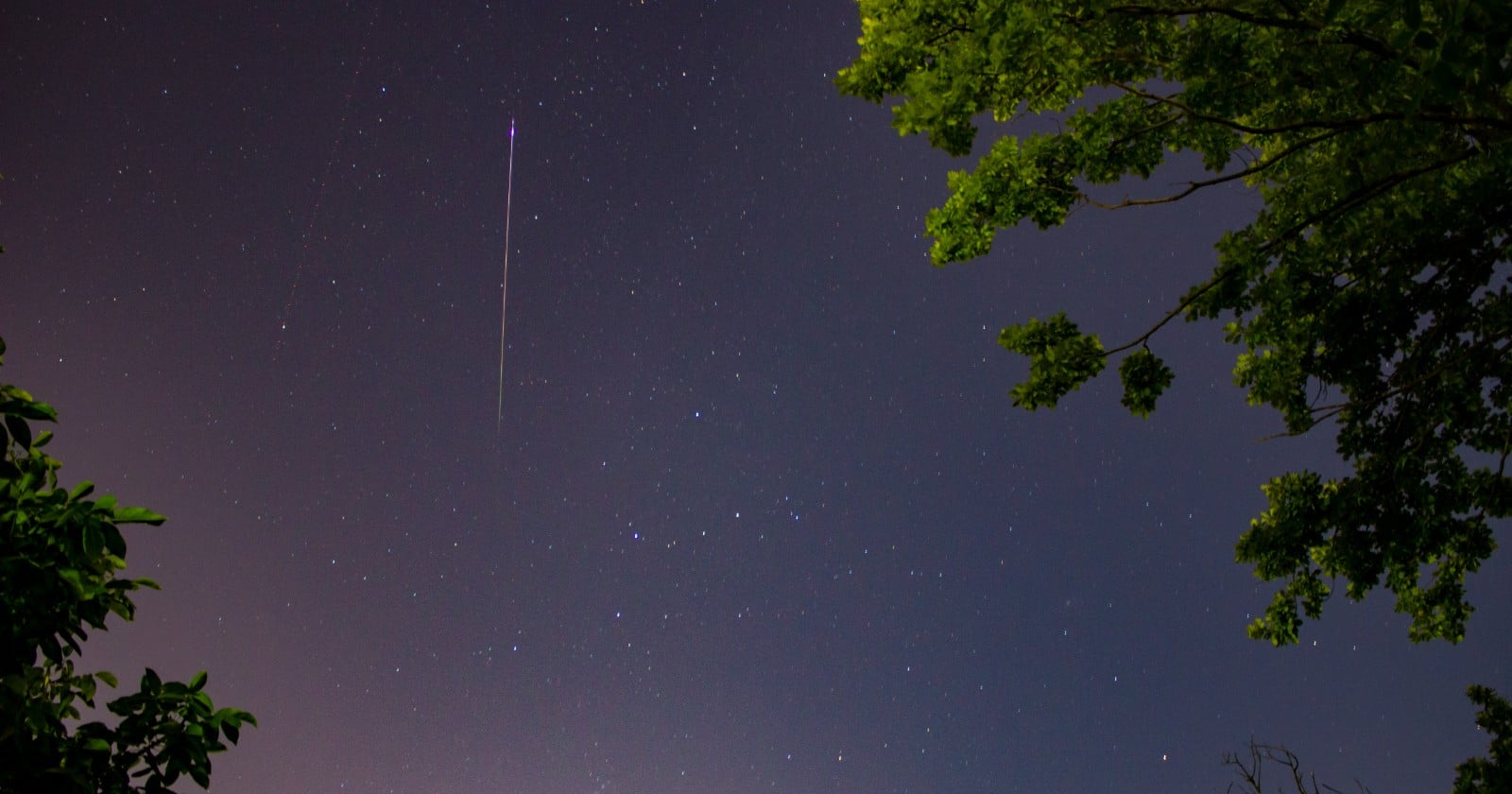
One of summer’s steadiest meteor showers reaches its peak around July 30, and in 2026 almost no one will see it at its best. The Southern Delta Aquariids are faint to begin with, and this year their maximum falls within two days of a full Moon that floods the whole sky with light.
The result is a shower worth planning around rather than showing up for. The peak date on the calendar is close to the worst night of the month to look, and the better strategy is to watch the dark mornings the week before, when the Moon is out of the way and the same meteors are already flying.
A faint shower, and a Moon two days off full
The Southern Delta Aquariids run from about mid-July through late August every year, the debris of an orbit the Earth crosses on its way toward the more famous Perseids. According to NASA, the shower is active from mid-July and visible into late August, with the strongest rates concentrated near the end of July. The American Meteor Society lists the 2026 maximum on the night of July 30 to 31.
The meteors themselves are modest. They enter the atmosphere at about 41 kilometers per second, a medium speed, and tend to be dim, with few of the bright fireballs that make other showers easy to catch. Their radiant, the point they appear to stream from, sits near the star Skat in the constellation Aquarius, low in the southern sky for most northern observers. That low radiant is why the shower has always favored the Southern Hemisphere and the southern latitudes of the Northern Hemisphere, where Aquarius climbs higher.
This year the timing is unkind. The full Moon falls on July 29, and by the shower’s peak a night or two later it is still a waning gibbous roughly 97 to 98 percent lit, sitting in neighboring Capricornus and washing out the sky for most of the night. NASA puts the problem plainly on its own shower page: if the Moon is up, the Delta Aquariids will be all but impossible to see.
The peak date is the wrong night to circle
The instinct with any meteor shower is to mark the peak and wait for it. For the Delta Aquariids in 2026, that instinct works against you. The shower has no sharp spike anyway. It rambles along at close to full strength for a week or more on either side of the maximum, which means the meteors flying on the moonlit peak night are also flying on the darker mornings before it.
Those earlier mornings are the opening. In the days leading up to July 29, the Moon rises later and sets earlier in the small hours, leaving a truly dark window before dawn. The radiant climbs highest around 2 a.m. local time, so the stretch from roughly 2 a.m. to the first light of dawn is when the most meteors fall, moonlight or not.
The viewing method is the same one NASA recommends for any faint shower. Find a spot well away from city lights, lie back so you can take in as much sky as possible, and look about halfway up from the horizon and around 45 degrees away from Aquarius rather than straight at the radiant. Give your eyes at least half an hour to adjust to the dark, and plan to stay out. Patience does more here than any equipment.
The comet nobody has fully pinned down
Most meteor showers can be traced to a specific parent, the comet or asteroid whose shed dust the Earth plows through. The Delta Aquariids are a genuine exception, and that is part of what makes them interesting. The long-suspected source is comet 96P/Machholz, a small comet found by amateur astronomer Donald Machholz in 1986, with a nucleus a few kilometers across and an orbit that swings it well inside Mercury’s every five to six years. NASA lists it as the origin, but adds the word “suspected,” and the American Meteor Society goes further, printing the parent object as “96P/Machholz?” with the question mark intact.
The picture is more tangled the closer you look. In-The-Sky.org, which draws its shower data from the International Meteor Organization, names a different body outright as the likely source: the small SOHO-discovered comet P/2008 Y12. Both candidates belong to the same sprawling family. Writing for EarthSky, the late comet hunter Don Machholz described the 96P/Machholz Complex as a collection of eight related meteor showers, two comet groups and at least one asteroid, all apparently born from the same original object and now scattered into slightly different orbits. A modeling study has suggested the specific dust that lights up the Delta Aquariids left its parent roughly 20,000 years ago. In other words, this is old material from a broken and still-debated lineage, which is a large part of why the exact parent has never been settled.
The rate on paper, and the rate overhead
The number attached to this shower is a zenithal hourly rate of about 25, and that figure is an idealized count, not a forecast. It is how many meteors a single observer would see under a perfectly dark sky with the radiant sitting directly overhead, conditions that essentially never hold in practice. NASA’s own estimate for what a real observer catches under genuinely dark skies is closer to 7 or 8 an hour.
Layer this year’s Moon on top of that, and the honest expectation for the peak night is a handful of the brightest streaks at most, not a downpour. This is the core of what separates a useful forecast from a disappointing one. The headline rate is a ceiling measured on paper, and the number overhead is always lower, sometimes far lower once light and a low radiant are accounted for. Anyone told to expect dozens of meteors on July 30 is being set up to feel cheated.
The shower is still worth chasing. It just rewards a particular kind of chase: a dark site, an early morning before the Moon reasserts itself, and the patience to wait out a slow, thin drizzle of meteors.
If this year disappoints, August is already waiting
The Delta Aquariids do not end at their peak. They keep drifting for weeks, thinning out through early August, right as the Perseids ramp up toward their own maximum on the night of August 12 to 13. That shower peaks under a new Moon this year, in a sky as dark as it gets, and a stray Delta Aquariid or two will still be mixed in among the Perseids for anyone watching, distinguishable by whether the streak traces back to the south or the northeast.
There is company at the end of July as well. The Alpha Capricornids peak on the same moonlit nights, and though they are sparse, at only about five an hour, they are known for slow, bright fireballs that can punch through moonlight better than the Delta Aquariids ever will. For the next few weeks, in other words, the sky keeps offering chances. The trick in 2026 is simply to take them when the Moon is down.
