

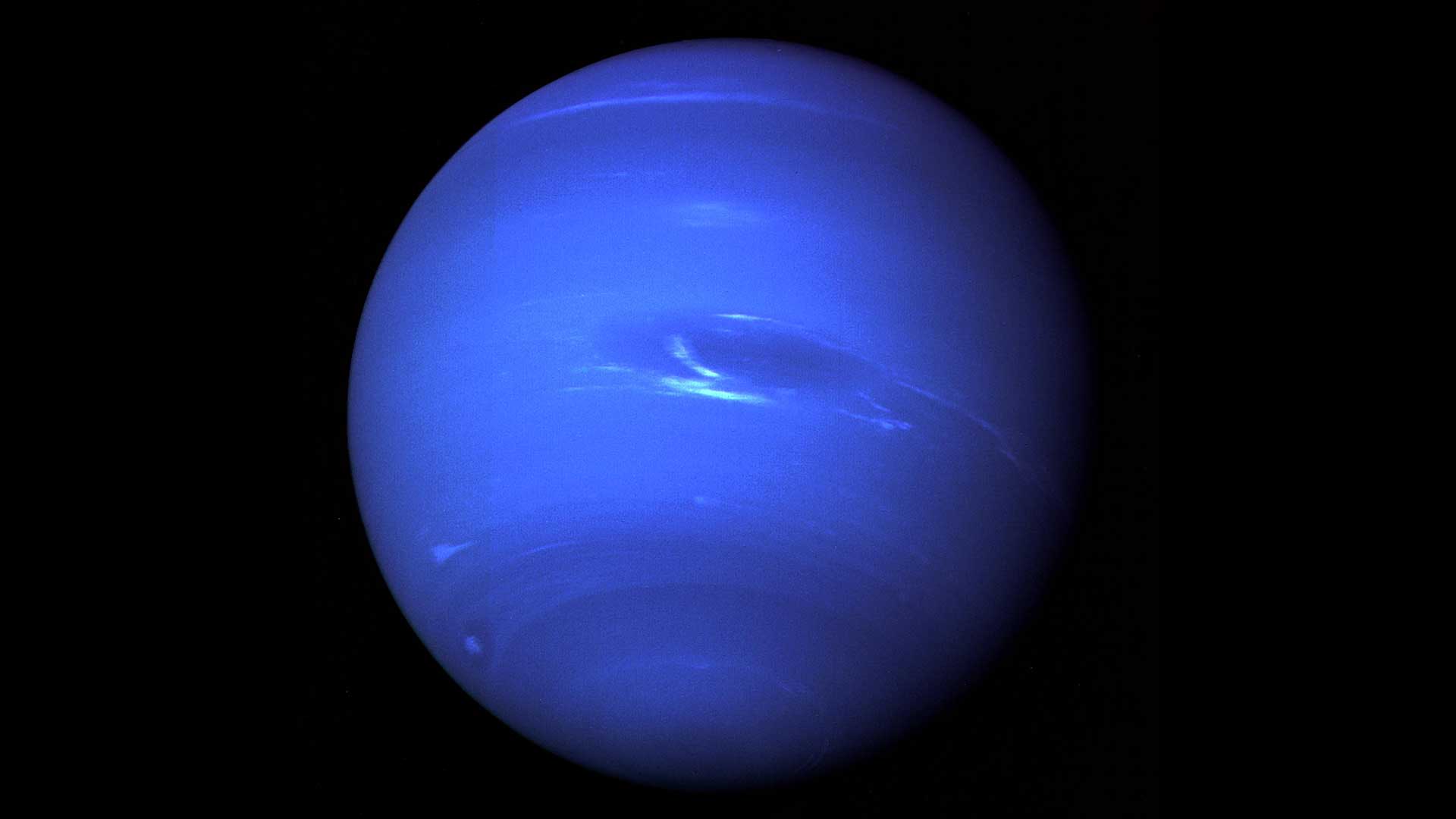
At Neptune’s average distance of 4.5 billion kilometres from the Sun, noon resembles a dim terrestrial twilight. Sunlight is about 900 times weaker than at Earth, yet bright methane-ice clouds can race around the planet in winds exceeding 2,000 kilometres per hour.
The apparent contradiction makes Neptune one of planetary science’s most compelling weather laboratories. On Earth, sunlight powers most weather. Neptune receives so little solar energy that another source must matter, and the planet supplies one from below: it radiates substantially more energy than it absorbs from the Sun.
Internal heat is the leading part of the answer, but it is not a complete explanation. Rapid rotation, convection, atmospheric waves and low friction appear to organise the available energy into powerful east-west jets. Exactly how the pieces work together remains unsettled.
The sunlight is weak, but not moonlight-weak
Neptune orbits roughly 30 times farther from the Sun than Earth does. Because light intensity falls with the square of distance, the planet receives about one nine-hundredth as much sunlight. NASA describes high noon there as comparable to dim twilight on Earth.
That is much brighter than a full-moon night, despite a common comparison. Full moonlight on Earth typically provides only a fraction of a lux, while dividing terrestrial daylight by 900 still leaves illumination of roughly a hundred lux, depending on atmospheric conditions and the Sun’s position. The accurate comparison is that Neptunian daylight is hundreds of times brighter than full moonlight, but around 900 times dimmer than daylight near Earth.
The distance is nevertheless extreme. According to NASA’s Neptune facts, sunlight takes about four hours to reach the planet. Neptune completes one orbit in 165 Earth years, so each season lasts more than four decades.
Voyager found a world moving at 2,000 kilometres per hour
Neptune has no solid surface where an anemometer could stand. Wind speeds are inferred by following clouds and storm features as they move relative to the planet’s underlying rotation. During its 1989 flyby, Voyager 2 revealed bands, bright clouds and the Earth-sized Great Dark Spot.
Near that storm, the spacecraft measured winds approaching 2,000 kilometres per hour, according to NASA’s Voyager fact sheet. Later observations by the Hubble Space Telescope and ground-based observatories showed that dark vortices can appear and disappear while the major jet pattern persists.
The strongest measured flow is a broad westward equatorial jet, not a single gust like one inside a terrestrial tornado. Neptune rotates once in about 16 hours, and that rapid spin strongly influences the circulation. The Coriolis effect deflects moving gas and helps arrange it into east-west bands rather than allowing heat simply to overturn from lower to higher latitudes.
Neptune carries its own furnace
Weak sunlight does not mean Neptune lacks an energy supply. The planet is still cooling after its formation 4.5 billion years ago. Heat escaping from its deep interior rises through layers rich in hydrogen, helium, water, ammonia and methane before reaching the weather-forming atmosphere.
Modern energy-budget estimates indicate that Neptune’s internal heat flow is about 162 per cent of the solar power it absorbs. Adding the absorbed sunlight means the planet emits roughly 2.6 times as much energy as it receives from the Sun. The figures were summarised in a 2025 Geophysical Research Letters study comparing the heat budgets of the giant planets.
Rising heat can drive convection. Gas warmed at depth becomes buoyant, rises and eventually cools, while denser material sinks. Condensation of methane and other substances may add latent heat, just as condensing water helps power storms on Earth. Turbulent eddies and atmospheric waves can then transfer momentum into the large zonal jets.
Fast wind does not require a proportionally huge power supply
It is tempting to imagine wind speed as a direct gauge of how much energy enters an atmosphere each moment. The relationship is not that simple. A jet can persist when momentum is continually reorganised and energy losses are small. Neptune has no mountains, forests or solid ground at its cloud tops to impose the drag familiar on Earth.
This does not make the atmosphere frictionless. Turbulence, waves and mixing still dissipate kinetic energy, and motion deeper inside the planet may encounter additional resistance. But if dissipation is slow, a modest continuous heat flow can maintain a large reservoir of atmospheric motion.
A classic 1991 paper in Science proposed that Neptune could operate as an unusually efficient heat engine. In that model, heat is added at warmer depths and removed at the extremely cold cloud tops, while the broad geometry of the circulation allows some processes to occur with relatively little irreversible loss. The idea showed that low solar input does not set a low ceiling on wind speed.
The weather may be shallower than it looks
Scientists have long debated whether Neptune’s jets extend through much of the interior or occupy a relatively thin atmospheric shell. A 2013 analysis in Nature combined observed winds with measurements of the gravity fields of Uranus and Neptune. It concluded that the circulation is confined to a weather layer no more than about 1,000 kilometres deep and containing only about 0.2 per cent of Neptune’s mass.
A thousand kilometres is deep by terrestrial standards, but small beside Neptune’s radius of nearly 25,000 kilometres. The result favours mechanisms operating in the outer atmosphere, although heat rising from the interior can still provide energy to that layer. Cloud-forming convection, waves and eddies may be the intermediaries that turn vertical heat flow into horizontal jets.
Uranus prevents the explanation from becoming too tidy. It has a broadly similar size, composition and banded circulation, but its measured internal heat flux is much smaller and its maximum winds are slower. Comparing the two ice giants is therefore one of the best ways to test which ingredients control their weather.
The fastest winds remain an open problem
Only one spacecraft has visited Neptune, and Voyager 2 had hours near the planet rather than years in orbit. Earth-based telescopes can follow the tops of clouds, but they cannot directly sample temperatures, composition and winds far below them. That leaves major uncertainties about where the jets gain momentum, how deeply they extend and where their energy is lost.
The most defensible answer is therefore a combination rather than a single mechanism. Neptune’s interior supplies more energy than the remote Sun. Convection and atmospheric disturbances move that energy upward. Rapid rotation shapes the motion into jets, while relatively weak drag allows them to endure. Together, those factors can support the fastest measured planetary winds in the solar system.
What remains unexplained is why Neptune converts its available energy into this particular circulation so effectively. A future orbiter and atmospheric probe could track the changing clouds from above while measuring pressure, temperature and wind below them. Until then, the blue planet’s speed limit remains one of the most striking questions left by Voyager.