
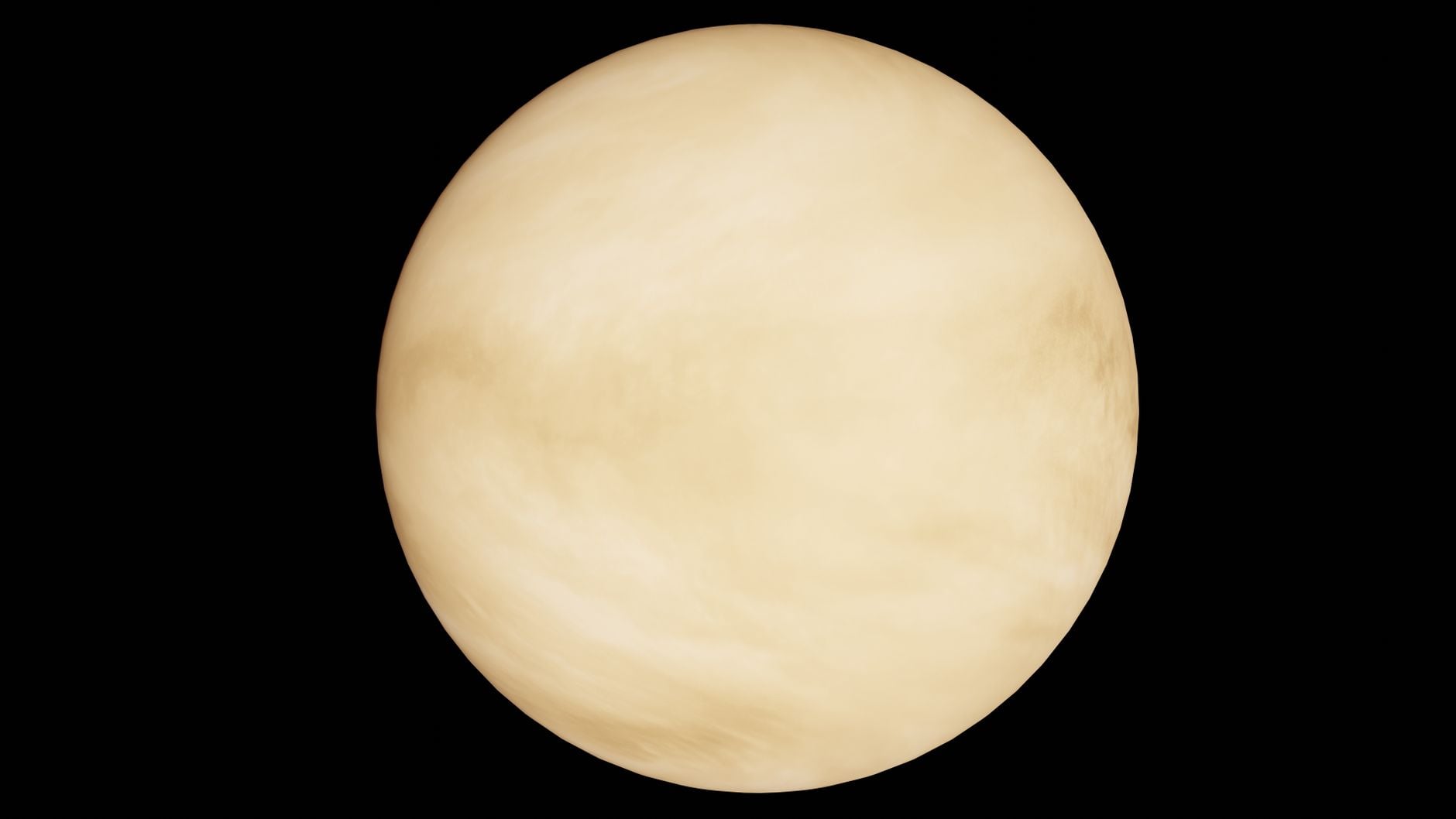
Venus keeps time in a way that seems almost designed to confuse. The planet takes about 243 Earth days to turn once relative to the distant stars, yet it completes an orbit around the Sun in only about 225 Earth days. In that specific sense, a day on Venus really is longer than its year.
Its rotation is also retrograde, opposite to the direction in which Venus travels around the Sun and opposite to the spin of most planets. From the surface, the Sun would therefore rise in the west and set in the east.
There is one important numerical distinction. The 117-day figure often attached to this fact is the full solar day, from one sunrise to the next, not the time taken for the Sun to travel from horizon to horizon. A notional sunrise-to-sunset passage lasts about half as long, or roughly 58 Earth days.
Venus has two different kinds of day
On Earth, the difference between the two common meanings of “day” is small enough to overlook in ordinary conversation. A sidereal day measures one rotation relative to the distant stars. A solar day measures the interval required for the Sun to return to the same position in the local sky.
Those clocks diverge dramatically on Venus. A NASA planetary fact sheet gives the planet’s retrograde rotation period as 243.02 Earth days, its orbital period as 224.70 days and the interval between successive sunrises as 116.75 days.
The famous comparison between the Venusian day and year refers to the first of those values. One turn relative to the stars takes longer than one circuit of the Sun. But a person counting apparent sunrises would experience nearly two solar days during each Venusian year.
Backward rotation makes the solar day shorter
Venus travels around the Sun in the same broad direction as most planets, but its surface rotates the other way. As a result, its orbital motion and rotation work together when determining the Sun’s apparent passage through the sky. The Sun returns to the same local position after about 116.75 Earth days, well before the planet has completed a 243-day turn relative to the stars.
A complete solar day includes both daylight and darkness. In a simplified horizon-to-horizon calculation, sunrise to sunset therefore takes about 58.4 Earth days, followed by a similarly long night. The planet’s thick clouds would blur the direct solar disc for an observer at the surface, but the geometric direction of travel would still be west to east.
“Backward” is a convenient comparison rather than a universal direction in space. Venus has an axial orientation of about 177 degrees, according to the European Space Agency. It can be pictured as spinning retrograde or as being almost upside down, with its axis only a few degrees away from a fully inverted orientation.
The atmosphere races ahead of the ground
The solid planet may rotate with extraordinary slowness, but the upper atmosphere does not. Clouds near the top of Venus’s atmosphere can circle the planet in roughly four Earth days. This rapid atmospheric “super-rotation” produces winds that move far faster than the surface beneath them.
That contrast matters because Venus has an atmosphere about 90 times as massive as Earth’s at the surface. The atmosphere is not merely a passive blanket over the planet. It can exchange angular momentum with the solid body and subtly change the rate at which the ground turns.
In a 2021 study in Nature Astronomy, Jean-Luc Margot and colleagues combined 21 successful Earth-based radar measurements made between 2006 and 2020. They calculated a mean sidereal rotation period of 243.0226 Earth days, with an uncertainty of about 0.0013 day. They also found variations in the instantaneous rotation period of roughly 21 minutes, most likely caused by exchanges of momentum between the atmosphere and solid planet.
Radar revealed a surface hidden by clouds
Venus’s global cloud cover prevents optical telescopes from tracking landmarks on the ground. Early astronomers could see changing cloud patterns, but those did not provide a reliable clock for the solid planet. Radar observations were needed to penetrate the clouds and follow surface features.
NASA’s Magellan spacecraft used radar to map the planet after entering orbit in 1990. Its first mapping cycle lasted 243 days, corresponding to one rotation of Venus, according to the Jet Propulsion Laboratory. The mission ultimately revealed volcanic plains, mountains, impact craters and other terrain across most of the surface.
Precisely measuring the rotation remains important for future missions. Even a small uncertainty accumulates over many slow rotations, shifting estimates of where a surface landmark will be when a spacecraft arrives. The 2021 radar study noted that outdated spin estimates could translate into landing-location errors measured in tens of kilometres.
Why Venus spins this way remains unsettled
Scientists do not have a single confirmed account of how Venus acquired its slow retrograde spin. A major collision early in the planet’s history is one possible ingredient, but present-day rotation also reflects long-running torques from the Sun and the atmosphere.
Solar gravity deforms the solid planet, while solar heating creates tides in the dense atmosphere. Models suggest that the balance between these effects can help maintain the unusually slow, retrograde state. Determining exactly how that balance developed requires better knowledge of Venus’s interior, atmosphere and history.
The familiar one-line fact is therefore correct only after defining the clocks. Venus takes about 243 Earth days to rotate once relative to the stars and about 225 days to orbit the Sun. Because it spins retrograde, the Sun rises in the west. From one sunrise to the next takes about 117 Earth days, while the Sun’s notional journey from the western horizon to the eastern horizon takes about 58. The strange arithmetic is not a contradiction. It is what happens when a planet’s year, rotation and solar day all run on different schedules.