
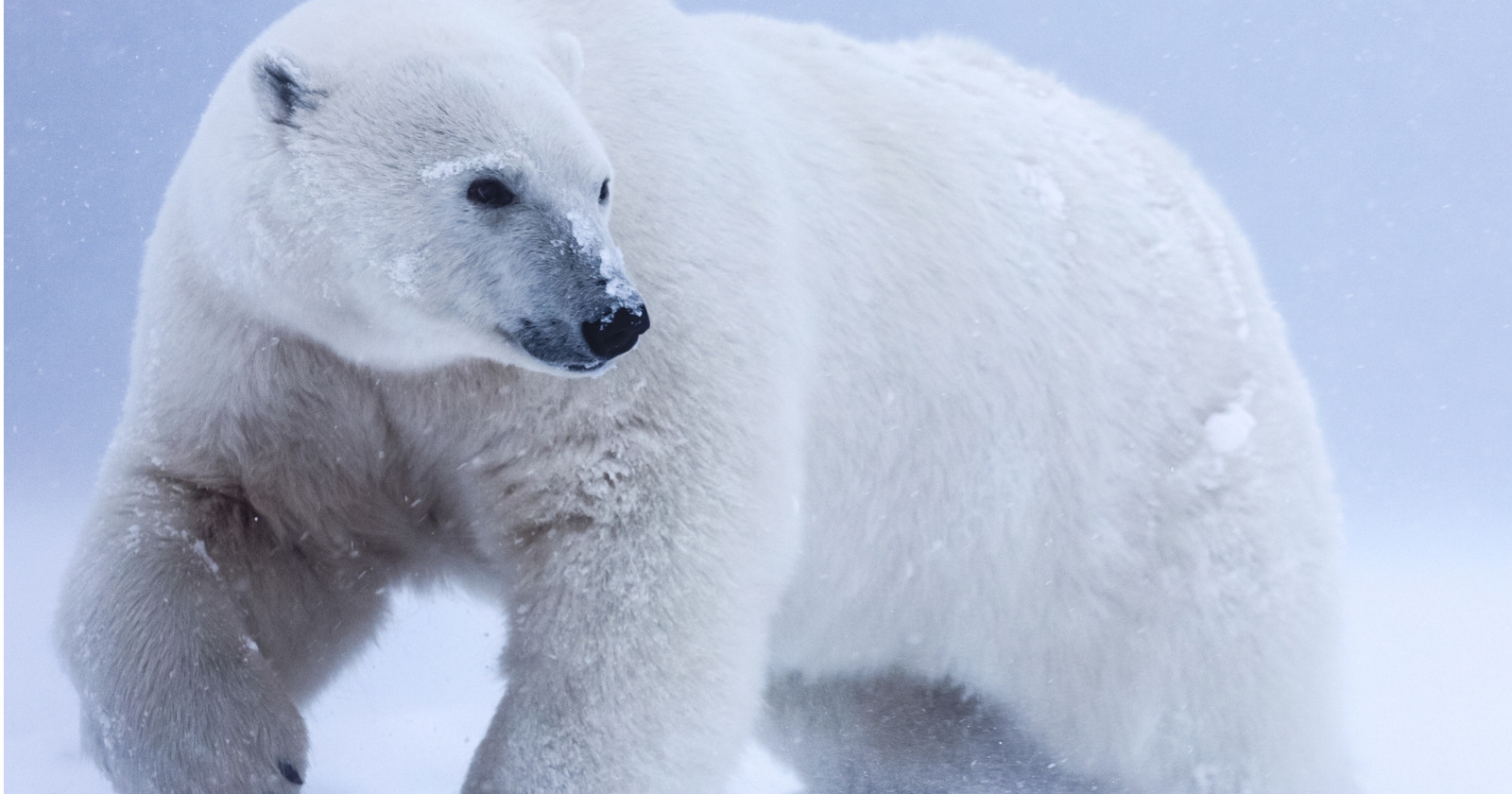
A single polar bear guard hair, held up to the light, is almost invisible. It is clear, not white. The animal that reads as the most solidly coloured thing on the ice is wearing a coat that contains no white pigment anywhere.
The white we see is a trick of structure rather than colour. The long guard hairs that form the outer coat are transparent, hollow tubes, and they scatter incoming light in every direction. All the visible wavelengths bounce back to the eye at once, and the result registers as white. It is the same effect that makes snow and clouds look white, even though the ice crystals and water droplets they are made of are themselves clear.
Two layers of clear hair
The coat is not uniform. According to the Library of Congress reference page drawn from USGS material, the coarse outer guard hairs are hollow and without pigment, while the denser, finer underfur beneath them is not hollow but is also unpigmented.
Both layers are doing work. The underfur is packed tightly enough to hold a still cushion of air against the body, which is where most of the insulation comes from. The guard hairs sit above it as a coarser outer barrier, shedding water and adding a second layer of trapped air. Their rough surfaces and hollow cores are also the main reason the coat looks white at all.
The appearance is not always a clean white. Guard hairs can pick up a yellow cast with age and oxidation, and in captivity bears have sometimes turned faintly green when algae took hold inside the hollow shafts. In the wild, against snow, the effect usually holds and the animal reads as white, which is useful for a predator working open ground with little cover.
Black skin under a clear coat
Part the fur on an adult and the skin beneath is black, the dark pigment visible on the nose, the lips, and the pads of the feet. The colour is not there from the start. According to Polar Bears International, cubs are born with pink skin showing through a short white fuzz, and it darkens to black at around three to four months, close to the time mother and cubs leave the maternity den.
Dark surfaces absorb more of the light that reaches them than pale ones do, so the black skin is well placed to take up whatever sunlight makes it through the coat. How much reaches the skin depends heavily on how thick the fur is at a given spot, and over the densest parts of the back very little gets through at all. Either way, the bear’s warmth is kept in far more than it is gathered from a low Arctic sun. The insulating fur and a fat layer that can exceed ten centimetres do most of that work.
Why the structure matters
The design is efficient enough that overheating, rather than cold, is often the harder problem for an active polar bear. A large animal generating body heat, wrapped in dense fur and thick fat, sheds warmth slowly. That is one reason bears move deliberately on land and will stretch out on ice or swim to cool down.
It is also why the fur has drawn steady interest from materials researchers. A clear, hollow-fibre coat that insulates while still letting some light through is an appealing thing to imitate, and several groups have tried to reproduce the structure in synthetic fibres and layered fabrics for cold-weather clothing. The bear got there first.
The everyday description gets its main points right. The fur carries no colour, the whiteness comes from light bouncing off clear hollow hairs, and an adult’s skin is black beneath it. In summer, when the coat thins, that dark skin can show faintly through, and a bear that looked white all winter takes on a greyer cast.
