

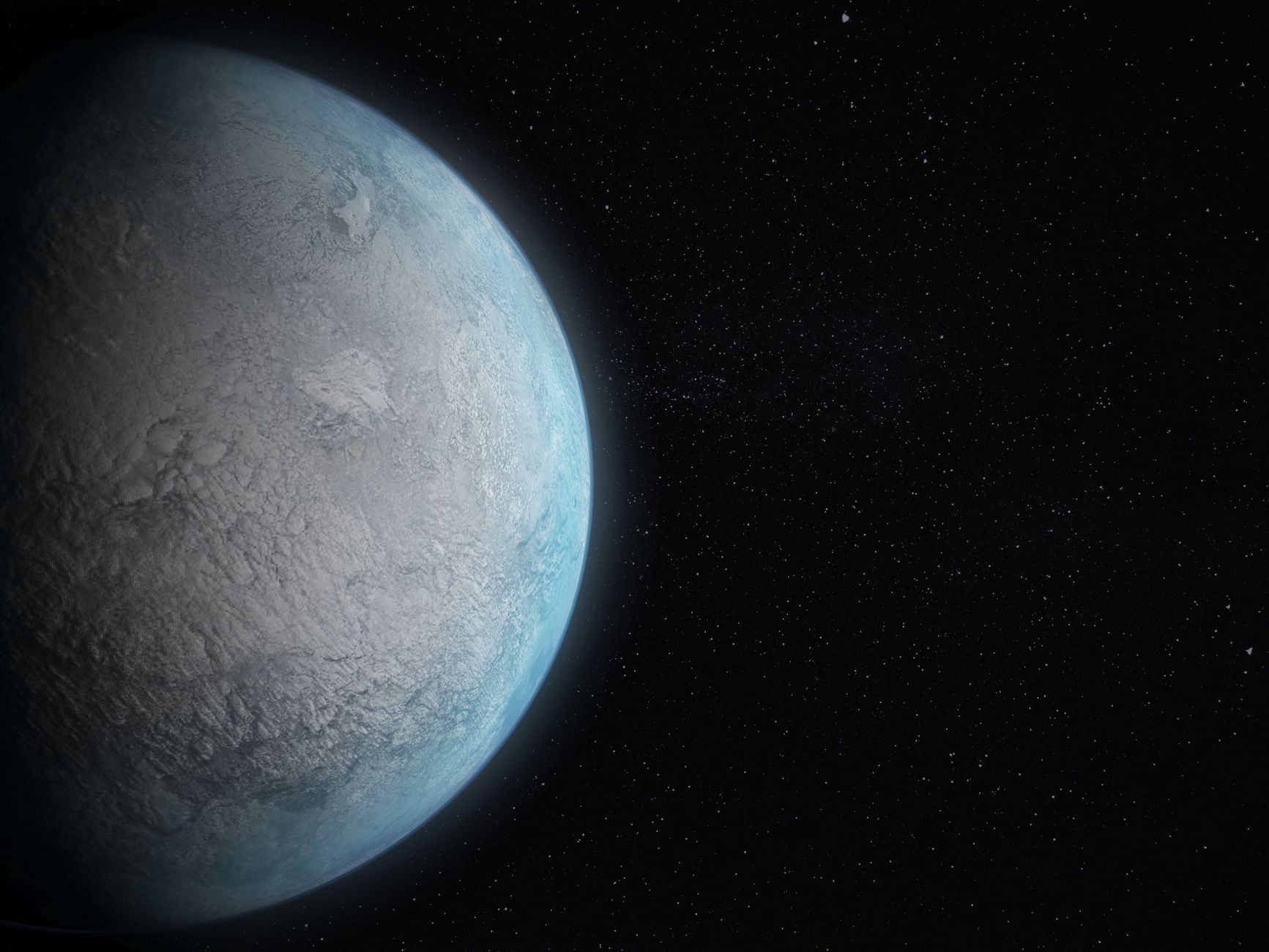
K2-18 b became the most argued-over exoplanet of 2025 because a faint pattern in James Webb Space Telescope data appeared compatible with dimethyl sulphide, or DMS, and dimethyl disulphide, or DMDS. On Earth, DMS in the atmosphere is closely tied to marine microbial activity. The observation was interesting. It was not a detection of life.
K2-18 b lies about 124 light-years away and is much larger than Earth. It has been proposed as a “Hycean” world, with a deep ocean beneath a hydrogen-rich atmosphere, but that interior remains hypothetical. What Webb directly measures is the small change in starlight as the planet passes in front of its red-dwarf star.
The debate that followed was not simply about whether one gas could count as a biosignature. It began one step earlier: whether the spectrum required either gas at all.
What Webb actually measured
In 2023, Nikku Madhusudhan and colleagues reported Webb observations made with NIRISS and NIRSpec. Their paper in The Astrophysical Journal Letters found methane at five-sigma significance and carbon dioxide at three sigma in their analysis of a hydrogen-rich atmosphere. It also described a lower-confidence hint of DMS.
A second paper from the same group appeared in April 2025, using the telescope’s Mid-Infrared Instrument. The spectrum covered wavelengths from about 6 to 12 micrometres. The authors reported that the data preferred DMS and/or DMDS at approximately three-sigma significance. Their paper stressed that more observations were needed, partly because the two gases have overlapping absorption features and could not be separated.
That is evidence generated by comparing atmospheric models. Webb did not collect a sample of alien air. Researchers inferred possible molecules by asking which combinations of gases could reproduce a small set of changes in transit depth.
Three sigma was not evidence of biology
Even if the molecular inference had held, the biological interpretation would have required further work. DMS is produced abundantly by life in Earth’s oceans, but the absence of a familiar non-biological source on one planet does not establish that none exists under the chemistry, pressure and radiation of another.
The point became more concrete in 2025 when an astronomy team reported DMS in an interstellar molecular cloud, providing observational evidence that the molecule can form without biology. A planetary atmosphere is a different environment, so this does not identify the source of any DMS on K2-18 b. It does remove a simple equation between the molecule and life.
The proposed abundance raised another question. The 2025 Webb paper inferred at least ten parts per million of DMS or DMDS, a concentration that would require a production and survival mechanism compatible with the planet’s atmosphere. Confirming a molecule and explaining its source are separate tasks.
Independent analyses changed the picture
Later work concentrated on whether the spectral signal was robust. Stephen Schmidt and colleagues processed the near-infrared observations through multiple reduction pipelines and retrieval codes. Their peer-reviewed paper in The Astronomical Journal confirmed methane at about four sigma, but found no reliable statistical evidence for carbon dioxide or DMS. Their atmospheric and interior models could explain the revised composition as an oxygen-poor mini-Neptune without requiring a liquid-water surface.
A separate team led by Kevin Stevenson reanalysed the mid-infrared data. It found that unresolved instrumental effects and different choices for grouping wavelengths could produce materially different spectra. Using the team’s preferred binning, 87.5 per cent of retrievals did not support DMS or DMDS. The Astronomical Journal paper concluded that the data contained no statistically significant evidence for a biosignature.
Luis Welbanks and colleagues reached a related conclusion in Nature Astronomy. When they expanded the range of molecular combinations tested, numerous alternatives fitted the low-signal data as well as or better than the proposed sulphur gases. Their analysis showed how an apparent detection can depend on which models are compared. A model beating one selected rival does not prove that its molecule is present.
The ocean is part of the uncertainty
K2-18 b orbits within the conventional habitable zone, where temperatures can permit liquid water under suitable conditions. That does not mean it has an accessible ocean. At roughly 2.6 Earth radii and about 8.6 Earth masses, it belongs to a class of planets absent from our Solar System.
Models have variously described it as a temperate ocean world, a gas-rich mini-Neptune, a world with supercritical water deep beneath its atmosphere, or a planet whose atmospheric chemistry is affected by a hot interior. Webb’s transmission spectrum probes the upper atmosphere, not the boundary far below it.
This makes the life question conditional several times over. The gases must be real, the planet must offer a habitable environment, and biology must explain the chemistry better than geological, photochemical or other abiotic processes.
Why the argument still matters
The evidence available in 2026 does not support saying that Webb found life, or even that it securely found DMS or DMDS on K2-18 b. A survey published in Nature Astronomy found that only 6.6 per cent of participating astrobiologists agreed that scientists had probably found extraterrestrial life there.
But the episode was not a scientific failure. Webb produced atmospheric spectra for a temperate sub-Neptune more than one hundred light-years away, and independent teams were able to test how reduction choices, noise and incomplete molecular libraries affected the result.
K2-18 b remains valuable because it exposes the full chain of evidence required for remote life detection. A suggestive spectral feature is the beginning of that chain. It is not the end.