

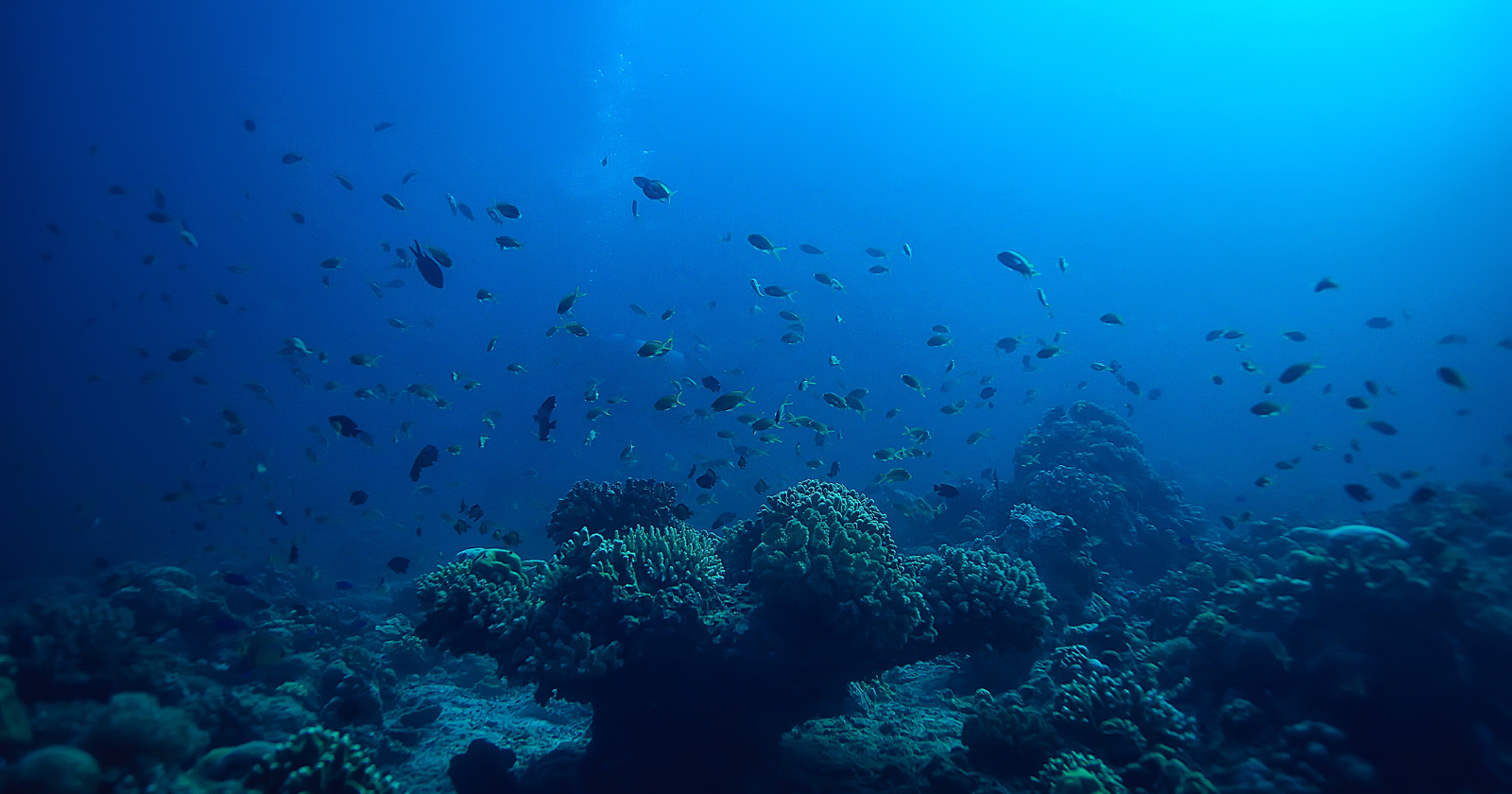
The deep ocean is not silent in the way a dark room is silent. It is full of signals. Many of them are not sound at all.
In the water column below the sunlit surface, living light becomes part of the working language of the sea. NOAA Ocean Exploration says that in the pelagic zone, 80 percent of animals living between 200 and 1,000 metres are bioluminescent. That means they can make light through chemistry inside their bodies, or eject glowing material into the water around them.
That figure changes the mental image of the deep sea. We tend to imagine darkness as emptiness. In much of the ocean, darkness is closer to a screen.
The twilight layer is not fully dark
NOAA defines the deep ocean as beginning around 200 metres, where sunlight starts to dwindle rapidly. Its explanation of ocean light zones notes that minimal light penetrates between 200 and 1,000 metres, while depths below 1,000 metres receive no light from the surface.
The 200-to-1,000 metre band is often called the mesopelagic, or twilight, zone. It is not bright enough for ordinary daylight vision, and photosynthesis largely falls away. But it is not irrelevant to vision. Animals living there often have large, sensitive eyes. Some migrate upward at night. Some hide their silhouettes against faint downwelling light. Others produce their own light.
That last adaptation is the one that makes the ocean feel less like an absence of light and more like a different lighting system altogether.
What bioluminescence is actually doing
Bioluminescence is not a single trick. It is a broad capacity shared across many different marine lineages. NOAA’s National Ocean Service describes it as the production and emission of light by a living organism, driven by energy released from chemical reactions inside or ejected by the organism.
The uses vary. Some animals flash to startle predators. Some release glowing clouds as decoys. Some use light to lure prey closer. Some carry built-in searchlights. Some use counterillumination, matching the faint light from above so their bodies become harder to see from below.
Communication is one of the important uses, but it should be handled carefully. NOAA says the functions are not known for all animals. Still, its National Ocean Service summary says bioluminescence is typically used to warn or evade predators, lure or detect prey, and for communication between members of the same species.
In other words, living light is not decoration. It is behaviour.
The paper behind the scale
The 80 percent figure on NOAA’s public page is consistent with a larger research picture. In a 2017 paper in Scientific Reports, Séverine Martini and Steven H. D. Haddock analysed 17 years of remotely operated vehicle observations off the California coast. The dataset included more than 350,000 observations from the surface down to 3,900 metres, classified by whether the observed animals were capable of bioluminescence.
The result was not a small minority of unusual animals. The paper reported that, after excluding uncertain cases, about 76 percent of observed individuals in the water column had bioluminescent capability. It also found that bioluminescent and likely bioluminescent organisms were dominant across much of the water column, not only in one narrow depth band.
That does not mean every flash is a message, or that every bioluminescent animal is communicating all the time. It means the capacity to make light is so widespread in open-ocean animals that any picture of deep-sea life built around darkness alone is incomplete.
Why blue dominates
Most ocean bioluminescence is blue or blue-green. That is not arbitrary. NOAA notes that blue light travels best through seawater, although bioluminescence can range from near violet to green-yellow, and occasionally red.
The physics matters because communication only works if the signal can move through the medium. Air, forest, desert and seawater each reward different signals. In the mesopelagic ocean, long-range visual signalling is constrained by water itself. Blue light survives best, so blue light becomes useful.
This is one reason the deep ocean can be hard to understand from a human vantage point. We are surface animals. We think of sight as something powered by the sun or by artificial lamps. In the midwater ocean, sight is often powered by bodies.
Not silent, just hard to watch
Part of the reason this world stayed hidden is that studying it can disturb it. NOAA points out that bioluminescent organisms are difficult to observe because bright lights can drive mobile animals away, damage light-sensitive organs, and make transparent or camouflaged animals hard to see even when the scene is illuminated.
That creates a paradox. To see the deep sea, researchers often bring light. But the light they bring can erase or alter the light the animals are using.
Modern deep-sea research has had to work around that problem with low-light cameras, remotely operated vehicles, red illumination in some settings, and patient observation. Even then, the record is incomplete. NOAA’s summary is explicit that much about bioluminescence remains unresolved, including why it is so common in the ocean water column compared with freshwater and land.
The largest conversation we barely notice
The claim that bioluminescence may be the most common form of communication on the planet is an inference, not a completed census of every signal exchanged by every organism. It rests on scale: the ocean is Earth’s largest habitat, the open water column is enormous, and in the dim layer from 200 to 1,000 metres, NOAA says most animals can make their own light.
NOAA’s Ocean Today transcript featuring deep-sea explorer Edie Widder puts the contrast plainly: bioluminescence is rare on land, but in the ocean it is the rule rather than the exception. The same NOAA video describes light being used to find food, attract mates, defend against predators and communicate visually.
That does not make the deep ocean bright in the human sense. Most of the time, most of it is still dark to us. But it means the darkness is inhabited by flashes, pulses, glows and chemical signals tuned to eyes we do not have and distances we rarely imagine.
The deep sea is not a quiet black basement beneath the living planet. It is a vast visual environment where sunlight fades and biological light takes over. In that environment, a flash is not merely light. It can be warning, camouflage, bait, panic, recognition or invitation.
From the surface, the ocean looks blue because of how water handles sunlight. Far below, the more important blue may be made by animals themselves.