
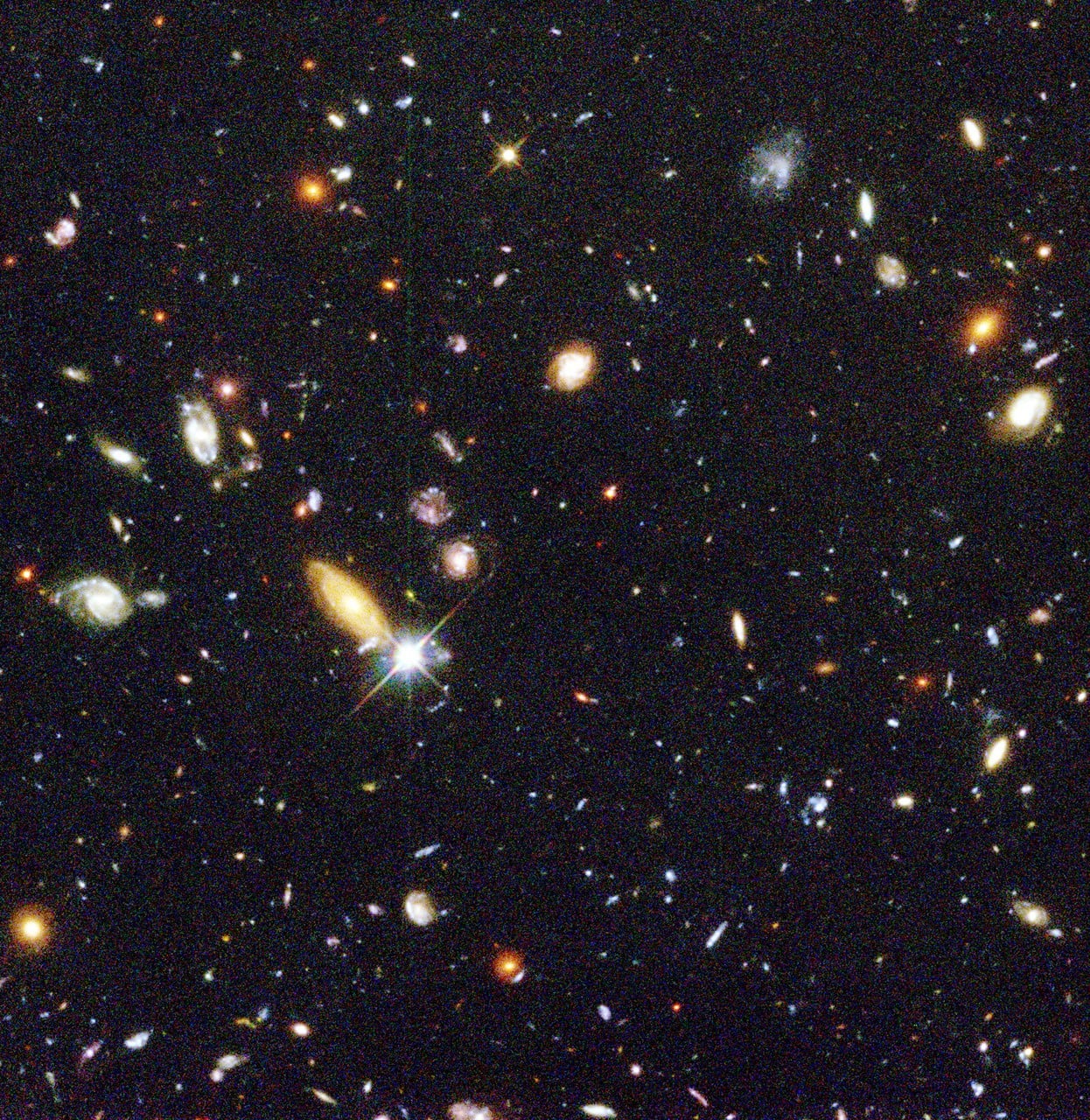
The short answer is: galaxies. Not one or two, and not a scattering of nearby stars, but thousands of galaxies in a piece of sky selected because it looked almost empty.
That is what made the Hubble Deep Field so disorienting. In December 1995, astronomers aimed the Hubble Space Telescope at a tiny patch near the handle of the Big Dipper, kept it there for ten days, and combined hundreds of exposures. NASA’s modern Hubble Deep Fields overview says the result captured roughly 3,000 distant galaxies in different stages of evolution.
The patch had been chosen precisely because it looked unpromising. It was far from the plane of the Milky Way, away from bright foreground stars, away from obvious nearby galaxies and large galaxy clusters. The point was to give Hubble the cleanest possible line of sight into deep space.
What came back was not emptiness. It was a core sample of the universe.
Why stare at nothing?
From the outside, the plan sounded like a misuse of a great telescope. Hubble observing time was precious. Astronomers had planets, nebulae, star clusters, galaxies and exploding stars they wanted to study. Spending days on a blank-looking patch of sky was not an obvious bet.
The decision came from Robert Williams, then director of the Space Telescope Science Institute. He controlled a portion of Hubble time called director’s discretionary time and chose to spend some of it on a long, public deep-field exposure. NASA’s account explains that Williams and his team spent nearly a year preparing, taking test images and choosing a field that would avoid bright objects and remain viewable without interruption from Earth, the Sun or the Moon.
The target was in Ursa Major, near the Big Dipper. NASA’s original 1996 release says the field was like a narrow keyhole view stretching toward the visible horizon of the universe, covering a patch of sky about the width of a dime seen from 75 feet away.
That smallness is the whole point. Hubble was not surveying the sky broadly. It was asking what would appear if one apparently empty pinprick were allowed to collect enough light.
Ten days became 342 exposures
The Hubble Deep Field was not a single photograph in the ordinary sense. Between December 18 and 28, 1995, Hubble’s Wide Field and Planetary Camera 2 took image after image of the same dark patch. The original NASA release says the final Hubble Deep Field was assembled from 342 separate exposures.
With each exposure, more faint light accumulated. Objects too dim to register in a short image began to appear. The method is simple in principle and demanding in practice: keep the telescope stable, keep collecting photons, remove artifacts, combine the data and let the faintest objects emerge from the noise.
ESA’s Hubble Deep Fields explainer describes the first Deep Field North as 342 separate exposures over ten consecutive days, with more than 100 hours of total exposure time. ESA says the resulting image showed almost 3,000 galaxies.
That number is still difficult to hold in the mind. The image did not show 3,000 stars. It showed roughly 3,000 galaxies, each a system that could contain billions of stars of its own.
The empty sky was full of time
The Hubble Deep Field was not only deep in space. It was deep in time.
Light takes time to travel. When we see a distant galaxy, we are seeing it as it was when the light left, not as it is now. The farther away the galaxy, the older the light and the earlier the cosmic scene. A deep image is therefore not like looking across a flat map. It is more like looking down a tunnel made of time.
NASA’s 1996 release described the field as showing galaxies at different stages of evolution, some of them seen when the universe was far younger than it is today. The image gave astronomers a way to study galaxy formation and evolution statistically rather than relying only on a few bright, unusual examples.
The Deep Field also changed the public imagination because it made a statistical idea visible. If a tiny, carefully chosen patch of empty-looking sky contained thousands of galaxies, then emptiness itself had to be rethought. The dark spaces between familiar stars were not simply blank. They were hiding light too faint for ordinary looking.
It was not the end of the story
The 1995 Hubble Deep Field was followed by Hubble Deep Field South, the Hubble Ultra Deep Field, the eXtreme Deep Field and later deep-field programs using Hubble and other observatories. Each pushed the same idea further: long exposure, tiny patch, faint light, earlier universe.
NASA’s page on the Hubble Ultra Deep Field notes that the later 2003-2004 image contained nearly 10,000 galaxies and required 800 exposures over 400 Hubble orbits. The Hubble eXtreme Deep Field went deeper still by combining years of observations from a smaller region.
But the original Hubble Deep Field remains the cleanest version of the question. What happens if you point a telescope at nothing and wait?
You find out that “nothing” was a limit of your exposure time.
To human eyes, that patch of sky was empty. To Hubble, after ten days, it was crowded with galaxies. The answer was not simply that astronomers found more objects. It was that they found a different scale of reality hidden inside a dark-looking square of sky: a universe in which even apparent blankness can be thick with billions of stars.