
At first glance, HD 189733b sounds almost comforting.
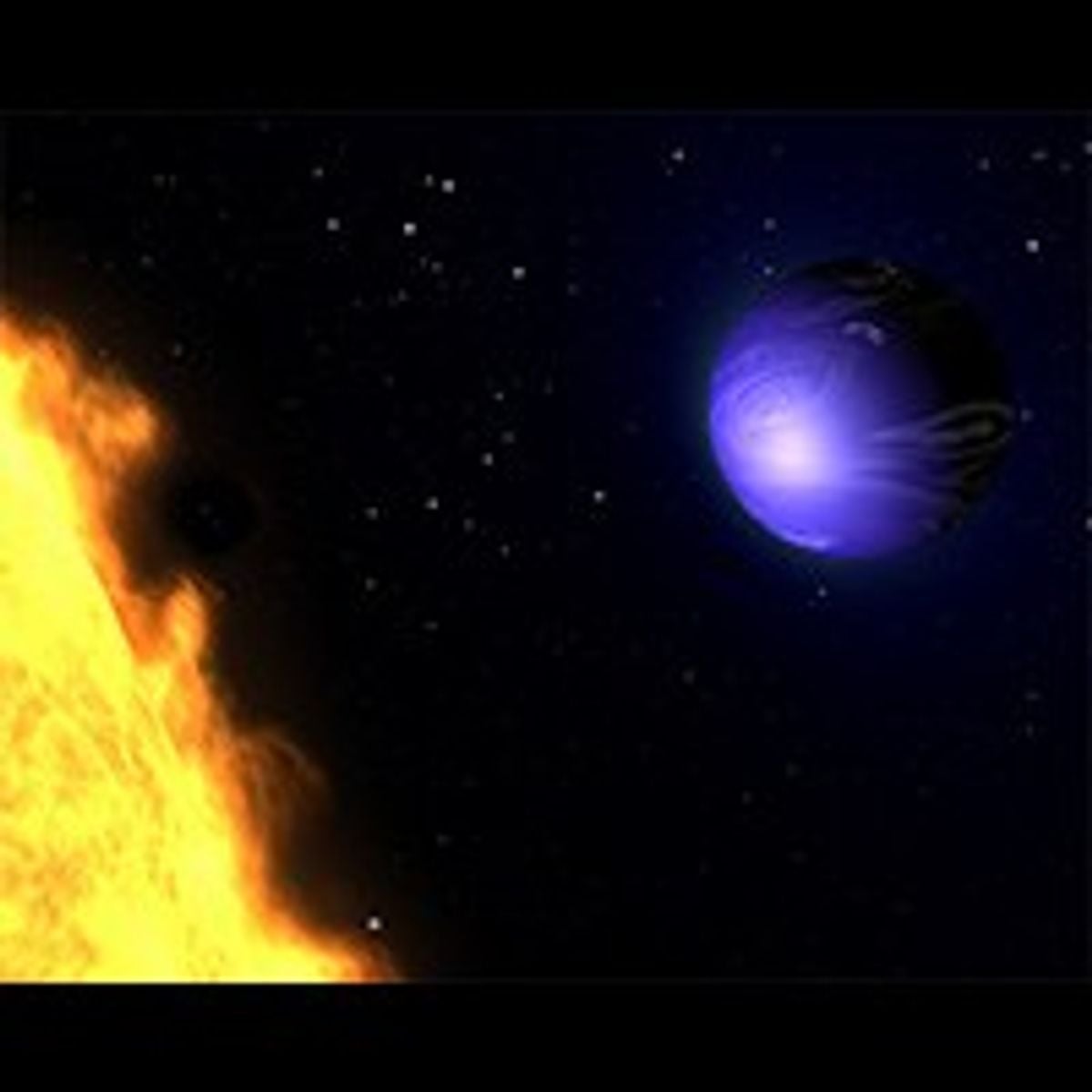
It is blue. Not merely imagined as blue in an artist’s palette, but measured as blue in visible light. Seen from a distance, NASA says, the planet would look like a deep blue dot, faintly reminiscent of Earth as seen from space.
That resemblance ends with the colour.
HD 189733b is not blue because of oceans, cloud-shadowed continents or a breathable sky. It is a gas giant orbiting extremely close to its star, with a dayside atmosphere hot enough to melt silicates and winds powerful enough to carry those particles around the planet. NASA’s 2013 Hubble release put the contrast plainly: the planet orbits 63 light-years away, appears deep blue, and may rain glass sideways in 4,500-mile-per-hour winds.
The planet is a useful antidote to a common visual habit. We see blue and think water. In this case, blue means heat, haze and violent atmospheric chemistry.
How Hubble measured a planet’s colour
HD 189733b belongs to a class known as hot Jupiters: large gas planets orbiting very close to their stars. It was discovered in 2005 and has become one of the most studied exoplanets because it transits, meaning it regularly passes in front of and behind its star from our point of view.
That geometry lets astronomers do something subtle. They cannot take a normal photograph of the planet’s surface. Instead, they measure the combined light from the star and planet, then watch what changes when the planet slips behind the star. The missing light is the planet’s contribution.
Using Hubble’s Space Telescope Imaging Spectrograph, astronomers measured the system before, during and after one of those secondary eclipses. The signal was tiny, but it had a colour signature: when the planet disappeared, the system lost more blue light than red or green. The object being hidden was therefore blue.
NASA’s image page for the Hubble result says the telescope measured the planet’s actual visible-light colour and that the deep blue is not caused by oceans, but by a hot atmosphere in which silicate particles can melt into glass-like droplets that scatter blue light more efficiently than red light.
That is the key distinction. Earth’s colour is bound up with liquid water, atmosphere and sunlight. HD 189733b’s colour is an atmospheric warning sign.
A blue planet that is not Earth-like
The planet orbits only about 2.9 million miles from its star, far closer than Mercury orbits the Sun. It completes an orbit in just 2.2 Earth days and is tidally locked, so one hemisphere constantly faces the star while the other remains in darkness.
NASA’s exoplanet catalog lists HD 189733 b as a gas giant about 1.13 times Jupiter’s radius and 1.13 Jupiter masses. In other words, this is not a rocky world with a surface where weather happens overhead. The weather is the planet’s visible face.
The dayside temperature has been described at roughly 2,000 degrees Fahrenheit, or a little over 1,000 degrees Celsius. At those temperatures, silicate particles high in the atmosphere can behave very differently from dust in Earth’s sky. Silicates can condense into tiny glass-like droplets, and those particles can scatter shorter blue wavelengths of light.
That blue scattering is why the planet can look deceptively familiar. It is not ocean blue. It is furnace blue.
The glass-rain language is vivid, but it should be read in the careful planetary-science sense. No spacecraft has flown through HD 189733b’s atmosphere with a collector plate. The idea comes from the temperatures, atmospheric composition and cloud physics inferred from observations. The planet’s atmosphere appears capable of making silicate condensates: material that, under those conditions, would be more like tiny molten or glassy particles than ordinary raindrops.
The winds may be even faster
The 4,500-mile-per-hour figure attached to the Hubble colour story describes the expected high-altitude flow from the day side toward the night side. That figure already reads less like weather than machinery.
But HD 189733b did not stop there. In 2015, researchers reported a direct measurement of winds on the planet using high-resolution spectroscopy. NASA’s account of the University of Warwick result says astronomers found winds exceeding 5,400 miles per hour moving from the heated dayside toward the nightside.
That later result does not erase the 4,500-mile-per-hour figure in the older Hubble description. It strengthens the broader picture: HD 189733b is a world where atmospheric circulation is extreme enough to move material around the planet at speeds far beyond anything familiar on Earth.
The physics is not hard to sketch. One side of the planet is permanently heated by its star. The other is permanently darker and cooler. That temperature contrast drives fierce winds as the atmosphere tries to redistribute heat. Spitzer observations had already produced one of the first temperature maps of an exoplanet, showing a shifted hot spot and a day-night contrast that implied strong circulation.
On Earth, winds can move dust, sea spray, ash and ice crystals. On HD 189733b, the moving particles may include silicate condensates in an atmosphere hot enough to make the phrase “glass rain” more than a metaphor.
Why this planet mattered
HD 189733b is not important because it might be habitable. It is important because it is observable.
Its star is relatively nearby. The planet transits. Its atmosphere has been examined by Hubble, Spitzer and ground-based instruments. Over time, astronomers have been able to treat it not just as a point in a catalog but as a laboratory for hot-Jupiter weather: colour, temperature, winds, clouds, atmospheric escape and stellar effects.
That is why the blue colour still matters more than a decade after the Hubble result. It was one of the clearest demonstrations that exoplanets are not just masses and orbital periods. They can have observable colours, changing atmospheres and weather systems that force planetary science beyond the examples available in our own solar system.
HD 189733b is only blue in the most dangerous sense. From far away, it borrows one of Earth’s gentlest visual cues. Up close, that colour belongs to a planet where glass may be carried sideways through a scorched atmosphere at thousands of miles per hour.