
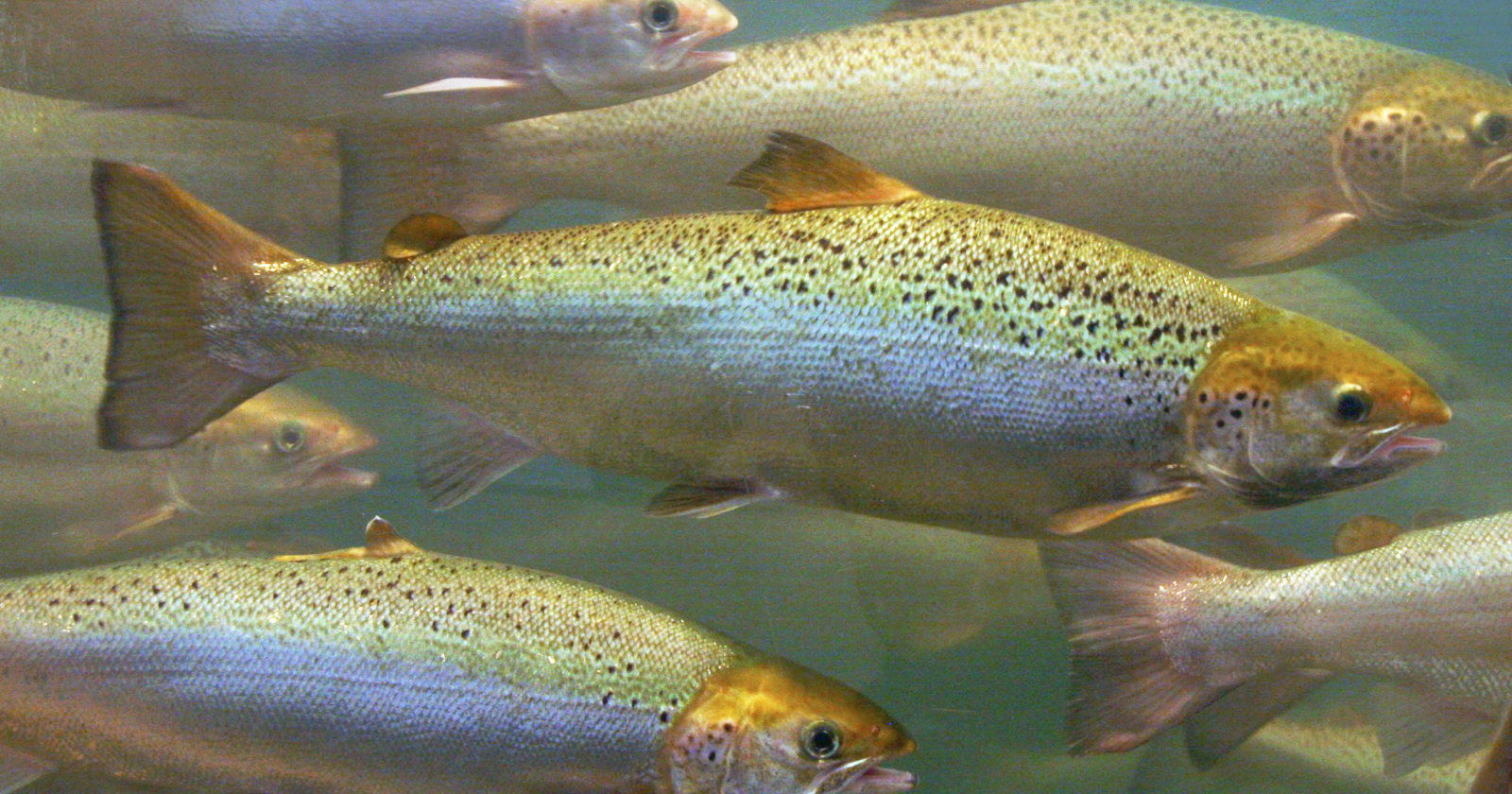
A salmon returning to spawn is usually described as finding the exact stream where it hatched. Closer to the truth, it is reading water. In the last stretch of the trip, the fish matches the chemical signature of the river in front of it against a scent it learned years earlier, as a juvenile, before it had ever reached the sea.
That scent memory is the securely established part of the story. The familiar line about a fish following a map it was never given glosses over something real. It is solving two separate problems at very different scales, and only one of them is settled.
How the scent claim was actually tested
The olfactory hypothesis was put forward by Arthur Hasler and Warren Wisby at the University of Wisconsin in 1951, and first tested in 1954 by a blunt experiment. They plugged the nasal openings of migrating fish and released them below a fork in the stream. Fish that could still smell chose the correct branch. Fish whose sense of smell had been blocked chose more or less at random.
The stronger confirmation came two decades later. In a 1976 study published in Science by Allan Scholz, Ross Horrall, Jon Cooper and Hasler, juvenile coho salmon were exposed for about six weeks to one of two synthetic chemicals, morpholine or phenethyl alcohol, then released into Lake Michigan. Eighteen months later the researchers dosed two separate streams, one with each chemical, and monitored seventeen other sites as well. Most of the fish exposed to morpholine turned up in the morpholine stream, and most of the phenethyl-alcohol fish in the other. They were returning to a chemical they had learned in youth, not to the birthplace itself.
What a wild salmon imprints on is a mixture of dissolved organic material, its exact makeup shaped by the soil and vegetation of each catchment. Every stream carries a slightly different blend, and the fish learns it.
The window that makes it stick
The learning is not open-ended. It concentrates in the parr-smolt transformation, the phase when a juvenile salmon reorganises its body for salt water, and coincides with a surge in the hormone thyroxine. In work gathered in their 1983 monograph, Hasler and Scholz reported that presmolt coho given thyroxine formed lasting odour memories while untreated fish of the same stage did not, which pins the imprinting window to the hormone itself, independent of the fish’s age.
This is why hatchery practice matters for wild stocks. Fish denied the normal sequence of natal water during that window stray more often to the wrong streams as adults, a point drawn out in a 2014 review of homing and straying by Matthew Keefer and Christopher Caudill in Reviews in Fish Biology and Fisheries. Disrupt the imprinting sequence and the homing behaviour degrades measurably.
The part the scent cannot explain
A dissolved chemical cue disperses. It cannot carry hundreds or thousands of kilometres out into open water, which rules it out as the thing steering a sockeye across the Gulf of Alaska toward the right piece of coast.
Smell only takes over near the end.
Geomagnetic imprinting is the leading explanation for the open-ocean leg. A young salmon, on this account, logs the magnetic field where it first enters the sea and, as an adult, seeks the same reading on the way back. Its most cited support is a 2013 paper by Nathan Putman, Kenneth Lohmann and colleagues in Current Biology, which analysed a 56-year fisheries record of Fraser River sockeye. Those fish must detour around Vancouver Island through either a northern or a southern passage. The share of fish taking each route tracked the slow drift of Earth’s magnetic field: the more the field at a passage entrance had diverged from the field at the river mouth, the fewer fish used it.
That pattern is consistent with the hypothesis, and it is a genuine result. It is also correlational, drawn from decades of catch records rather than a controlled test of individual fish, and the team behind it, whose work is collected on the Lohmann Lab site, presents it as support for the idea, not proof of the mechanism. Scent homing rests on repeated field experiments. The magnetic account rests, for now, on a strong statistical pattern in old fisheries data.
Where the neat picture misleads
Two things get lost in the popular telling. The first is that homing is not perfect. A small share of salmon stray to other streams every generation, and that straying does useful work, letting the species reach new habitat and recover ground after a river is disturbed.
Perfect fidelity would be a liability.
The second is the word memory. It is a serviceable shorthand, but the fish is not recalling its birthplace the way a person recalls a childhood home. During a hormonally defined window it learned a chemical profile, and years later it moves toward water that matches it. No stored image, no planned route: a learned preference meets the right cue at the right moment.
The open questions are specific. Nobody has fully pinned down the chemical makeup of a natal-water bouquet in wild populations. How the magnetic and olfactory systems hand off to each other along the migration remains unclear. And whether the geomagnetic signal found in Fraser River sockeye holds as firmly in other species and on other coastlines is a question only more datasets will settle.
