

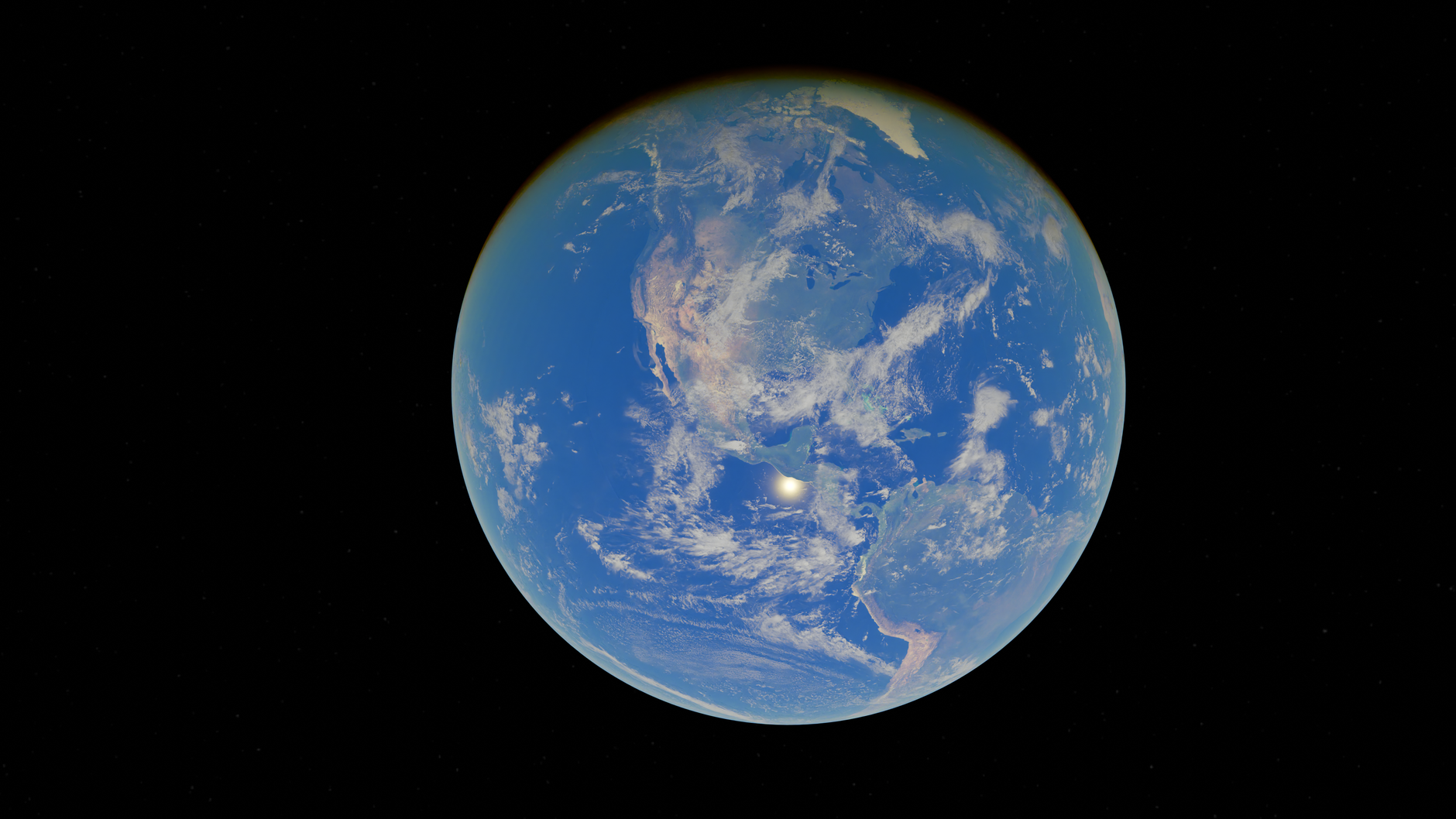
A day is short enough to feel. That is why it is such a useful trick for thinking about Earth.
Take the planet’s roughly 4.5-billion-year history and compress it into 24 hours. Midnight is Earth’s formation. The next midnight is now. Suddenly, deep time stops being a number too large to hold and becomes a clock with familiar hands.
On that clock, almost everything human beings think of as history happens so late that it barely appears. The rocks, oceans, microbes, forests, dinosaurs and mammals take almost the entire day. We arrive at the end.
The U.S. Geological Survey describes Earth as 4.5 billion years old or more, a span so large that geologists often need metaphors just to make it imaginable. Compressing that span into one day gives each second a value of about 52,000 real years. One minute becomes about 3.1 million years. One hour becomes about 187.5 million years.
Once the scale is set, the shock is immediate.
Life Before Breakfast
Earth forms at midnight. For hours, the young planet is not a friendly place: hot, battered, volcanically active and still settling into the world that will eventually grow oceans and crust stable enough to preserve a record.
Then life appears astonishingly early.
The Smithsonian National Museum of Natural History says the earliest life forms currently known were microscopic organisms that left signals in rocks about 3.7 billion years old. On the one-day clock, that puts life at about 4:16 in the morning.
If you use the older-fossil benchmark of around 3.5 billion years, life still appears by roughly 5:20 a.m. Either way, biology is not a late guest on Earth. It is there before breakfast, long before animals, long before plants, long before anything with eyes can look back at the sky.
That early life is not dramatic in the way a dinosaur is dramatic. It is microbial. For most of Earth’s day, life is small, chemical, oceanic and patient. It changes the planet not by spectacle, but by persistence.
Oxygen does not dominate the air at first. Complex animals do not appear for billions of years. Continents shift. Oceans change. The planet freezes, thaws, erupts and rearranges itself. The clock keeps moving, and for hour after hour, Earth belongs mostly to organisms too small to see.
The Long Empty Afternoon
The hardest part of deep time is not that events are ancient. It is that the gaps between them are enormous.
On the one-day Earth clock, the first clear signs of life arrive in the early morning, but the familiar living world does not rush in after them. Animals, forests, insects, reptiles, birds and mammals are all late developments. Multicellular complexity takes most of the day to build.
The National Park Service uses a similar idea when it explains geologic time, noting that with all geologic time stretched across a human body or a small model, the familiar human world occupies only the smallest final part of the scale. Its geologic time overview makes the same point: Earth is old enough that ordinary units fail us.
This is why the one-day clock is useful. It stops the story from becoming a list of dates and turns it into a feeling. Morning life. Long microbial afternoon. Animals late. Humans at the final breath.
By the time the first complex animals become common, the day is already far advanced. By the time forests and large animals appear on land, most of Earth’s clock has already run. The planet has spent far more time without trees than with them, far more time without animals than with them, and far more time without humans than with any trace of us.
Dinosaurs Near Eleven
Dinosaurs feel ancient because, by human standards, they are. Tyrannosaurus rex is farther from us than any civilization, any ice age, any cave painting, any human ancestor we can picture easily.
But on Earth’s full clock, dinosaurs are late-night arrivals.
The Natural History Museum in London describes early definitive dinosaurs in the fossil record at around 230 million years ago. On a 24-hour Earth clock, that is about 10:46 p.m. If you use broader estimates that put the first dinosaurs closer to 245 million years ago, they arrive at about 10:42 p.m. Either way, the dinosaurs appear near eleven at night.
They do not vanish twenty literal clock-minutes after arrival if the standard 230-million-year date is used. Their reign lasts roughly 165 million years, which is about 53 minutes on this scale. What happens twenty minutes before midnight is their catastrophic ending. The U.S. Geological Survey says dinosaurs went extinct about 65 million years ago, after living on Earth for about 165 million years. On the one-day clock, that extinction falls at about 11:39 p.m.
That correction makes the picture stronger, not weaker. Dinosaurs dominate terrestrial ecosystems for a span that seems immense from our perspective, yet on Earth’s clock their entire age fits into the last hour and a bit of the day.
They arrive near eleven. The asteroid age ends around 11:39. The remaining 21 minutes contain the rise of many modern mammal groups, the cooling and reshaping of the planet, the spread of grasslands, the evolution of hominins, and eventually us.
The Final Seconds
The human part of the story depends on what you mean by “human history.”
If you mean our species, Homo sapiens, the Smithsonian Human Origins Program says we have lived from about 300,000 years ago to the present. On the one-day clock, that places Homo sapiens at about 11:59:54 p.m., less than six seconds before midnight.
If you mean recorded history, cities, writing, states, empires, books and dated events, the window becomes even thinner. Five thousand years is less than one-tenth of a second on a 4.5-billion-year day. Agriculture, at roughly 10,000 years old, fits inside the final quarter-second.
So the statement that all of human history fits in the final two seconds is, if anything, generous for written history and civilization. Two seconds on this scale represents about 104,000 real years. It is enough to include much of the late story of behaviourally modern humans, but not the full 300,000-year span of Homo sapiens as a species.
That distinction matters because deep-time metaphors are powerful but slippery. They can make the past vivid, but only if we remember what is being compressed. “Human history” can mean the fossil history of our species, the archaeological history of our behaviour, or the written history of civilizations. On Earth’s clock, all of them are late. They are just late by different numbers of seconds.
The Shock Of Scale
The one-day Earth clock is not a perfect scientific instrument. It rounds dates that are themselves estimates. The origin of life is debated. The first dinosaurs are not tied to a single clean fossil moment. Human categories blur between species, behaviour, culture and writing.
But the central lesson survives every reasonable adjustment.
Earth is not a human stage with a long prelude. It is a 4.5-billion-year planet on which humans are a final-second phenomenon. Life is ancient. Microbes are ancient. Dinosaurs are late. We are almost impossibly recent.
That perspective can feel humbling, but it is also clarifying. The modern world, with its satellites, cities, farms, languages and histories, is not the main body of the day. It is the flicker at the end.
Compress Earth into 24 hours and the planet becomes a lesson in proportion. Life wakes early. Dinosaurs stride in near the end. Human beings arrive with the clock already touching midnight.
Everything we have written, built, remembered and argued over belongs to the final seconds of a day that had already been running for almost all of time.