
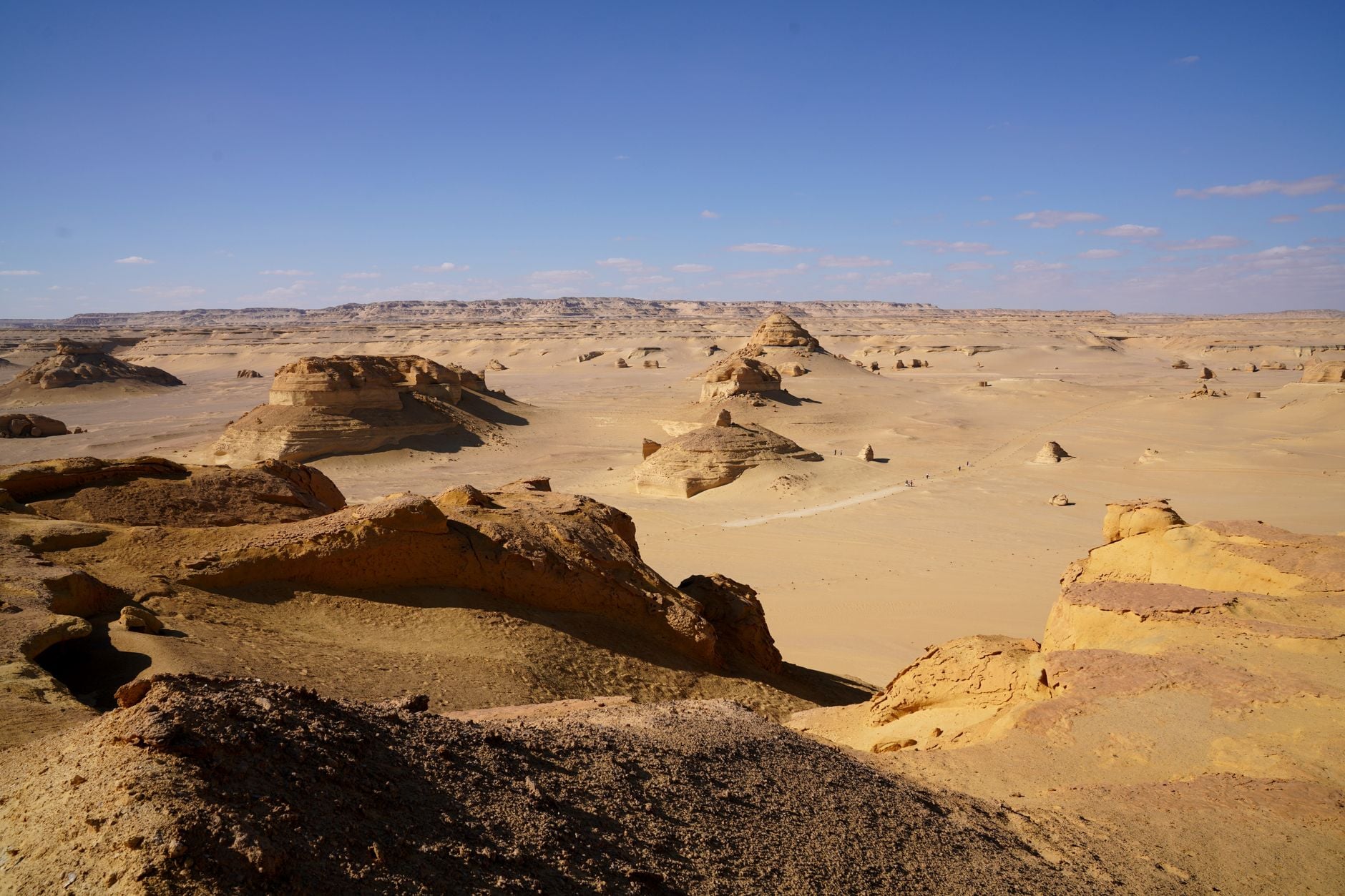
The 2020 field season in Egypt’s Fayum Depression was almost over when palaeontologist Bilal Salem saw teeth projecting from the desert floor. The fossil beneath them was upside down. As the surrounding rock was carefully removed, the teeth became part of an exceptionally complete, three-dimensionally preserved skull belonging to a predator that had lived about 30 million years ago.
The animal is now known as Bastetodon syrtos. In a paper published in the Journal of Vertebrate Paleontology, Shorouq Al-Ashqar and colleagues described it as a newly recognised genus of hyaenodont, one of a group of meat-eating mammals that occupied predatory roles long before cats, dogs and hyenas became familiar parts of the world’s fauna.
This is one study, not settled consensus. The anatomy leaves little doubt that Bastetodon was a highly specialised meat-eater, but its place at the top of the local food web is an inference drawn from its size, teeth and the other animals found in rocks of the same age. “Apex predator” describes its probable ecological role. It is not a behaviour that can be observed directly in a fossil.
The teeth appeared as the expedition was ending
Field discoveries are usually the result of methodical surveying rather than a single cinematic moment. This one still had such a moment. According to Nature Africa’s account of the expedition, the team was preparing to wrap up when Salem noticed the exposed teeth. The cranium was buried upside down, its dental row visible while most of the specimen remained concealed.
What emerged was far more informative than an isolated tooth or jaw fragment. The specimen retained most of the cranium, including the broad, short snout, the upper teeth and the bony structures associated with powerful jaw muscles. It had also kept its three-dimensional shape instead of being flattened by the sediment above it. Researchers could therefore compare the overall construction of the head, rather than relying on a few separated features.
It was neither a cat nor a hyena
Bastetodon was about the mass of a small leopard or striped hyena. The study’s estimate is roughly 27 kilograms, although estimates derived from fossils carry uncertainty. Its short face can look cat-like, and the hyaenodont name invites comparison with hyenas. Neither comparison is a family identification.
Hyaenodonts belonged to an entirely extinct radiation of mammals. They ranged across Africa, Asia, Europe and North America and occupied meat-eating niches for tens of millions of years. Some were modest predators; others grew much larger. They were not members of Carnivora, the living order that includes cats, dogs, bears, seals, mongooses and hyenas, and they left no living descendants.
A bite suited to flesh, not a preserved hunting film
The skull supports the description of Bastetodon as a hypercarnivore, an animal whose diet was dominated by meat. Its cheek teeth formed cutting edges, while its short, broad face and substantial muscle attachments indicate that the jaws could close with considerable force. This was equipment for slicing flesh and other soft tissue.
It does not follow that the animal used its jaws exactly as a living hyena does. The teeth were not principally built for crushing large bones. Nor does the cranium tell us whether Bastetodon ambushed its prey, pursued it, hunted alone or scavenged whenever an opportunity appeared. The site yielded no associated limb skeleton from which researchers could reconstruct its locomotion.
National Geographic’s reporting on the fossil sought an assessment from palaeontologist Lars Werdelin of the Swedish Museum of Natural History, who was not involved in the study. He considered the case for a distinct genus convincing. The report also set out a cautious ecological picture: an animal capable of hunting smaller mammals and taking soft tissue from larger carcasses, without pretending that a specific hunting technique had been recovered with the skull.
Today’s desert held forests and wetlands
The modern setting can make the ancient ecosystem easy to misread. Egypt’s Fayum Depression is now arid, but around 30 million years ago the region supported warm forests and wetlands. Early primates lived there alongside early proboscideans from the broader lineage that includes elephants, and semiaquatic mammals related to the line that produced hippos.
Within that community, a leopard-sized hypercarnivore would have encountered many potential sources of food. Smaller mammals were plausible prey, as were young or vulnerable individuals of larger species. A carcass would also have been valuable. The authors place Bastetodon among the leading predators in this ecosystem, but no prey specimen bearing a diagnostic Bastetodon bite has been identified. The menu remains reconstructed rather than witnessed.
A new name built from an old skull lineage
Fossils associated with this species had previously been assigned to Pterodon, a name also applied to hyaenodont material elsewhere. The new skull supplied enough anatomy for Al-Ashqar and her co-authors to argue that the Egyptian animal belonged in its own genus. They chose Bastetodon, referring to Bastet, the ancient Egyptian goddess commonly represented with a cat’s head, and a suffix derived from the Greek word for tooth.
The name acknowledges the head’s feline appearance without claiming feline ancestry. It also reflects what made the discovery possible: teeth visible at the surface led to the skull, and the teeth helped distinguish the animal once it reached the laboratory.
The end of the hyaenodonts was probably not simple
Hyaenodonts eventually vanished. An older account cast their disappearance as a straightforward defeat by modern carnivorans arriving from elsewhere. The timing across continents and lineages is too uneven for that to serve as a universal explanation. In some places the groups overlapped, while hyaenodont decline also unfolded amid climatic cooling, changing vegetation and turnover among prey animals.
What a skull can and cannot recover
The end-of-expedition timing makes this fossil memorable, but the scientific value lies in the amount of anatomy preserved behind those first exposed teeth. From the skull, palaeontologists can recognise a distinct animal, reconstruct its cutting bite and place it among the large meat-eaters of an ancient African forest.
They cannot recover a complete life history. Its gait, social behaviour, preferred prey and method of attack remain open questions. Calling it an apex predator is a concise ecological interpretation, not an invitation to turn a few bones into a nature documentary.
Even with those limits, the specimen changes the resolution of the picture. A desert surface that was nearly left behind at the end of a field season had preserved the head of an animal from a wetter Egypt, when an extinct branch of mammals held one of the most powerful positions in the landscape.
