

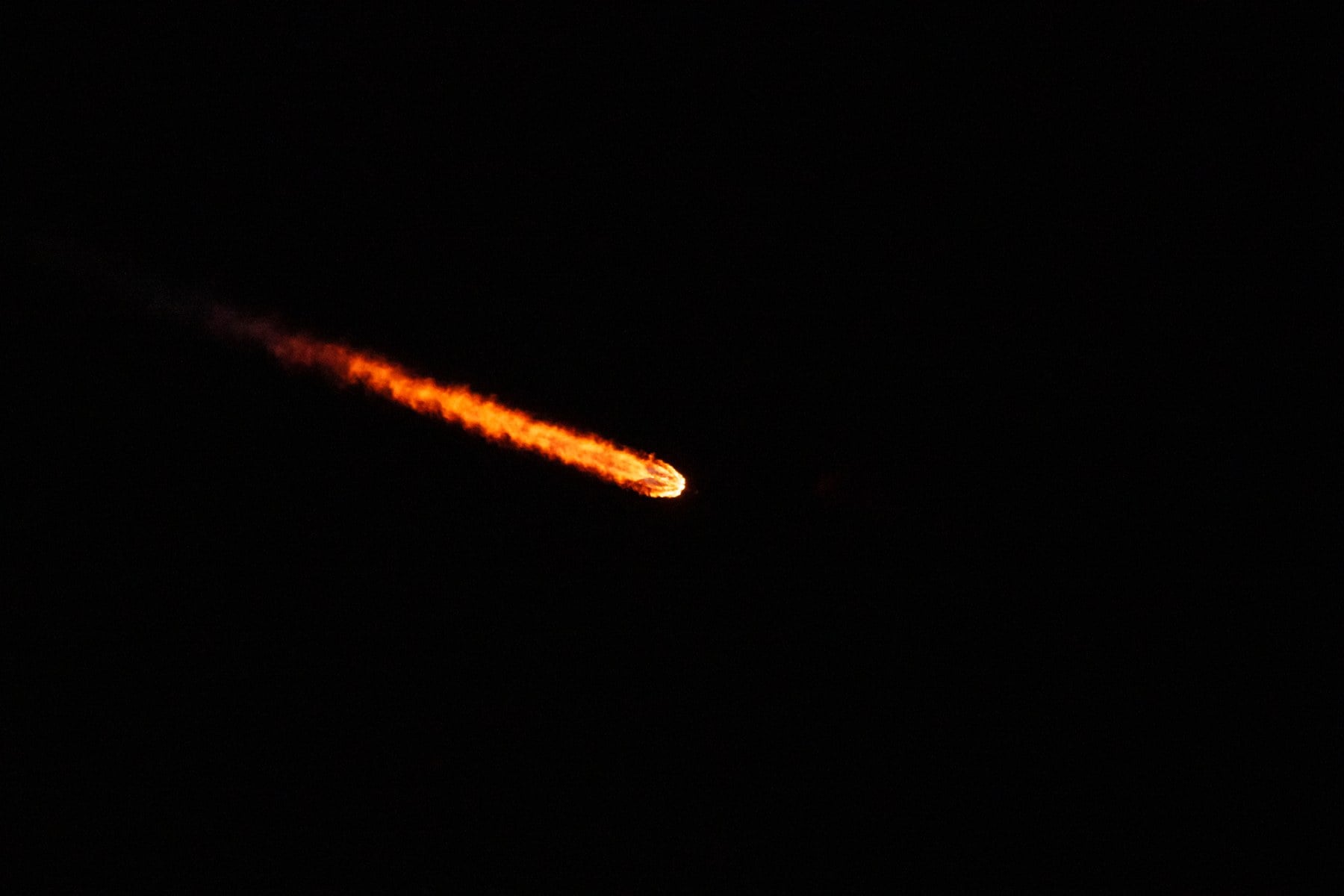
The old image of a reusable rocket is still a test article: stainless steel, scorch marks, crowds watching for the landing, engineers waiting to see whether the thing survives.
Falcon 9 has moved past that stage.
In 2025, SpaceX’s workhorse rocket flew so often that its reusability became almost easy to miss. The company launched 165 orbital missions with Falcon 9, according to Space.com reporting based on SpaceX’s year-end records. Spread across a 365-day year, that is one Falcon 9 flight every 2.21 days.
Even more important, the rocket did not merely leave pads at record speed. Each flight delivered its payload. Jalopnik’s launch-year review put the operational point bluntly: all 165 Falcon 9 launches successfully delivered their payloads, while only one booster recovery attempt failed outright.
That distinction matters. Reusability used to sound like the hard part. In 2025, payload delivery had become the baseline, and the question was whether the returning booster would make the fleet even more efficient.
Partly Reusable, Fully Routine
Falcon 9 is not fully reusable. Its second stage is still expended after delivering the payload to orbit. But its first stage, the most expensive and most dramatic part of the vehicle, is designed to fly back, land and be used again. SpaceX also recovers and reuses payload fairing halves on many missions.
SpaceX describes Falcon 9 as the world’s first orbital-class reusable rocket, designed to carry people and payloads into Earth orbit and beyond. NASA’s Launch Services Program uses similar language, noting that Falcon 9 is a reusable, two-stage rocket and that reusability lets SpaceX refly the most expensive parts of the vehicle.
The important word is “refly.” A single booster is no longer a one-use machine. It becomes a vehicle with a flight history, maintenance cycle and operational life. In 2025, that is what Falcon 9 looked like in practice: a production fleet, not a series of experiments.
A SpaceX disclosure filed with the U.S. Securities and Exchange Commission said Falcon 9 had completed about 620 orbital launches by 31 March 2026, with an overall mission success rate above 99 per cent. It also said that 157 of the 165 Falcon 9 rockets launched in 2025 used flight-proven boosters. That means almost every Falcon 9 mission that year rode on a first stage that had already flown before.
That is the quiet revolution. Reused hardware was not the exception. New boosters were.
The Cadence Changes the Meaning
A rocket launch once carried the feeling of a rare national event. Even routine missions were separated by long stretches of preparation, inspection and schedule uncertainty. Falcon 9 did not eliminate any of the underlying difficulty. It changed the cadence enough that the difficulty became operational.
One launch every 2.2 days is not a stunt. A stunt can happen once. This was a year-long tempo sustained across Florida and California launch sites, across Starlink deployments, commercial missions, national security payloads and crewed Dragon flights.
The launch count was heavily shaped by Starlink. Space.com reported that 123 of SpaceX’s 165 Falcon 9 launches in 2025 were Starlink missions. That matters because it explains both the scale and the business logic. SpaceX was not just selling launches. It was using its own rocket to build its own satellite network, then using the demand from that network to justify flying the rocket again and again.
That vertical loop is one reason no other company has matched the tempo. A reusable rocket becomes most powerful when paired with something that needs constant launch capacity. Starlink provided the demand; Falcon 9 provided the ride; reuse kept the machine turning.
This is also why the number can mislead if read too casually. Falcon 9 did not prove that the entire launch market had become airline-like. It proved that one company, with one reusable rocket family and one enormous internal satellite constellation, could make orbital launch behave more like infrastructure.
Payload Success and Booster Risk
The public often treats a rocket mission as one event: launch, orbit, landing. In Falcon 9’s reusable era, those pieces need to be separated.
The primary mission is payload delivery. If the satellite, cargo craft or crewed spacecraft reaches its intended trajectory, the launch mission has done its essential job. The booster landing is valuable, but it is secondary. A booster can fail to return and the customer payload can still be delivered successfully.
That is exactly why 2025 was so revealing. Not every booster came back. Space.com noted that Falcon 9 boosters returned safely on all but three missions that year, including two intentionally expended high-energy flights and one landing failure after a Starlink launch. But the payload record stayed intact.
That is the operational maturity of partial reuse. SpaceX can choose to expend a booster when mission performance requires it. It can lose a recovery and still count the payload delivery as a success. The reusable system adds economic value without making every customer dependent on the landing.
For engineers, that separation is crucial. Reuse has to reduce cost and increase availability without compromising the payload. Falcon 9’s 2025 record suggests that, at least for this vehicle and this launch architecture, the balance has become routine.
Why This Still Feels Strange
The idea of a reusable orbital rocket was not obviously practical when SpaceX began pursuing it. Early booster landing attempts failed in spectacular ways. Ocean platforms exploded. Rockets tipped over. Landing legs crushed. The whole project looked, for years, like a public test programme strapped to commercial launches.
That memory lingers. It is why many people still think of reusable rockets as experimental, even while Falcon 9 boosters have become the default ride for much of the orbital economy.
The numbers now tell a different story. In 2025, Falcon 9 flew more often than any rocket in history, did so almost entirely with reused first stages, and delivered payloads successfully on every mission. Reuse was not a future promise. It was the operating model.
The shift is easiest to miss because it did not arrive as a single dramatic moment. There was no day when reusable rockets suddenly became normal. The system simply kept flying, landing, refurbishing and flying again until the extraordinary became the schedule.
The Next Question
Falcon 9 is not the endpoint. SpaceX is trying to move beyond partial reuse with Starship, a fully reusable system designed to recover both booster and ship. Other countries and companies are developing reusable launch vehicles of their own. The technical and economic lessons of Falcon 9 are now spreading through the industry.
But Falcon 9 remains the proof that matters because it has already done the dull part. It has made reuse boring enough to count by annual flight rate, booster history and payload delivery.
That is why 165 missions in 2025 is more than a launch statistic. It is evidence that reusable rocketry has crossed from demonstration into infrastructure. The rocket still burns like a rocket, shakes like a rocket and risks failure like a rocket. But it is no longer treated like a miracle every time it flies.
A Falcon 9 leaving the pad every 2.2 days is what experimental success looks like after it stops looking experimental.