

In 1953, Henry Molaison underwent a bilateral operation that removed portions of his medial temporal lobes and profoundly impaired his ability to form new long-term declarative memories. Yet across repeated mirror-drawing trials, he improved at tracing a star while seeing his hand only in reflection, even though he did not remember doing the task before. A later postmortem study of Molaison’s brain showed that significant posterior hippocampal tissue remained, making the familiar shorthand that his hippocampus had simply been removed inaccurate.
The skill was improving. The episode of learning it was not being stored in the usual way. Molaison’s case helped establish that memory is not one system: motor-skill learning can survive severe damage to the medial temporal memory network because it also relies on circuits elsewhere in the brain.
The basal ganglia are part of that wider machinery. These nuclei, buried beneath the cortex, help select actions, learn repeated sequences and push familiar behaviour towards automatic control. They do not work alone, but they are central to the way a route, a serve or a morning routine can demand less conscious supervision with practice.
The walnut under the dashboard
The basal ganglia are not one thing. They are a linked set of deep nuclei wired into loops that exchange information with the cortex and other brain regions. Research on basal ganglia circuitry describes parallel networks involved in movement, working memory, decision-making and inhibitory control.
Think of the cortex as a room full of people proposing actions. The basal ganglia help decide which proposal gets the microphone and which competing responses stay quiet.
When a behaviour is new — a commute, a phone passcode, a tennis serve — conscious attention carries more of the load. You narrate each step. Turn left at the bakery. Index finger on the 7. Toss the ball a little higher. Across repetitions, striatal circuits learn which actions tend to follow particular cues and which sequences reliably reach the desired outcome.
With practice, less has to be narrated step by step.
Chunking: the compression trick
Recordings from the striatum of rats learning T-maze tasks revealed one of the defining patterns in habit research. Early in training, neural activity was spread across the run. With practice, prominent bursts emerged around the beginning and end of the sequence. Researchers describe this task-bracketing pattern as part of the way repeated actions become organised into larger units.
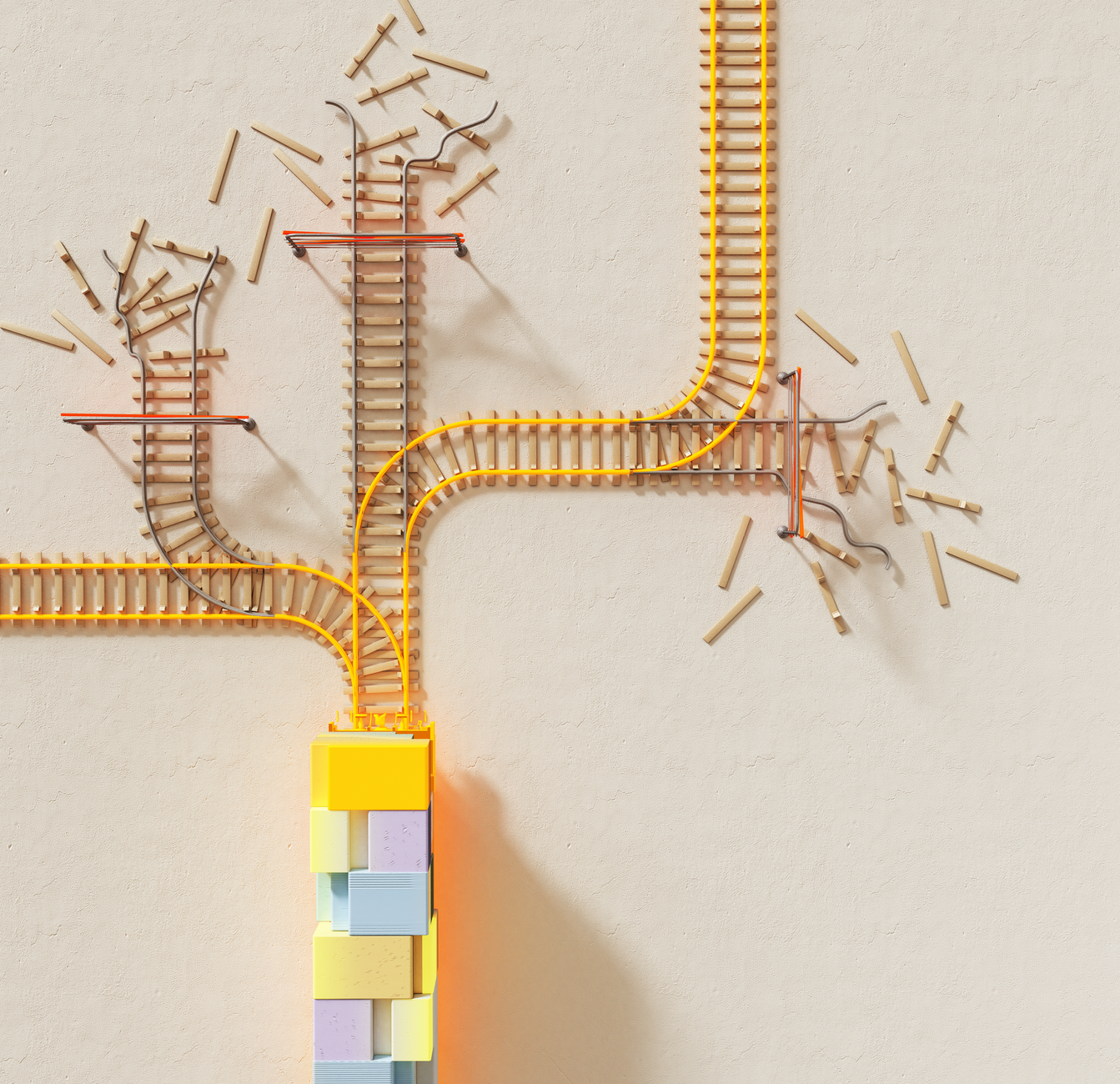
The technical name often used for that organisation is chunking. The brain can group a string of familiar actions — leave the driveway, right at the school, left at the light, park in the third row — so that one cue can set a well-practised sequence in motion.
This helps explain why a familiar route can require far less deliberate thought than a new one. It does not mean the cortex switches off or that the basal ganglia literally drive the car. Safe driving still depends on attention, perception and a distributed network that can interrupt the routine when conditions change.
Memory systems, working in parallel
Molaison’s mirror-drawing performance helped reveal multiple interacting forms of memory. Declarative memory — facts and events that can be consciously recalled — depends heavily on the hippocampus and neighbouring medial temporal structures. Procedural learning draws on a broader network that includes the basal ganglia, cerebellum and motor regions of the cortex.
The split between implicit and explicit memory is useful, provided it is not treated as a pair of sealed boxes. Implicit memory supports skills and habits that can be expressed without deliberate recollection; explicit memory supports facts and episodes that can be described. The systems can be affected differently, which is why Molaison could improve at a motor task while insisting each session was new.
Procedural skills can also prove unusually durable, but they are not indestructible and they do not live in one structure. Disease, injury and ageing can affect different parts of the network in different ways. The safer conclusion is that knowing how to perform a practised action and remembering the episode in which it was learned are separable achievements.

The city-map problem
Consider what happens after moving to a new city. At first, you carry the map in your pocket. You stop at corners, count blocks and rehearse the route. Flexible spatial planning leans heavily on the hippocampus, working memory and cortical systems that can compare alternatives.
After enough repetition, familiar landmarks begin to cue familiar turns. The journey can be followed with less deliberation because practised responses have become easier to retrieve.
Research on human navigation links cognitive-map strategies to the hippocampal system and well-learned, response-based routes to the caudate, part of the striatum. But the map does not literally migrate from one structure to another. Familiar navigation can still recruit both systems, especially when a route changes, overlaps with another or demands a detour.
That division of labour can make an old route feel available before every turn can be put into words. It is a difference between performing a practised sequence and describing it, not evidence that the whole journey has been stored as a single wordless file.
Why habits outlast intentions
The frustrating corollary is that once a response has been practised in a stable setting, a fresh intention may not be enough to stop it. The cortex can decide, at 11pm on Sunday, that the phone will stay untouched on Monday morning. Then the familiar cue arrives — waking, reaching towards the nightstand — and the old response is already easy to launch.
Procedural memory includes skills and habits that become more automatic with repetition. That durability is useful when the skill is swimming or typing. It is less welcome when years of practice have made an unwanted response the path of least resistance.
The old pattern is not a single trace sitting only in the striatum, and it does not dissolve because a resolution has been written down. Changing the cue, altering the environment and repeatedly practising a competing response can make a different sequence easier to retrieve. New learning often has to outcompete the old routine rather than erase it overnight.
Under stress, the practised response gains ground
Police firearms instructors have long been concerned with what survives when attention narrows. Analysis of habit formation and firearms training argues that automatic skills can become the default under pressure as prefrontal control becomes less effective and habitual systems exert more influence.
That is not the same as saying the cortex goes offline. People can still perceive, decide and adapt under stress, but flexible control may be degraded. The quality of repetition therefore matters: a clean movement and a hidden shortcut can both become easier to reproduce when there is little spare attention.
The lesson runs in both directions. A carelessly rehearsed routine can surface at the worst moment. A well-built one can preserve useful action when deliberate thought is slow or overloaded.
Building a chunk from scratch
Habit formation is not a switch that installs a routine in one brain structure. Repetition in a stable context is the more defensible starting point. Key steps to habit formation include a clear cue, a behaviour small enough to repeat consistently, fewer practical obstacles and an outcome that makes repetition feel worthwhile.
The old claim that a habit takes 21 days is not supported by modern evidence. The much-repeated figure of 66 days came from the median in one influential study, not a universal biological deadline. A 2024 systematic review of habit-formation studies found median estimates of roughly 59 to 66 days in the studies that reported them, alongside far wider variation between behaviours and people. In the original study behind the 66-day figure, the range was 18 to 254 days.
Across those repetitions, cue-response associations become more efficient across distributed circuits. Conscious narration can recede as the sequence becomes easier to retrieve. One day, the clearest sign of change is mild surprise: the action happened with less negotiation than it used to require.
The ghost in the machine
A person who learned to ride a bicycle years ago may regain the feel of it quickly, but no single cluster of neurons contains every exact adjustment. Balance and skilled movement emerge from a network involving the basal ganglia, cerebellum, motor cortex, sensory systems and spinal circuits. What persists is a distributed capacity, not a tiny recording hidden in one anatomical drawer.
Molaison died in 2008. During an uninterrupted postmortem procedure, researchers collected 2,401 digital anatomical images and selected corresponding tissue sections, then used the images to build a three-dimensional reconstruction of his brain. The result showed extensive medial temporal damage but also a significant amount of residual hippocampal tissue. His preserved mirror-drawing learning remains powerful evidence for multiple memory systems — not proof that one intact structure, acting alone, held the skill.