
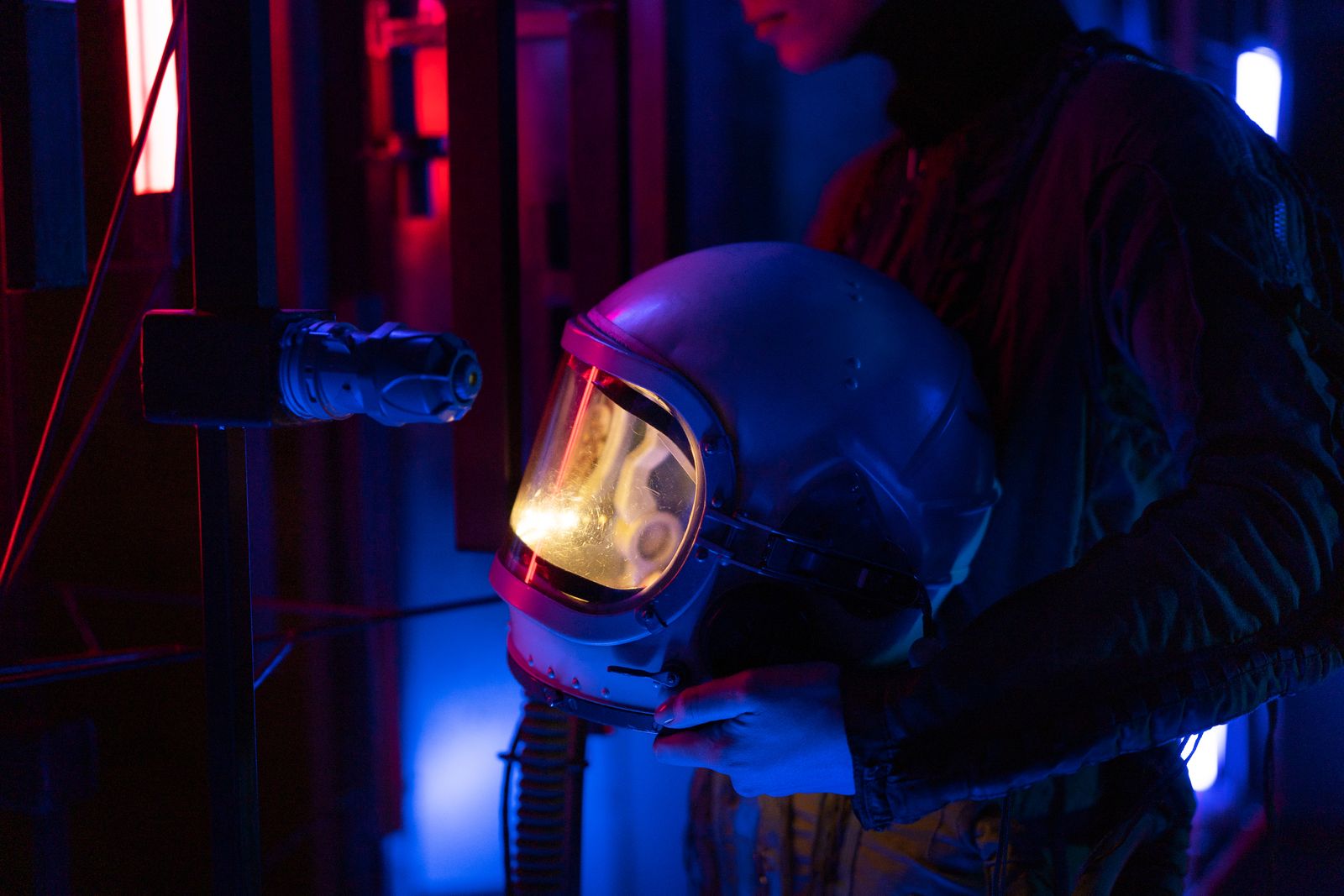
Technical skill gets astronauts into space. Living well with other people helps determine whether a crew can keep functioning once a mission stretches from weeks into months.
A 2024 study led by researchers working with NASA’s Behavioral Health and Performance Laboratory developed a short measure for something deceptively ordinary: whether people sharing an isolated habitat are tidy, considerate, and pleasant to live with. The Group Living Skills Survey drew on 83 people across 24 teams living in the International Space Station and several spaceflight analog environments for periods ranging from 45 to 240 days.
The small behaviours that became measurable
The final survey contained five items. Crewmembers rated whether people kept personal and work items tidy, used humour appropriately, appreciated the knowledge and abilities of others, and considered other people’s preferences.
Those questions may sound closer to a roommate questionnaire than an astronaut assessment. That is precisely the point. In an environment where work, meals, sleep, exercise, and recreation happen inside the same confined structure, ordinary household behaviour becomes part of operational performance.
The researchers found that higher group-living scores were strongly related to team viability and overall cohesion. The additional variance associated with group living was 0.40 for viability, 0.28 for team cohesion, 0.25 for social cohesion, and 0.18 for task cohesion. The relationship with reported team performance was smaller, at 0.08.
These results do not prove that wiping a surface or remembering a preference directly causes a mission to succeed. They show that crews reporting stronger everyday living skills also tended to report healthier team dynamics.
Why NASA separated living skills from job competence
The distinction began taking shape during the Shuttle-Mir era. Across seven missions, individual NASA astronauts spent roughly four to six months living with two Russian cosmonauts, creating a very different social environment from a short Space Shuttle flight.
Peer assessments from that period produced two broad clusters. One concerned job competence, including knowledge and work performance. The other concerned group living, including listening, helpfulness, consideration, and tolerance of cultural differences.
Later job analyses made the duration effect clearer. Group living skills ranked seventh for short missions and third for longer missions in an analysis conducted before the International Space Station era. A 2013 update placed them much higher for yearlong, communication-delayed, and Mars-like missions than for a conventional six-month ISS stay.
The pattern is intuitive. A habit that is mildly irritating during a two-week mission can become a persistent source of tension when the same people remain together for months without a genuine escape from one another.
What astronaut journals actually revealed
NASA also has a valuable source that is less structured than a survey: private astronaut journals. A NASA analysis of journals from six-month ISS expeditions examined what crewmembers chose to write about when they were given space to record their experiences privately.
Work occupied the largest share of the entries, followed by communication with mission control, family, and friends. Adjustment, interactions with crewmates, recreation, equipment, sleep, food, and organisational issues also appeared repeatedly.
The study found evidence of lower morale during the third quarter of missions. Astronauts also said that writing helped them maintain perspective on their work and their relationships with other people.
Related journal research cited by the Group Living Skills paper reported increasing conflict and declining group positivity over time. Some conflicts centred on personal habits rather than mission tasks, reinforcing the idea that a technically capable crew can still be weakened by the accumulated friction of daily life.
The published evidence does not establish that astronauts who recorded birthdays, anniversaries, or personal favours earned higher cohesion scores. Birthdays are celebrated aboard the station, but they were not an item in the Group Living Skills Survey and were not tested as predictors in the journal research.
Two dimensions of being a good space roommate
The statistical analysis produced two related factors. The first was tidiness, covering personal belongings and work materials. The second was consideration, covering appropriate humour, appreciation of other people’s skills, and respect for their preferences.
The distinction matters because a person can be orderly without being socially considerate. Someone can also be warm and supportive while leaving shared spaces difficult for everybody else to use. Long-duration crews need both forms of reliability.
The survey can be used at crew level, where astronauts rate the team as a whole. In analog missions, it was also used sociometrically, allowing crewmembers to rate individual roommates and identify differences between people over time.
NASA describes team capabilities as an established part of astronaut assessment, although the agency also acknowledges limits in how crews are assembled. Its official Team Risk assessment says individual-level team skills are included in astronaut selection, while crew composition itself is not yet data-driven.
Privacy changes the social equation
Habitat design can either soften or amplify interpersonal strain. The ISS gives crewmembers private sleeping quarters, although each is only about the size of a telephone booth. That small personal space is repeatedly described as an important psychological countermeasure.
Orion presents a tighter problem. Its four crewmembers share the cabin without individual private quarters, making cooperation and consideration especially visible even during a comparatively short lunar mission.
Artemis II demonstrated that environment in practice. NASA astronauts Reid Wiseman, Victor Glover, and Christina Koch, together with Canadian Space Agency astronaut Jeremy Hansen, completed a nearly ten-day journey around the Moon and splashed down on April 10, 2026.
The mission carried research intended to examine the human side of deep-space travel as well as the spacecraft. For the ARCHeR investigation, participating astronauts wore wrist-mounted actigraphy devices before, during, and after the flight.
The monitors tracked movement, sleep patterns, and exposure to light. NASA said the Artemis II human research programme would combine those readings with information about cognition, behaviour, team dynamics, and post-mission performance.
Why analog missions remain essential
The Group Living Skills study did not rely only on astronauts. It also included participants in NASA’s Human Exploration Research Analog in Houston and the SIRIUS isolation experiments in Moscow.
HERA missions in the dataset lasted 45 days, while the two SIRIUS missions lasted 120 and 240 days. Researchers administered the survey repeatedly, allowing them to examine whether the measure remained reliable as each mission progressed.
These habitats cannot reproduce every risk of spaceflight. They can, however, place crews inside controlled conditions where privacy, communication delays, workload, sleep disruption, and months of enforced proximity can be studied more frequently than actual launches allow.
The researchers recommend administering the survey at least monthly during long missions. More frequent measurements may be useful around events that change the crew’s living situation, such as the arrival or departure of station personnel.
The finding, without the mythology
The strongest conclusion is less cinematic than a story about secret birthday lists. Crews function better when ordinary consideration is not treated as an optional personality trait.
Keeping shared spaces usable matters. So does knowing when humour is welcome, recognising what another person contributes, and adjusting behaviour when a preference affects the people living beside you.
The study’s authors are careful about the limits. The sample was small, the environments varied, and more data are needed to understand how group living affects different crews and mission designs. The relationships are meaningful, but they are not proof of a simple cause-and-effect formula.
Still, the practical lesson is difficult to dismiss. As missions become longer, more isolated, and more communication-delayed, NASA will need astronauts who can operate advanced spacecraft and remain tolerable companions after hundreds of days in the same enclosed volume.
That is what the survey makes visible. Spaceflight competence includes the discipline of noticing that every personal habit eventually becomes part of somebody else’s environment.
