
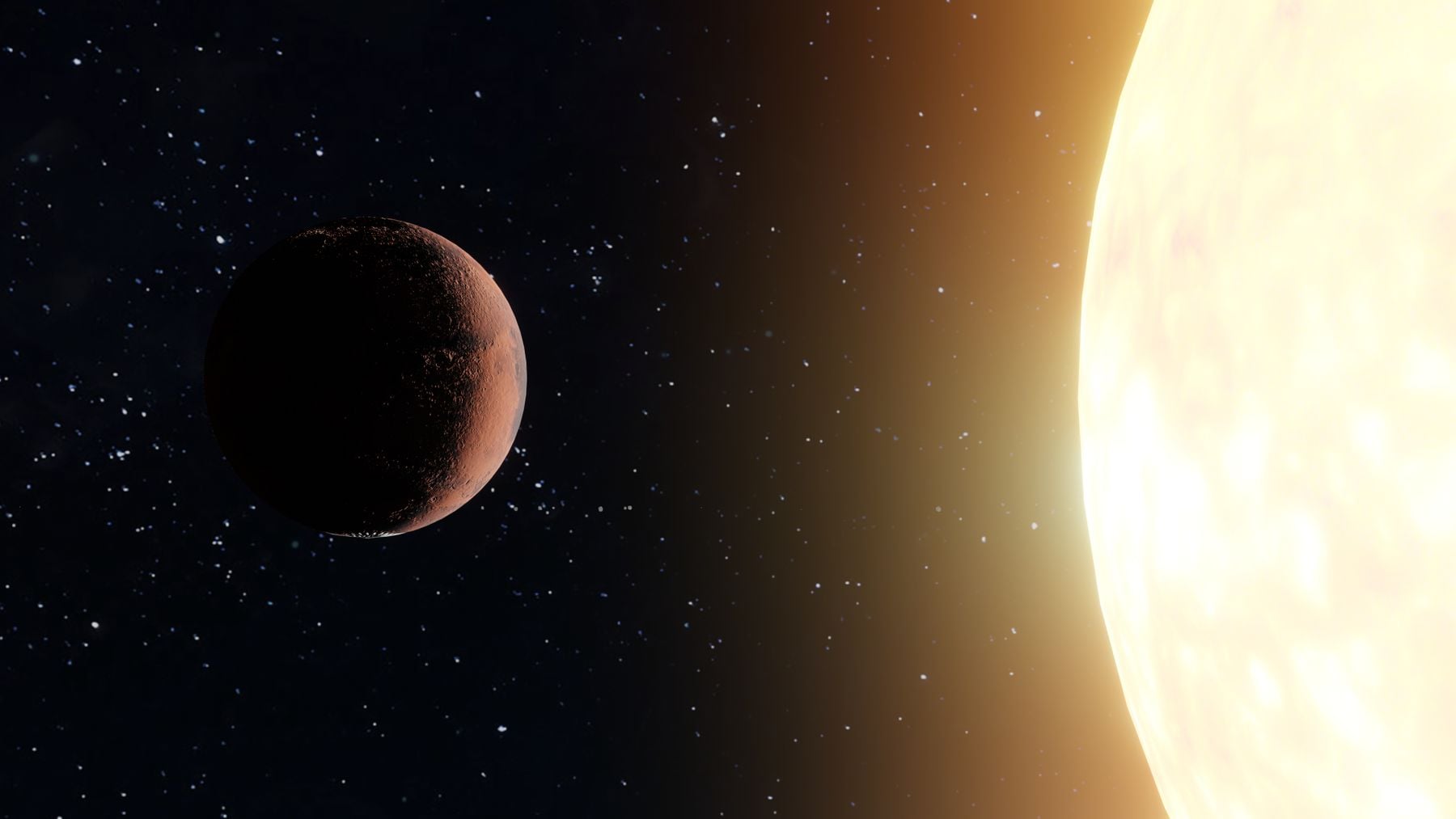
Astronomers have detected helium escaping from LHS 1140 b, a rocky super-Earth orbiting within the habitable zone of a small red star about 48 light-years away. The signal is the first clear evidence of an atmosphere around a rocky planet in the habitable zone of another star.
The finding, reported on 16 July in Science by Collin Cherubim of Harvard University and an international team, closes one question while leaving the more interesting ones open. LHS 1140 b has air. The observations do not yet reveal what the lower atmosphere is made of, whether liquid water is present, or whether the planet is habitable.
This is one result, not the final word. The helium appeared strongly in observations made in 2024 but was not recovered when the team observed the planet again in 2025. The authors interpret that difference as possible variability in the escaping gas, but another detection will be important.
Helium provided the atmospheric signal
LHS 1140 b passes in front of its star once every 24.7 days. During a transit, a small fraction of the star’s light filters through any gas surrounding the planet. Different atoms absorb particular wavelengths, leaving patterns in the spectrum that can be separated from the star’s own light.
Cherubim and his colleagues used the WINERED near-infrared spectrograph on the 6.5-metre Magellan Clay Telescope at Las Campanas Observatory in Chile. A rare alignment in September 2024 allowed them to observe LHS 1140 b and the system’s hotter inner planet, LHS 1140 c, crossing the star on the same night.
The spectrum of planet b contained absorption from helium at high altitude, extending beyond the planet’s solid radius. Planet c showed no comparable signal. The team concluded that helium is escaping from the upper atmosphere of LHS 1140 b as high-energy radiation from the star heats the gas.
Finding escaping helium is evidence that the atmosphere is being lost, but the important part is that helium is still there. LHS 1140 b is thought to be more than three billion years old. Detectable helium at this age implies a continuing atmospheric reservoir.
The planet has enough gravity to hold heavier gases
Current measurements put LHS 1140 b at about 1.73 Earth radii and 5.6 Earth masses. Its stronger surface gravity improves its chance of retaining an atmosphere.
The team’s modelling indicates that heavier atoms and molecules could remain bound even while helium leaks into space. That does not establish that nitrogen, oxygen, carbon dioxide or water is present. The observation probes the extended upper atmosphere, while the composition closer to the surface remains unknown.
The host star helps, though it is not harmless. LHS 1140 is an old, comparatively quiet M dwarf at the low end of the X-ray output measured for its type. It still produces enough high-energy radiation to drive helium escape, but it is less hostile than many active red dwarfs.
Liquid water remains a modelled possibility
The habitable zone is a temperature range, not evidence of habitability. LHS 1140 b receives enough energy from its star for liquid water to exist under a suitable atmosphere, but no telescope has seen an ocean there.
Refined mass and radius estimates found that LHS 1140 b is less dense than a purely Earth-like rocky planet. A 2024 analysis suggested that water could account for roughly 9 to 19 per cent of its mass. Climate models allow an ocean near the point that permanently faces the star.
James Webb Space Telescope observations published in The Astrophysical Journal Letters ruled out a thick hydrogen-rich mini-Neptune atmosphere at high confidence. The data contained tentative, 2.3-sigma evidence consistent with nitrogen, but that was too weak to count as a detection.
The new helium result changes that earlier discussion. An airless surface is now much harder to reconcile with the observations, while a heavier lower atmosphere and possible water layer remain open. It does not turn the modelled ocean into an observed one.
Why this planet survived when others did not
Rocky planets around red dwarfs have repeatedly disappointed atmospheric searches. These stars emit strong ultraviolet and X-ray radiation when young, and their habitable zones sit close to them. A planet can occupy the right temperature range today after losing its early atmosphere long ago.
LHS 1140 b appears to sit on the surviving side of that divide. Its mass helps it retain gas, its present-day star is relatively quiet, and its wider orbit exposes it to less radiation than LHS 1140 c. Two planets in the same system therefore offer a useful comparison: the hotter inner world showed no helium, while the cooler outer one did.
The comparison suggests that survival depends on stellar radiation, orbital distance, planetary gravity and the material available to replenish what escapes.
Webb and Hubble now have a specific atmosphere to test
LHS 1140 b is included in the joint Hubble and Webb Rocky Worlds programme. Future transits can test whether the helium signal returns and search for carbon dioxide, water vapour and other constituents lower in the atmosphere.
A second helium detection would address the quiet 2025 observation. Repeated Webb measurements will be needed to distinguish a nitrogen-rich atmosphere from other heavy compositions.
There is no evidence of life on LHS 1140 b, and there is not yet evidence of liquid water. What astronomers have is a rocky, temperate planet that appears to have kept an atmosphere for billions of years. That makes it the first habitable-zone world where the next questions can move beyond whether there is any air to study at all.
