
The promotional language around NEOM keeps returning to one idea: a clean start. A blank stretch of desert. A place to build the future without the weight of the past. The land the project now occupies in north-west Saudi Arabia was never blank. People had farmed it, buried their dead in it, and carved their names into its sandstone for thousands of years before it was renamed as a site for the city of the future.
NEOM is the flagship of Crown Prince Mohammed bin Salman’s Vision 2030 plan, a development of roughly 26,500 square kilometres in Tabuk province, along the Gulf of Aqaba and the Red Sea, carrying a headline figure of about US$500 billion. Its best known component, The Line, was unveiled in 2021 as a mirror-clad linear city meant to run 170 kilometres inland. The ground it was drawn across belongs, in the sense that matters most to the people who lived there, to the Huwaitat, a tribe present in the region since before the modern Saudi state was founded.
What the land already held
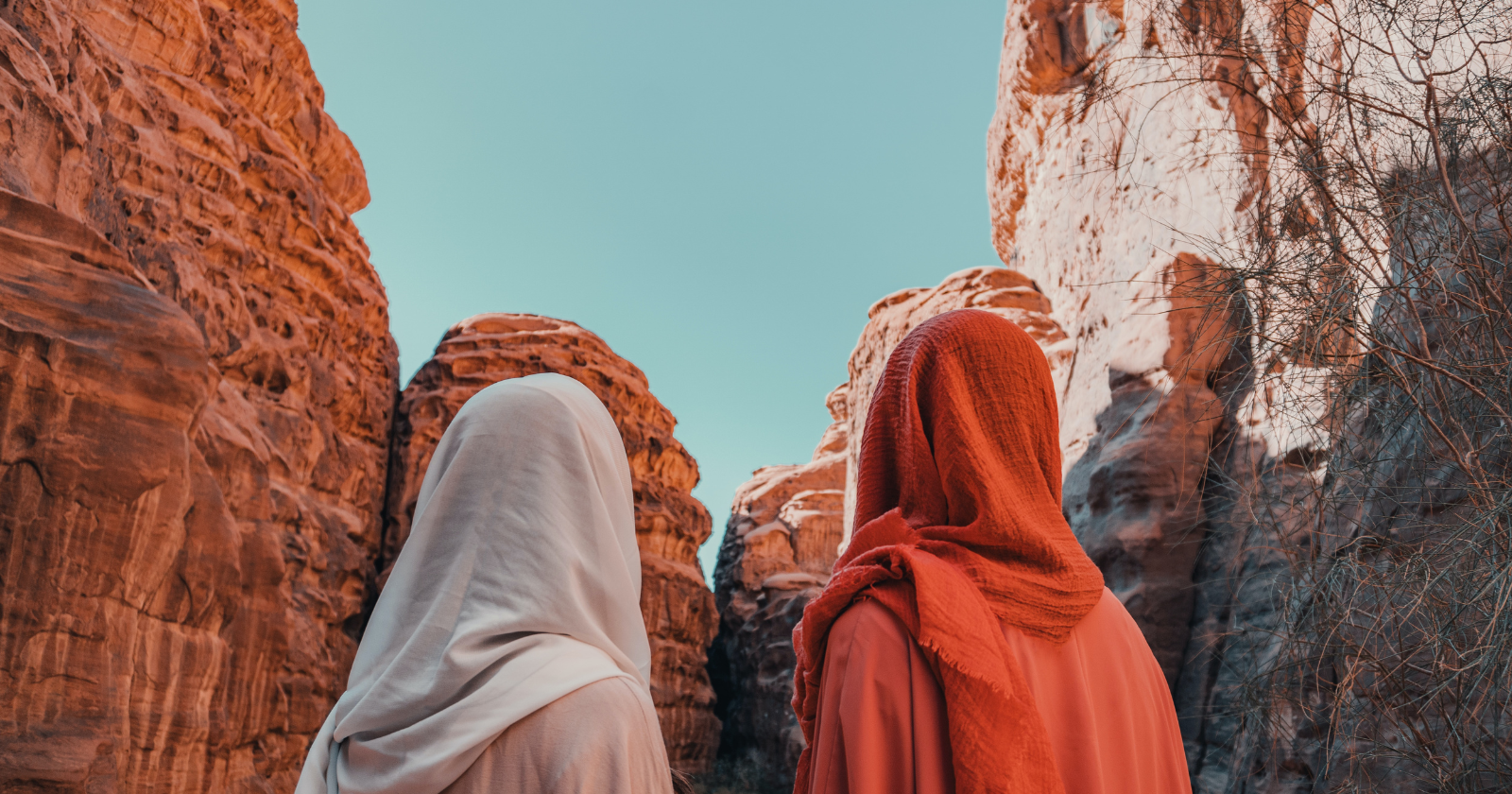
Tabuk is one of the more archaeologically dense parts of the Arabian Peninsula. Two kilometres south of the town of al-Bda’ sit the rock-cut tomb facades of Maghair Shuaib, carved into sandstone and attributed to the Nabataeans, the same trading culture that left Hegra and Petra further north. The Hisma desert to the south carries older marks still. In a 2020 paper in the journal Arabian Archaeology and Epigraphy, Jérôme Norris and Ali Al-Manaser documented Hismaic and Nabataean inscriptions and rock drawings on a single panel in the massif of Tur al-Qawwas, near Tabuk, a written trace of the languages and tribal marks of people who moved through this ground two millennia ago.
The layers do not stop there. The Kilwa site, north-east of Tabuk city, holds some of the oldest rock carvings in the province, and the Hejaz Railway later crossed the region under the Ottomans. Tabuk itself takes its name from a seventh-century military campaign led by the Prophet Muhammad.
This is the setting the marketing describes as empty. The Huwaitat themselves are part of that continuity, a population estimated in the tens of thousands who held the land long before it acquired a brand.
The evictions and the killing
The clearances began in January 2020. Members of the Huwaitat were moved from three villages, Al-Khuraybah, Sharma and Gayal, in the name of the project. Homes were demolished. Residents have said the compensation promised did not arrive, or arrived without meaningful choice about whether to accept it.
One man refused. Abdul Rahim al-Huwaiti, a Ministry of Finance employee, posted videos online saying he would not leave, and predicting that the authorities would plant weapons in his house to incriminate him. He was killed by Saudi security forces at his home on 13 April 2020. State Security said he had opened fire and was a wanted man. His family, along with Saudi activists and human rights groups, rejected that account, as reported by Al Jazeera at the time. His funeral was held near the village days later.
Four years on, a former Saudi intelligence officer added an account of his own. Colonel Rabih Alenezi, living in exile in the United Kingdom, told BBC News in 2024 that he had been ordered to clear Al-Khuraybah and authorised to use lethal force against anyone who stayed, citing an April 2020 order that described the tribe as containing many rebels. The claim carries a clear caveat: the BBC said it could not independently verify Alenezi’s account, and both the Saudi government and NEOM declined to comment, as documented by Dezeen. Riyadh has said more than 6,000 people were relocated for the project. Rights groups put the number of tribe members affected far higher, around 20,000.
The sentences
Resistance carried a steep price beyond the one man killed. In 2022, Saudi Arabia’s Specialised Criminal Court, a body set up in 2008 to try terrorism cases and since criticised for prosecuting dissent, sentenced three members of the tribe to death: Shadli al-Huwaiti, Abdul Rahim’s brother, along with Ibrahim and Ataullah al-Huwaiti. The charges rested on peaceful opposition to the evictions, including posts on social media, brought under the Kingdom’s Counter-Terrorism Law. The Court of Appeal upheld the sentences in January 2023.
In May 2023, UN human rights experts said they were alarmed at the prospect of imminent executions linked to NEOM, noting that international law reserves the death penalty for the most serious crimes involving intentional killing, and that the free, prior and informed consent of the Huwaitat had not been obtained. Their statement is set out at the Office of the High Commissioner for Human Rights.
Others among the tribe received long prison terms, with sentences reported at 27, 35 and 50 years. Rights organisations including ALQST say the number handed capital sentences is higher than the three most widely documented cases. As of the most recent reporting, there is no confirmation that the three men have been executed, and no confirmation that their sentences have been commuted. They remain, on the available evidence, in a state of legal limbo years after the land they resisted leaving was taken.
What the project became
The city those clearances were meant to serve now looks very different from the one announced. Cost estimates for The Line rose steeply beyond early projections, and in September 2025 the Public Investment Fund suspended construction, with only about 2.4 kilometres of foundation work completed against a planned 170. The fund booked a write-down on the project. Population targets for 2030 were cut from an early figure of 1.5 million to a small fraction of that. In May 2026, Semafor reported that work had been pushed back until after 2030. NEOM has continued to describe The Line as a strategic priority, which is the company’s framing rather than an independent assessment.
Held side by side, the two timelines are difficult to reconcile. The removal of the Huwaitat from their villages was permanent and, for at least one family, fatal. The city that removal was carried out for has been paused, scaled down, and left uncertain in both scope and date.
What to watch
Three questions sit open. Whether the death sentences against Shadli, Ibrahim and Ataullah al-Huwaiti are carried out, commuted, or quietly left in place. Whether the tribe’s members ever receive land, return, or compensation on terms they had a say in. And whether the older material in that ground, the Nabataean tombs, the Hismaic panels, the carvings at Kilwa, is surveyed and documented before more of it is lost.
A place marketed as having no past is being built, slowly and at reduced ambition, on one of the more heavily inscribed landscapes in the region. The people who could speak to that past directly are the ones who were moved off it first.