

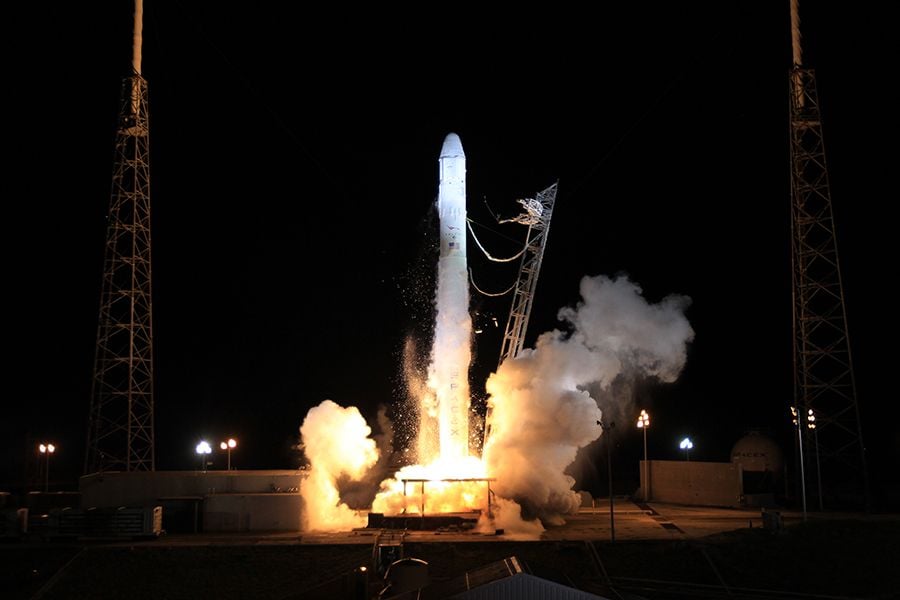
Sixty-three military data-relay satellites now circle the Earth for the Pentagon’s newest space network — half of the planned constellation — and the optical laser mesh that is supposed to let them pass data to one another at nearly the speed of light has still not been switched on. A SpaceX Falcon 9 added the latest 21 on July 16, lifting off from Vandenberg Space Force Base and restarting a deployment that had been frozen for nine months while engineers worked through hardware and software faults on the spacecraft already in orbit.
The mission, designated T1TL-E, launched at 4:32 p.m. Eastern and carried the third batch of Tranche 1 Transport Layer spacecraft, all built by York Space Systems, according to SpaceNews. With them, the constellation reached 63 of its planned 126 satellites.
Restarting a stalled program
The launch matters less for what it did than for what it signals: the SDA is moving again. The agency’s previous Tranche 1 flights placed 21 York satellites in orbit last September and 21 Lockheed Martin satellites in October 2025. Then everything stopped.
SDA Director Gurpartap “GP” Sandhoo told reporters ahead of the flight that the pause came from problems discovered on the first 42 Tranche 1 satellites already circling the Earth. The list was not trivial. It included thermal-modeling issues, delays making contact with ground entry points, and propulsion and orbit-raising challenges, as Federal News Network reported.
Those are the kinds of problems that reveal something uncomfortable about how quickly a proliferated military constellation can actually be fielded. The Space Development Agency was built on speed. Its founding pitch — that the Pentagon could out-iterate slow-moving prime contractors by buying small satellites in two-year tranches — assumed that new hardware would work well enough on orbit to keep the assembly line moving. When it did not, the line stopped.
From monthly launches to “whoever is ready”
The gap between October 2025 and July 2026 also reflects a quiet shift in how SDA manages its constellation. Sandhoo said the agency once envisioned a cadence of roughly monthly satellite launches. That target is gone. SDA is now launching satellites based on readiness rather than a fixed schedule.
Launch availability, in other words, is no longer the pacing item. Spacecraft checkout, assembly, integration and test readiness are. That is a meaningful admission in an era when the Pentagon has often framed launch as the bottleneck and commercial providers like SpaceX as the solution.
The T1TL will eventually consist of 126 satellites built by York Space Systems, Lockheed Martin and Northrop Grumman. Space.com reported that the booster used on Thursday’s flight — designated 1103 — was on its fourth mission, landing on the drone ship Of Course I Still Love You in the Pacific about 8.5 minutes after liftoff. SpaceX cut its webcast shortly after booster landing at the SDA’s request, and neither the company nor the agency disclosed exactly where the 21 satellites would be deployed.
What the Transport Layer is supposed to do
The Transport Layer is the communications backbone of the Proliferated Warfighter Space Architecture, or PWSA — the Space Force’s planned network of low Earth orbit satellites designed to support missile warning, missile tracking and military data relay. Its job is to move data across space through optical intersatellite links and deliver it to ground systems, ships, aircraft and other military users.
SDA describes the Transport Layer as delivering assured, resilient, low-latency connectivity worldwide for military missions. The larger PWSA is envisioned as a proliferated constellation of hundreds of optically linked small satellites, spiraling into new capability every two years through successive tranches.
The pitch is straightforward: a resilient, distributed network that an adversary cannot easily kill by taking out a handful of exquisite satellites. The reality is harder.
The mesh network that isn’t there yet
Perhaps the most striking detail from Sandhoo’s briefing is what the constellation cannot yet do. The agency has not established the mesh network that would allow the satellites to route data across the constellation. That capability — the whole reason optical intersatellite links exist — remains ahead of the program, not behind it.
SDA plans to first build optical links within each orbital plane before attempting links between planes, a step Sandhoo indicated adds significant complexity. His summary was blunt: the mesh network has not yet been established, but progress is being made toward that goal.
Tech Times noted that the laser-linked backbone underpinning the Space Force’s battle network is still being switched on incrementally. Until the mesh is live, the Transport Layer functions more as a set of individual data pipes than the resilient web that its designers describe in briefing slides.
Still, Sandhoo argued the program has reached a threshold worth noting. He said the launch would place half of the transport constellation in orbit, adding that with three planes deployed, SDA can begin discussing actual operational capability.
A busy day for SpaceX
The Falcon 9 launch was not the only thing SpaceX had on the manifest for July 16. The company was preparing its Starship megarocket for its 13th test flight from Starbase in South Texas during a 90-minute window opening at 6:45 p.m. Eastern. That attempt was later aborted, another reminder that even the most experienced launch provider in the world runs into constraints when it tries to fly two very different vehicles on the same afternoon.
The split-screen matters for how the Pentagon thinks about launch dependency. On one screen: a workhorse Falcon 9 quietly assembling a military constellation. On the other: an experimental heavy-lift vehicle whose success is central to SpaceX’s longer-term commercial ambitions, including the Starlink expansion documented in SpaceX’s recent regulatory filings.
What half a constellation buys
The strategic case for the PWSA has only sharpened in the past several years. Commercial LEO communications have already changed the shape of terrestrial conflict; the operational advantages of distributed satellite networks have become increasingly apparent in recent military operations. The Pentagon does not want its own operational forces dependent on a commercial constellation whose owner can change access policy overnight.
Other militaries are drawing the same conclusion. South Korea has been developing a solid-fuel rocket capable of putting spy satellites in orbit on short notice, betting that responsive launch and sovereign satellites are worth the cost of duplicating capability that commercial providers already sell.
Sixty-three satellites is a real number. It is also not the number the SDA has promised. The Tranche 1 Transport Layer was designed as a 126-satellite system, and Tranche 2 is meant to layer on top of it. The program is now roughly at the halfway point of deployment, with the mesh network not yet operational and hardware issues still being resolved.
That is a normal position for a first-of-its-kind military constellation. It is also a fragile one. The next several launches will decide whether SDA’s readiness-based cadence produces a functioning battle network by the time Tranche 2 satellites start arriving, or whether the program keeps discovering problems in orbit faster than it can fix them on the ground.
Thursday’s launch bought the program time. The mesh will decide whether it bought capability.