

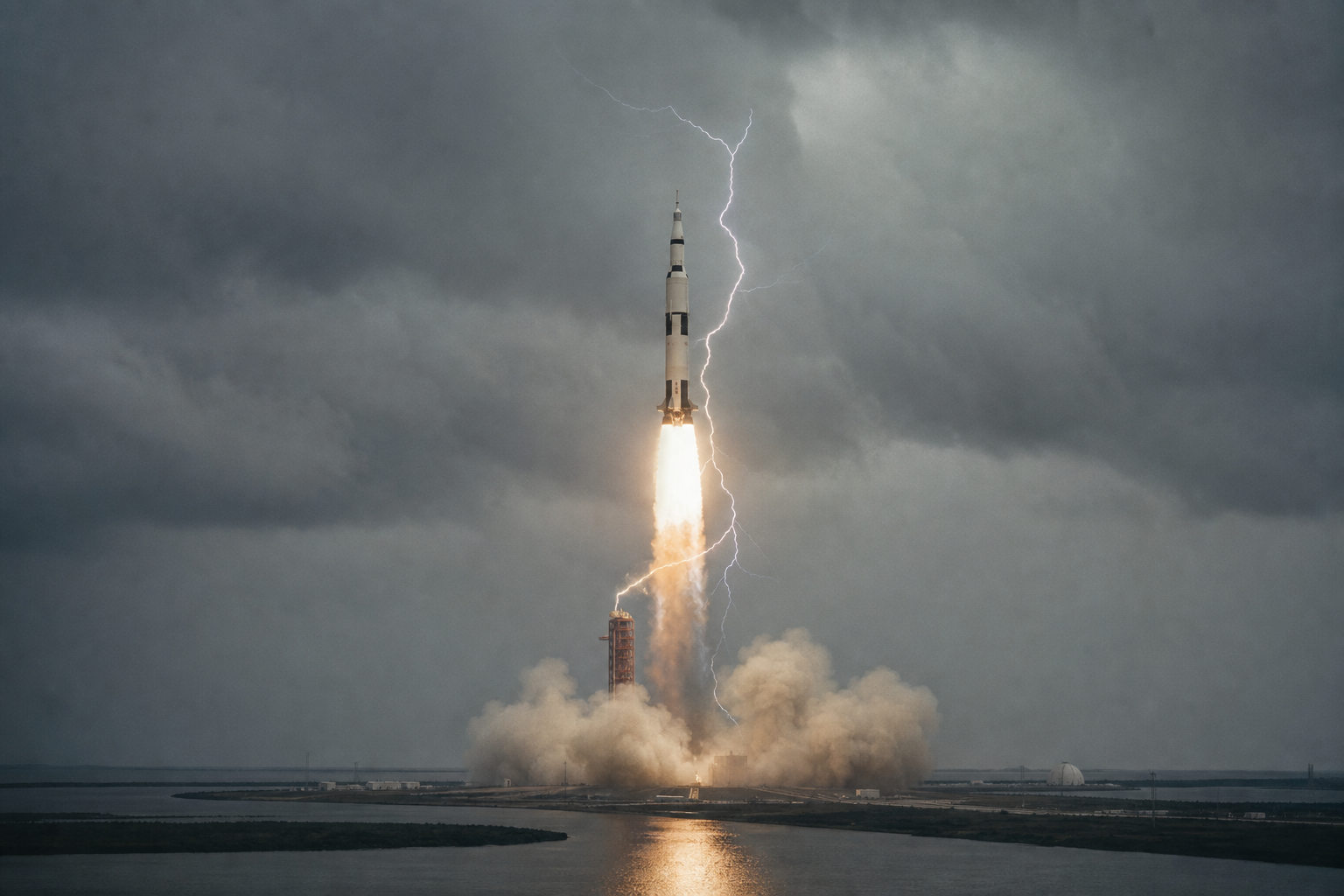
Thirty-six and a half seconds after Apollo 12 left Kennedy Space Center on 14 November 1969, lightning travelled through the Saturn V and its exhaust trail. The spacecraft’s electrical system reacted as if several unrelated failures had arrived at once. Warning lights filled the cabin, telemetry on the ground dissolved into implausible numbers and the command module’s master alarm sounded.
Fifteen and a half seconds later, at 52 seconds after liftoff, a second lightning event struck. The launch vehicle kept flying, but Mission Control could no longer make sense of much of the spacecraft data it needed to judge whether the mission was safe.
At the EECOM console in Houston, 26-year-old flight controller John Aaron recognised the shape of the nonsense. He had encountered it during an obscure spacecraft test and knew that the readings did not necessarily mean every sensor had failed. His call was short: “Try SCE to Aux.” The flight director did not initially recognise it. The capsule communicator had to ask which panel was involved. Lunar module pilot Alan Bean knew where the switch was and moved it.
That action restored usable telemetry. It did not repair every electrical problem by itself, and Aaron did not save the mission alone. The Saturn V guidance system, the flight director’s judgement, Bean’s cockpit knowledge and the crew’s recovery work all mattered. But without Aaron identifying the pattern, controllers would have remained largely blind at the moment they most needed to understand the vehicle.
Two strikes in the first minute
Apollo 12 launched at 11:22 a.m. Eastern time into rain and a low cloud layer. There was no nearby natural lightning before liftoff, and the weather complied with the launch rules then in force. Those rules did not fully account for the possibility that a large rocket and its conductive exhaust plume could trigger lightning while passing through an electrically charged cloud.
The official NASA analysis of the Apollo 12 lightning incident concluded that the vehicle initiated the discharges. The first event began when the rocket was about 6,400 feet above the ground. The second occurred around 14,000 feet. Investigators judged that the cloud’s electric field was high even though the storm was not producing lightning on its own.
The electrical path passed through the launch vehicle and spacecraft. In the command module, all three fuel cells disconnected from the main power buses. The spacecraft’s entry batteries took the load, preventing an immediate total loss of power, but bus voltage fell low enough to disrupt other equipment.
The inertial measurement unit also lost its reference, producing the crew’s “platform” warning. That sounded severe, but the Saturn V had its own guidance system in the instrument unit below the spacecraft. The booster continued on course. Commander Pete Conrad later recalled that the engines still sounded and felt normal, an important reason not to pull the abort handle while the crew and ground tried to understand what had happened.
Why the telemetry looked impossible
The Signal Conditioning Equipment, or SCE, sat between many spacecraft sensors and the systems that displayed or transmitted their readings. Sensors did not all produce signals in the same form. The SCE converted their raw outputs into standardised electrical values that the instruments and telemetry encoders could use.
Under normal power, the primary SCE supply did this work. The lightning-induced voltage drop pushed that supply below its operating range. The underlying systems had not all suddenly developed the bizarre conditions shown on the consoles. Instead, the electronics translating their measurements were producing corrupt output.
This distinction was hard to see from the ground because the failure presented as a page of unrelated bad numbers. Aaron’s NASA oral history explains why the pattern meant something to him. About a year earlier, he had stayed on a night shift to watch a command module test at Kennedy. Operators accidentally dropped spacecraft power, and the telemetry values did not fall neatly to zero. They landed on strange intermediate numbers such as 6.7 and 12.3.
Aaron was curious enough to investigate. He learned that switching the SCE to its auxiliary supply would allow it to operate under low-voltage conditions. No lightning simulation had trained him for Apollo 12. The simulator would have shown zeroes for a comparable power loss, not the peculiar pattern he saw on launch day. What he recognised was an accidental test signature remembered from outside the formal script.
A command almost nobody recognised
Flight director Gerry Griffin asked Aaron what he was seeing. Aaron answered, “Flight, EECOM. Try SCE to AUX.” The Apollo 12 Flight Journal reconstruction records the confusion that followed. Griffin repeated the phrase as a question. When he passed it to capsule communicator Gerald Carr, Carr needed to ask where the switch was.
Griffin later said in his own NASA oral history that he had never heard of the switch despite the hundreds of controls involved in Apollo operations. Bean had. The SCE selector was on the lower right side of the command module’s main display console, near his position. He moved it to auxiliary.
The surviving air-to-ground and onboard transcript shows the sequence in real time. Carr’s call reached the spacecraft about 96 seconds after liftoff. Conrad initially repeated it incorrectly as “FCE,” then Bean found the control. By about 110 seconds, Conrad confirmed “SCE to Aux,” and intelligible spacecraft data began returning to Houston.
Restored telemetry let Aaron see the next problem clearly: the fuel cells had dropped offline. The crew reset them, returned them to the buses and stopped the entry batteries from carrying the spacecraft unnecessarily. The guidance platform could not be trusted for the remainder of ascent, but the Saturn V’s independent guidance delivered Apollo 12 safely into orbit.
The mission was not automatically safe
Reaching orbit did not settle whether Apollo 12 should continue to the Moon. Lightning could have damaged the heat shield deployment circuits, pyrotechnic systems or other equipment in ways that telemetry did not reveal. The crew and controllers spent the Earth-orbit checkout examining the spacecraft and restoring the command module’s inertial platform.
The Apollo 12 Mission Report states that the spacecraft’s performance was excellent after the incident. Controllers concluded that the strikes had caused no hidden failure serious enough to prevent the mission. The third stage restarted for translunar injection, and Apollo 12 went on to make the first precision crewed landing on the Moon, touching down close to the Surveyor 3 spacecraft.
The episode is sometimes compressed into a story about one magic switch. The SCE did not control the rocket, restart the fuel cells or realign the guidance platform. Its auxiliary mode restored the information needed to diagnose and manage those tasks. The critical achievement was turning an apparently system-wide catastrophe back into a set of specific, recoverable faults.
The launch rules changed
NASA’s investigation treated the incident as a failure of weather criteria, not proof that Saturn V vehicles could safely absorb lightning. The rocket had effectively created the discharge by entering a strong electric field. Future rules were tightened to avoid launches through cloud conditions capable of supporting triggered lightning.
A later NASA review of launch vehicle lightning protection traced modern design criteria and operational safeguards back in part to Apollo 12. The lesson reached beyond weather forecasting. A spacecraft needs electrical bonding, shielding and fault tolerance, but it also needs procedures that prevent avoidable exposure to a poorly understood environment.
The human lesson is narrower and more useful than the legend. Aaron’s call worked because he had followed an anomaly that formal training did not explain, then recognised it under pressure. Griffin trusted a controller whose language he barely recognised. Carr transmitted the instruction, Bean located the control and the crew kept working while the launch vehicle remained stable.
Mission Control is often remembered as a room full of people who knew everything about the spacecraft. Apollo 12 survived because the knowledge was distributed, incomplete and connected quickly enough. One controller understood a pattern almost no one else recognised. Another person knew where the switch was. A chain of trust turned both facts into action before the batteries, the clock or the uncertainty forced a different decision.