

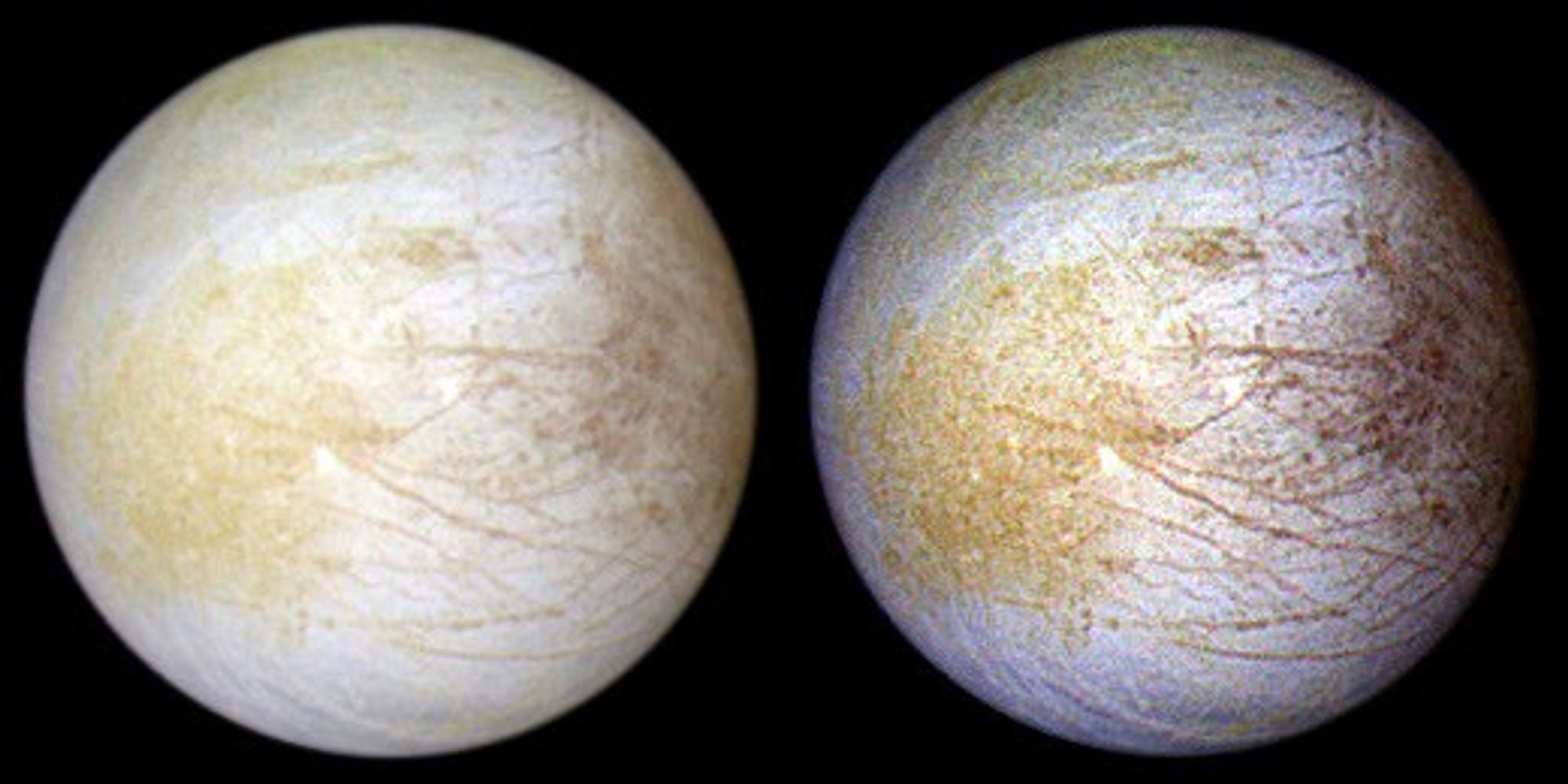
From a distance, Europa looks like a frozen world. Its surface is a pale shell crossed by rust-coloured bands, ridges and fractures, with few of the impact craters that scar most old moons. Yet beneath that ice, scientists think, lies a global saltwater ocean that could contain more than twice as much liquid water as all of Earth’s oceans combined.
That enormous ocean has never been seen directly. No spacecraft has landed on Europa, drilled into its crust or lowered an instrument into the water. The conclusion instead comes from a convergence of magnetic measurements, surface geology and models of the moon’s interior. NASA’s comparison of Europa and Earth estimates that the Jovian moon could hold about twice the water of our planet, even though Europa is only slightly smaller than Earth’s Moon.
The reason is depth. Earth’s oceans cover a much larger surface area, but average only about 3.7 kilometres deep. Europa’s suspected ocean may extend roughly 100 kilometres from its icy roof to the rocky interior below. Wrapped around the entire moon, that layer would add up to a staggering volume of water.
A sea detected without being seen
Some of the strongest evidence arrived with NASA’s Galileo spacecraft, which repeatedly flew past Europa while exploring the Jupiter system in the 1990s. Its magnetometer detected a changing magnetic field around the moon. In a 2000 paper in Science, researchers reported that the signal was consistent with an electrically conductive layer close to Europa’s surface.
A global layer of salty liquid water is the most plausible explanation. As Europa moves through Jupiter’s powerful and changing magnetic environment, electrical currents would be induced in the ocean. Those currents would in turn generate a secondary magnetic field detectable by a passing spacecraft. The result is compelling evidence, but it is still an inference. Scientists need better measurements to determine the ocean’s depth, salinity and exact location.
Europa’s face provides another clue. Long cracks and double ridges stretch across its surface, while broken blocks in areas known as chaos terrain appear to have shifted, rotated and frozen into new positions. The relative scarcity of craters suggests that the surface is geologically young and has been renewed. According to NASA’s summary of the ocean evidence, these features are consistent with a warm, mobile layer beneath the brittle exterior, although researchers still debate how directly the ocean interacts with the surface.
Even the thickness of the ice remains uncertain. Estimates vary with the model and with what researchers mean by the shell, including whether warm, convecting ice lies below a rigid lid. NASA describes a commonly cited range of about 3 to 30 kilometres. That uncertainty matters because a thin shell would allow easier exchange between the ocean and surface, while a thick one could make such transport slower and more complicated.
How Jupiter turns motion into heat
Saying that Jupiter’s gravity keeps Europa warm is broadly correct, but the mechanism is more interesting than a simple gravitational pull. Europa travels around Jupiter on a slightly eccentric orbit, so its distance from the giant planet changes. Jupiter therefore tugs on the moon with varying strength during every 3.5-day orbit.
The near side of Europa also feels a stronger attraction than the far side. Together, these differences stretch and relax the moon. The repeated deformation is called tidal flexing. Friction within the ice and deeper interior converts some of that mechanical energy into heat, much as repeatedly bending a piece of material can warm it.
Ordinarily, tidal forces would gradually make a moon’s orbit more circular, reducing the flexing. Europa, however, is locked in an orbital resonance with Io and Ganymede. For every orbit Ganymede completes, Europa completes two and Io completes four. Their regular gravitational nudges help preserve Europa’s orbital eccentricity and keep the tidal engine operating. NASA’s Europa facts page explains how this resonance maintains the flexing that can supply enough heat to keep water liquid beneath the ice.
Researchers do not yet know exactly where all that heat is produced or how it moves through Europa. Some may be generated in the ice shell, while some may arise in the rocky mantle. Models also allow the possibility of volcanism or hydrothermal activity on the seafloor, but there is no direct evidence yet that active vents exist there. The safe conclusion is that tides provide a durable internal heat source capable of helping maintain the ocean, not that every detail of Europa’s hidden geology has been established.
An ocean in permanent night
Europa’s surface receives sunlight, weak though it is at Jupiter’s distance from the Sun. Its buried ocean is different. Kilometres of ice would block sunlight, placing the water below in permanent darkness. If life exists there, it could not depend on ordinary photosynthesis.
Darkness does not make life impossible. On Earth, ecosystems around deep-sea hydrothermal vents draw energy from chemical reactions rather than sunlight. Europa may also have chemical gradients where water meets rock. Meanwhile, radiation from Jupiter breaks apart molecules in the surface ice and creates oxidants. If surface material is carried downward through cracks, impacts or slow ice circulation, those compounds could potentially provide another source of chemical energy.
Each step in that picture contains uncertainty. Europa appears to have liquid water and persistent energy, but habitability also requires suitable chemistry and a way to bring the ingredients together. An ocean can exist without being inhabited. A vast water inventory therefore makes Europa an exceptionally important target for astrobiology, not proof of an extraterrestrial biosphere.
The mission built to test the ocean world
NASA’s Europa Clipper spacecraft is now travelling towards Jupiter after launching on 14 October 2024. It is scheduled to reach the giant planet in April 2030 and make 49 close flybys of Europa. The mission overview states its objective carefully: to determine whether Europa has conditions suitable to support life.
Europa Clipper will not land, drill through the ice or search directly for organisms. Instead, its instruments will examine the moon from repeated passes, some as low as about 25 kilometres above the surface. Ice-penetrating radar will probe the shell’s structure. Magnetic and gravity measurements will constrain the ocean’s properties and Europa’s interior. Cameras and spectrometers will map fractures, composition and possible sites where material has moved between the surface and the layers below.
Those observations could turn today’s broad picture into quantitative answers. Scientists want to know how thick the ice is, whether pockets of liquid sit within it, how salty and deep the global ocean may be, and whether the seafloor and surface can supply the chemical ingredients needed for life. NASA’s description of the mission’s three main science objectives focuses on the ice and ocean, the moon’s composition and its geology.
For now, Europa remains a world reconstructed from indirect signals: a magnetic response measured during fleeting flybys, a shattered icy surface photographed from space and the physics of a moon continually flexed by a giant planet. Together they point to an extraordinary possibility. Beneath a frozen landscape exposed to Jupiter’s radiation, a dark global sea may have remained liquid for billions of years, holding more water than every ocean on Earth and perhaps some of the most promising conditions for life beyond our planet.