

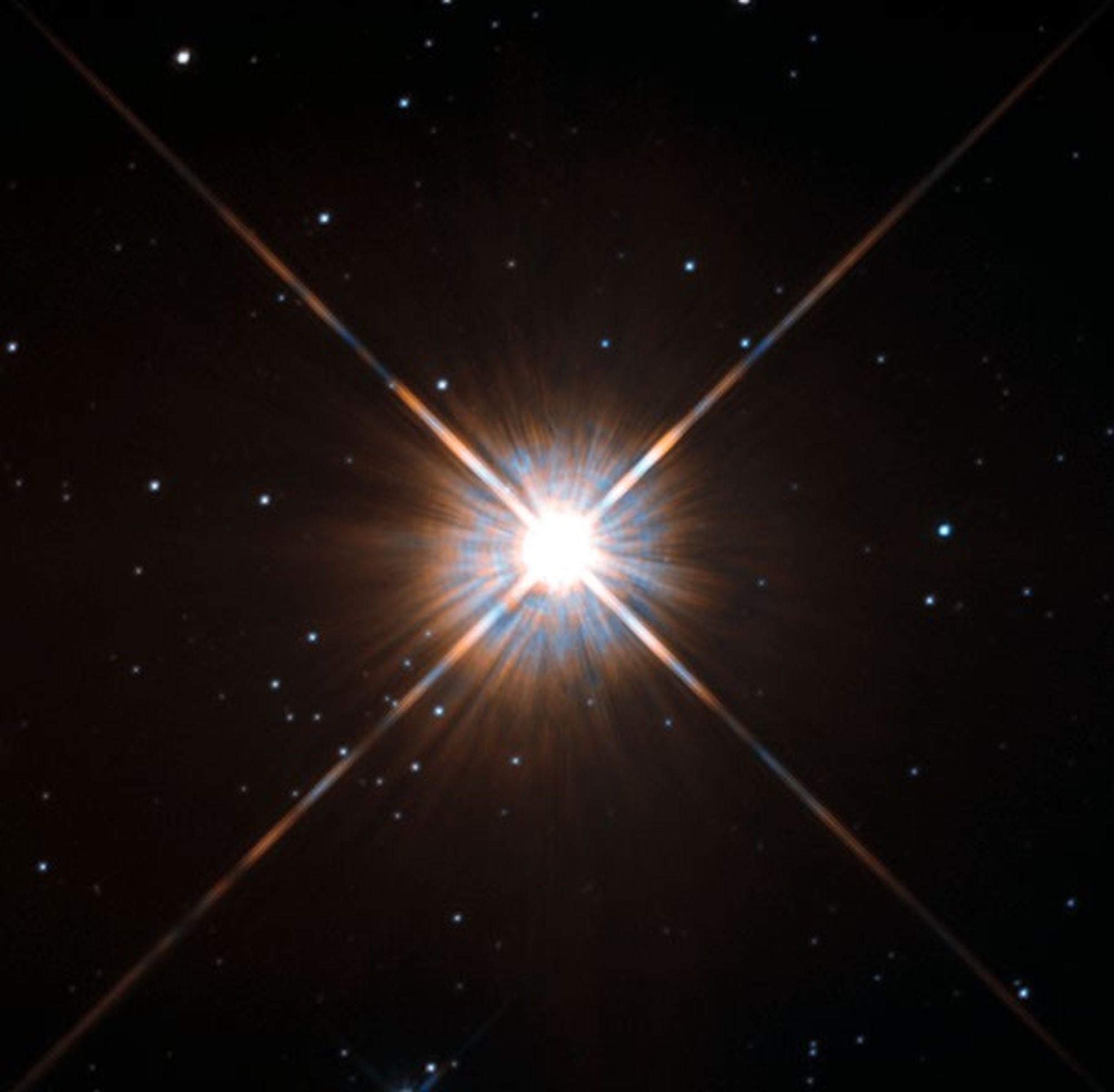
Four light-years sounds close only because astronomy usually deals in much larger numbers. Proxima Centauri is the nearest known star beyond the Sun, but its light still takes about 4.25 years to reach Earth. A spacecraft moving at the fastest speed ever recorded for a human-made object would need roughly 6,600 years to cover the same distance in a straight line.
That comparison is an idealisation, and a generous one. The speed record belongs to NASA’s Parker Solar Probe, which reaches about 430,000 miles per hour, or roughly 700,000 kilometres per hour, only during its closest passes by the Sun. Parker is not an interstellar spacecraft, is not travelling towards Proxima Centauri, and could not simply carry that solar-encounter speed into deep space. The calculation is useful because it sets an optimistic scale using hardware that actually exists.
Written records begin with the development of cuneiform in Mesopotamia before 3200 BC, according to the British Museum’s history of the script. That gives recorded civilisation a span of about 5,200 years. Even the artificial Parker-speed journey would therefore be longer than the whole interval from the first surviving writing to the present.
The nearest star is still 40 trillion kilometres away
Proxima Centauri is a small red dwarf in the Alpha Centauri system. Alpha Centauri A and B form a brighter pair, while Proxima lies farther from them and slightly closer to us. NASA’s Hubble page calls it our closest stellar neighbour and places it just over four light-years from Earth. A NASA educational reference gives the more useful rounded value of 4.25 light-years, equivalent to about 40.2 trillion kilometres.
That number exposes the problem hidden by the phrase “only four light-years”. The average Earth-Sun distance is about 150 million kilometres. Proxima is roughly 268,000 times farther away. The distance is so large that familiar spacecraft speeds become almost stationary when placed against it.
Light covers about 9.46 trillion kilometres in a year. A radio message sent towards Proxima would need a little over four years to arrive, and any reply would take another four years to return. Even communication with a hypothetical receiver would operate on a minimum round-trip delay of roughly eight and a half years.
What the Parker number really means
Parker Solar Probe became the fastest human-made object by diving deep into the Sun’s gravitational field. During its record close approach on December 24, 2024, NASA reported a speed of 430,000 miles per hour. The spacecraft passed only 3.8 million miles above the visible solar surface.
Dividing Proxima’s approximate 40.2 trillion-kilometre distance by 692,000 kilometres per hour gives about 58 million hours. Dividing again by the average number of hours in a year produces a journey near 6,630 years. Using NASA’s rounded 700,000-kilometre-per-hour figure gives about 6,550 years. “Roughly 6,600 years” is an appropriate result because both the distance and the speed are rounded.
The arithmetic assumes the craft starts immediately at maximum speed, travels in a perfectly straight line, never slows and aims at where the moving star will be when it arrives. None of those conditions describes a real mission. A vehicle that intended to enter the Proxima system rather than flash through it would also need a way to decelerate, adding further propulsion demands.
Parker’s speed is also measured relative to the Sun during a short section of a highly elliptical orbit. The probe acquires it by falling towards the Sun, much as a dropped object accelerates towards Earth. As Parker climbs away, it slows. Its heat shield, orbit and instruments were designed to study the solar corona, not to escape the Solar System carrying a large payload.
Voyager gives the harsher comparison
Voyager 1 is a better example of sustained outbound travel. After its encounters with Jupiter and Saturn, it followed an escape trajectory and eventually crossed into interstellar space. NASA lists its velocity relative to the Sun at about 17 kilometres per second, or 38,027 miles per hour.
At that speed, covering 4.25 light-years would take about 75,000 years. Voyager is not heading towards Proxima Centauri, so this too is only a speed comparison. NASA says it is leaving the Solar System at roughly 3.6 astronomical units per year, where one astronomical unit is the average Earth-Sun distance.
Seventy-five millennia reaches far beyond recorded history. It is comparable not to the rise and fall of one civilisation, but to a substantial fraction of the time our species has existed. Any mission operating across such a duration would have to survive without assuming continuity in languages, nations, institutions or even the technological systems that launched it.
The contrast between Parker and Voyager shows why “fastest spacecraft” needs a definition. Parker holds the peak-speed record. Voyager demonstrates long-term solar escape. Neither combines Parker’s speed with Voyager’s direction of travel, and neither carries a propulsion system able to sustain acceleration after launch.
Getting fast is only half the problem
Spacecraft do not spend fuel simply to keep moving through a vacuum. They need energy to change velocity. The difficulty of an interstellar mission lies in accelerating a useful spacecraft to an enormous fraction of light speed, protecting it for the journey, communicating across light-years and, if the mission calls for it, slowing at the destination.
Chemical rockets provide high thrust but exhaust propellant rapidly. Gravity assists can exchange momentum with planets and reshape a trajectory, as Voyager did, but the available planets and their orbital arrangement constrain the result. Parker used repeated Venus flybys to reduce its orbital angular momentum and fall closer to the Sun, which increased its speed near perihelion. That mission architecture does not translate into a free launch towards another star.
The rocket equation also punishes attempts to carry fuel for repeated large velocity changes. More propellant adds mass, which demands still more propellant. Concepts for interstellar flight therefore often move beyond ordinary onboard chemical propulsion, considering fusion, antimatter, externally powered sails or other systems that have not yet become operational spacecraft.
A NASA technical review of interstellar propulsion uses Voyager’s 17-kilometre-per-second speed as the baseline, describing it as only about 0.006 percent of the speed of light. At one percent of light speed, an idealised crossing of 4.25 light-years would take about 425 years. At ten percent, it would take about 42.5 years before adding acceleration and deceleration.
Small probes change the calculation
One proposed route is to abandon the idea of a conventional spacecraft carrying people, tonnes of instruments and its own fuel. Breakthrough Starshot proposes using powerful ground-based lasers to push gram-scale spacecraft attached to reflective sails. Its stated target is up to 20 percent of light speed, which would put the Alpha Centauri system within a flight time of a little over 20 years.
That proposal is a research programme, not a mission ready for launch. It would require a large laser array, sails that survive extreme acceleration and heating, electronics small enough to ride on a wafer-scale probe, accurate targeting across interstellar distance, and a way for a tiny transmitter to return data to Earth. At the destination, an unpowered sail probe would pass through rapidly rather than enter orbit.
The gap between 6,600 years and roughly 20 years is not a disagreement about distance. It is the consequence of moving from about 0.064 percent of light speed at Parker’s peak to 20 percent of light speed in an unbuilt concept. That is a speed increase of more than 300 times, applied to a vehicle with radically reduced mass.
The destination will not wait in place
Over thousands of years, Proxima Centauri’s position changes. Stars orbit the Milky Way, and the members of the Alpha Centauri system move relative to the Sun. A real flight plan would target the system’s future position rather than aim at the point where it appears today.
The nearest-star ranking also changes on astronomical timescales. Proxima is closest now, but stellar motions alter the neighbourhood. For a multi-thousand-year voyage, engineers would have to propagate those motions forward and continually refine navigation using observations made during flight.
Travel time is therefore not simply distance divided by a headline speed. It is a mission profile involving acceleration, cruise, course correction, braking, power, reliability and a moving destination. The simple division remains valuable only when its assumptions are kept visible.
Proxima Centauri is close enough for its light to arrive within a small part of one human lifetime. Matter is different. At Voyager’s outbound speed, the crossing approaches 75,000 years. Even granting Parker Solar Probe’s short-lived speed record as a permanent cruise velocity, the journey still extends past the entire written record of civilisation. Four light-years is our stellar doorstep, but the doorstep begins on the far side of millennia.