
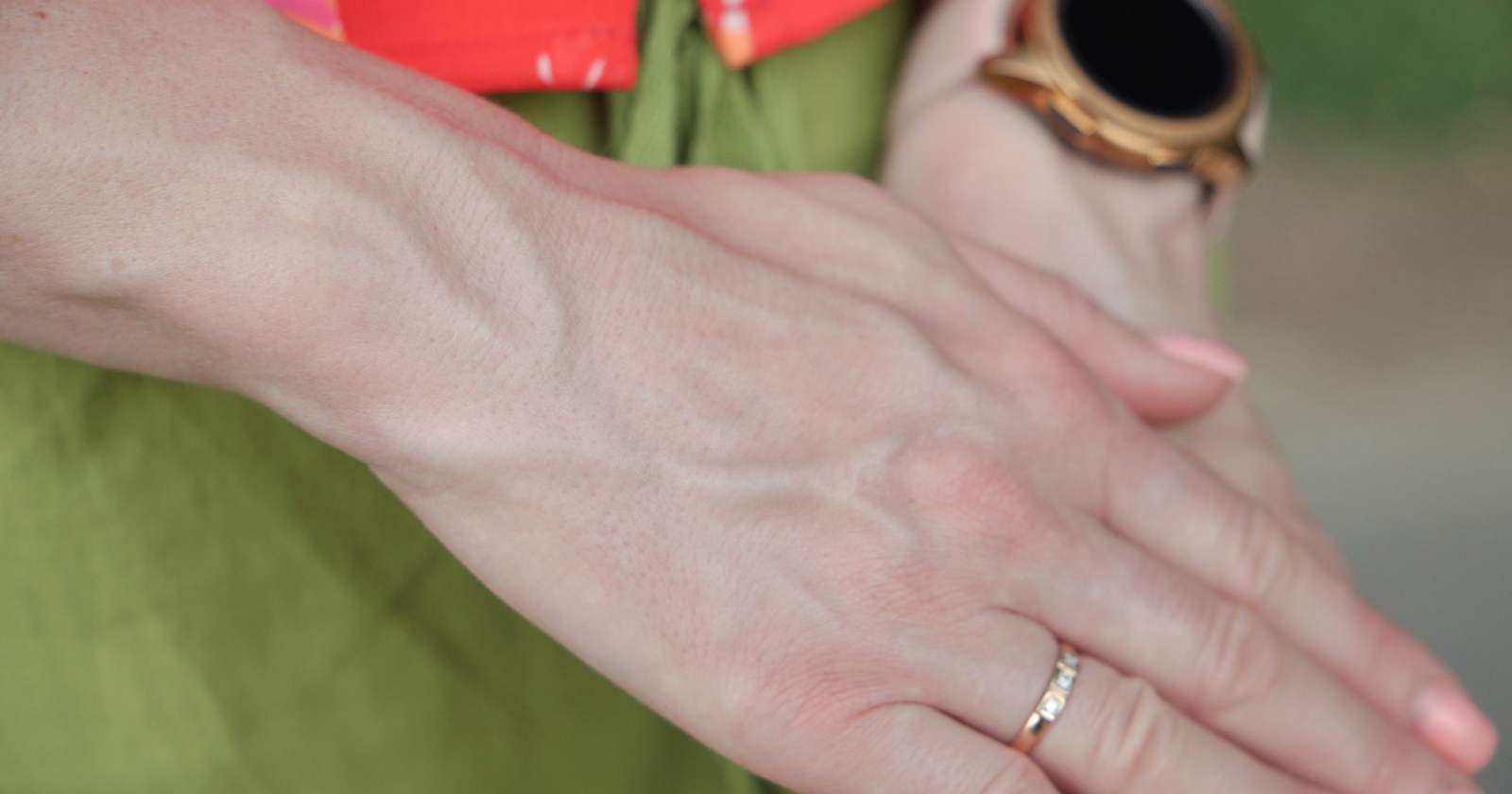
Look at the veins on the back of your hand. They probably read as blue, maybe faintly green, and the anatomy poster on the classroom wall backs you up: arteries in red, veins in blue. But the blood inside those veins has never been blue for a single moment. When it runs low on oxygen it turns a dark burgundy, closer to red wine than to anything cool or blue. The blue you see is not the blood. It is your skin playing a trick with light.
The claim that won’t die
The blue-blood idea is one of the stickiest errors in everyday biology. Every textbook that colours the veins blue for clarity reinforces it. And it survives because it seems to match what you can see on your own wrist. But the observation and the explanation parted ways long ago. Alan Lichtin, a haematologist at the Cleveland Clinic, puts the correction plainly: “Blood is not blue.”
The mix-up is understandable. The diagrams use blue as a label, not as a claim about the real colour. But nobody explains that at age ten, so the colour code hardens into a fact about the body.
What oxygen-poor blood actually looks like
The colour comes down to iron. According to Live Science, “Blood is always red. Every molecule of hemoglobin … contains four atoms of iron, which reflect red light and so give our blood the red color.” Blood leaving the lungs is full of oxygen and a bright cherry red. As it drops that oxygen off to the body, the red deepens toward maroon.
Anyone who has given blood, or watched a vial being drawn, has seen this. The blood is dark, not the bright red of a scraped knee, and certainly not blue. Take the oxygen out and you get burgundy, not sky. That dark red is the true colour of the blood in your veins, before any light or skin gets involved.
The trick of the skin
The blue happens in your eye, not in your vein. Kleber Fertrin, a haematologist at the University of Washington School of Medicine, sums it up in one line: “The colors we see are based on the wavelength that our retina perceives.” The light that reaches your eye after passing through skin is not the same light that went in.
The clearest account comes from a 1996 paper in Applied Optics by Kienle and colleagues, who used imaging and computer models to work it out. Blue light bounces back off the skin before it reaches the vein. Red light goes deeper, and most of it gets soaked up by the dark blood sitting a few millimetres down. More blue light makes it back to your eye than red, so the vein looks bluish, even though the blood absorbing that red light is a deep wine colour.
Depth is what decides it. Fertrin notes that fingertips look pink because the vessels sit so much closer to the surface. When the blood is near the top, the red light survives the trip and you see red. Push the same blood deeper and the illusion returns. As Lichtin describes it, the blue is “an optical illusion created by how light goes through your skin and the vein wall”.
Where blue blood really exists
The myth has one grain of truth, just not about us. Blue blood is real elsewhere in nature. According to the Ecological Research & Development Group, “The blood of the horseshoe crab is blue due to the copper-based oxygen carrying protein hemocyanin.” Octopuses and other creatures use the same copper-based chemistry. Our blood uses iron, which reflects red; theirs uses copper, which turns blue when it grabs oxygen. Blue blood is a genuine thing to find in a rock pool. It is just never inside a human wrist.
Why the myth persists
Part of the reason it sticks is that the illusion is so convincing. You can look at your own veins any time, and the blue is right there, which feels like better evidence than a sentence in a book. There is also a real medical detail that muddies things. When blood oxygen falls far enough, skin and lips can take on a bluish-purple cast, a condition doctors call cyanosis, which tends to show up once oxygen levels drop to around 85 percent. But even then the blood underneath is dark red. The blue is again about how blood and skin scatter light, not about the fluid itself turning blue.
The cost of keeping the myth around is small but not zero. It teaches us early, and by accident, that a diagram’s colour code is a fact about the world, and that what you see is simply what is there. Both lessons are worth unlearning.
Hold a hand up to the light and the vein trick is not a flaw in your eyesight. It is your skin sorting light by wavelength and handing your eye an edited version of what lies underneath. The blood was burgundy the whole time.
