
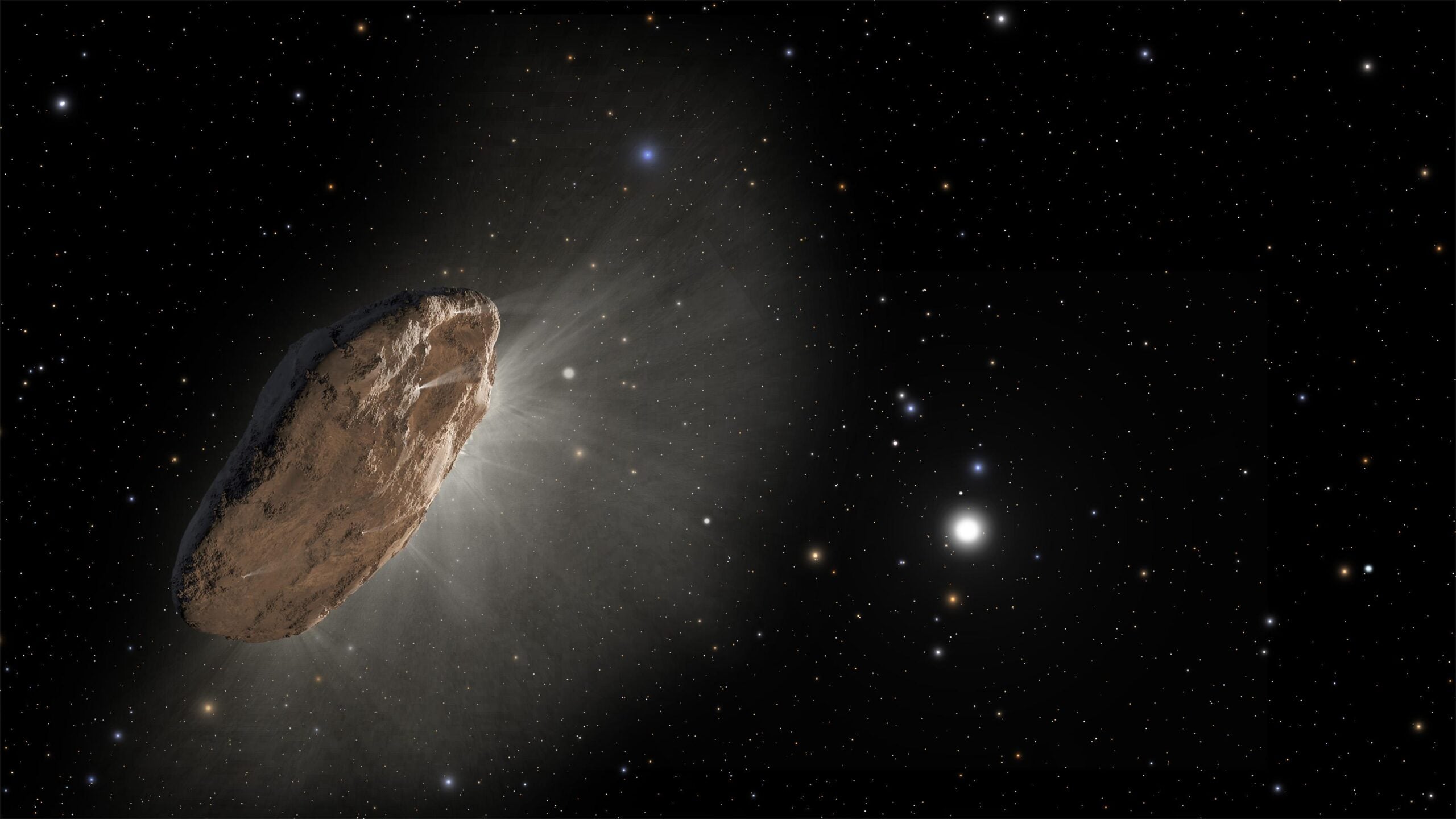
Harvard astrophysicist Avi Loeb, whose suggestion that the interstellar visitor ʻOumuamua could have been artificial made him one of astronomy’s most recognisable and disputed public figures, has been selected to chair a new scientific advisory council examining unidentified anomalous phenomena for the US government.
The appointment puts a scientist already associated in the public imagination with alien technology at the centre of an official effort to bring conventional scientific methods to objects that cannot immediately be identified. Yet the council’s job is not to prove that extraterrestrials are visiting Earth. It is to improve the evidence available to officials trying to distinguish unusual phenomena from aircraft, balloons, drones, satellites, sensor effects and other more familiar explanations.
An outside council advising the government
The institutional details matter because early accounts described the body in ways that could make it sound like a new White House agency. It is instead an external UAP Science Advisory Council supporting an interagency UAP Governance Board established by the Office of the Director of National Intelligence. An ODNI official confirmed that arrangement to DefenseScoop, while The Associated Press reported that Loeb had been chosen to lead the scientific group.
The work follows a presidential directive seeking greater transparency and declassification around UAP records. The advisory council is expected to provide scientific reports and recommendations to the governance board, which brings together officials with responsibilities spanning intelligence, defence and law enforcement. It does not replace the Pentagon’s All-domain Anomaly Resolution Office, commonly called AARO.
Loeb has said the council will work with unclassified information and concentrate on evidence, instruments and methods of analysis. In his description of its remit, he said members would advise on better ways to collect data and evaluate reports. That distinction is crucial. A dramatic video without reliable information about the camera, range, viewing geometry and environmental conditions may remain puzzling, but puzzling is not the same as physically extraordinary.
Why Loeb’s name carries so much weight
Loeb is the Frank B. Baird Jr. Professor of Science at Harvard and previously chaired the university’s astronomy department. Long before the UAP debate, he built a substantial career in theoretical astrophysics, working on subjects including the first stars, black holes and the early universe. His public identity changed after the 2017 discovery of 1I/ʻOumuamua, the first object observed passing through the Solar System on a trajectory showing that it came from interstellar space.
ʻOumuamua was strange even by the standards of a first-of-its-kind discovery. Its brightness varied sharply as it rotated, no obvious coma or tail was seen, and precise tracking revealed a small acceleration away from the Sun that gravity alone did not explain. Most astronomers have treated it as a natural object whose unusual behaviour reflected incomplete observations of an unfamiliar kind of comet or fragment.
Loeb and Shmuel Bialy examined whether sunlight pushing on an extremely thin object could account for the acceleration. Their 2018 paper in The Astrophysical Journal Letters discussed a light sail of artificial origin as one possible interpretation. The calculation did not establish that ʻOumuamua was technology, but Loeb continued to argue that the artificial hypothesis deserved serious consideration rather than automatic rejection.
Natural explanations have continued to appear. One model published in Nature proposed that hydrogen produced by cosmic-ray processing inside an icy body could have been released during its passage near the Sun, generating acceleration without a bright dusty display. Researchers still debate whether that mechanism and other natural models account for all the observations. There is no direct evidence that ʻOumuamua was manufactured.
UAP does not mean alien spacecraft
The modern government term UAP is deliberately broader than the familiar word UFO. It covers anomalous reports in the air, space and under water, including objects that appear to move between domains. The label describes an observation that has not yet been resolved. It does not name a cause.
AARO says the US government has found no verifiable evidence of extraterrestrial beings, activity or technology. Its historical review concluded that most investigated sightings were ordinary objects or phenomena, while many of the cases left unresolved lacked enough good data for a confident identification. NASA reaches the same central point in its UAP guidance: there are no data supporting the idea that UAP are evidence of alien technologies, and the scarcity of high-quality observations makes firm scientific conclusions difficult.
That leaves a real problem worth studying. Military aviators and sensors sometimes report things they cannot identify. Even if every case ultimately has a conventional explanation, an inability to recognise a drone, balloon, aircraft or sensor artefact can expose gaps in surveillance and flight safety. If a small residue withstands careful analysis, researchers need measurements good enough to describe exactly what remains unexplained.
A deliberately mixed group
The council is being assembled as a multidisciplinary body rather than a panel of astronomers alone. Publicly identified participants bring experience in areas such as data science, artificial intelligence, instrumentation, oceanography, biology, psychology and the philosophy of science. The reported membership includes Stanford researcher Garry Nolan, oceanographer and retired Rear Admiral Tim Gallaudet, physicist Matthew Szydagis, philosopher Carol Cleland and science writer and sceptic Michael Shermer.
That mixture could be useful. Instrument specialists can interrogate what a sensor was capable of recording. Data scientists can look for patterns without treating every anomaly as the same phenomenon. Psychologists can help evaluate perception and memory in witness accounts. Sceptics can pressure-test interpretations, while researchers willing to entertain unusual hypotheses can ask whether standard explanations genuinely fit.
The risk is equally clear. Loeb’s willingness to foreground alien technology has won attention for questions that many scientists once avoided, but it has also prompted criticism that speculative possibilities sometimes receive publicity ahead of decisive evidence. Former AARO director Sean Kirkpatrick questioned whether Loeb’s background prepared him for the national-security aspects of the work, according to the AP report. The council’s credibility will therefore depend less on its chair’s profile than on transparent standards, reproducible analysis and a clear separation between observations and hypotheses.
The hardest problem may be the data
NASA’s independent UAP study made the problem blunt: data are the lifeblood of science. Its 2023 report called for calibrated instruments, consistent metadata and systematic observations. Those are rarely available for famous historical sightings, which often involve short clips, classified sensor capabilities, uncertain distances or testimony recorded after the event.
The new council’s access only to unclassified material may help it communicate publicly, but it may also prevent members from seeing the full technical context behind some military cases. It is not yet clear how often the council will report, how its recommendations will be published, or how much raw information outside researchers will be able to examine.
A scientifically successful council would not be measured by the number of cases it labels extraordinary. Resolving a supposed anomaly as a balloon or an image-processing effect would be useful. So would identifying which details future sensors must record to avoid the same ambiguity. For cases that remain open, success would mean replacing suggestive language with measurable constraints on speed, distance, temperature, shape and behaviour.
Loeb’s appointment guarantees attention because it joins two subjects already attached to his name: the search for extraterrestrial technology and the demand that unusual observations be tested rather than ignored. Whether the council changes the UAP debate will depend on a more ordinary scientific discipline. It must collect better evidence, expose its reasoning to scrutiny and accept a mundane answer whenever the data support one.
