
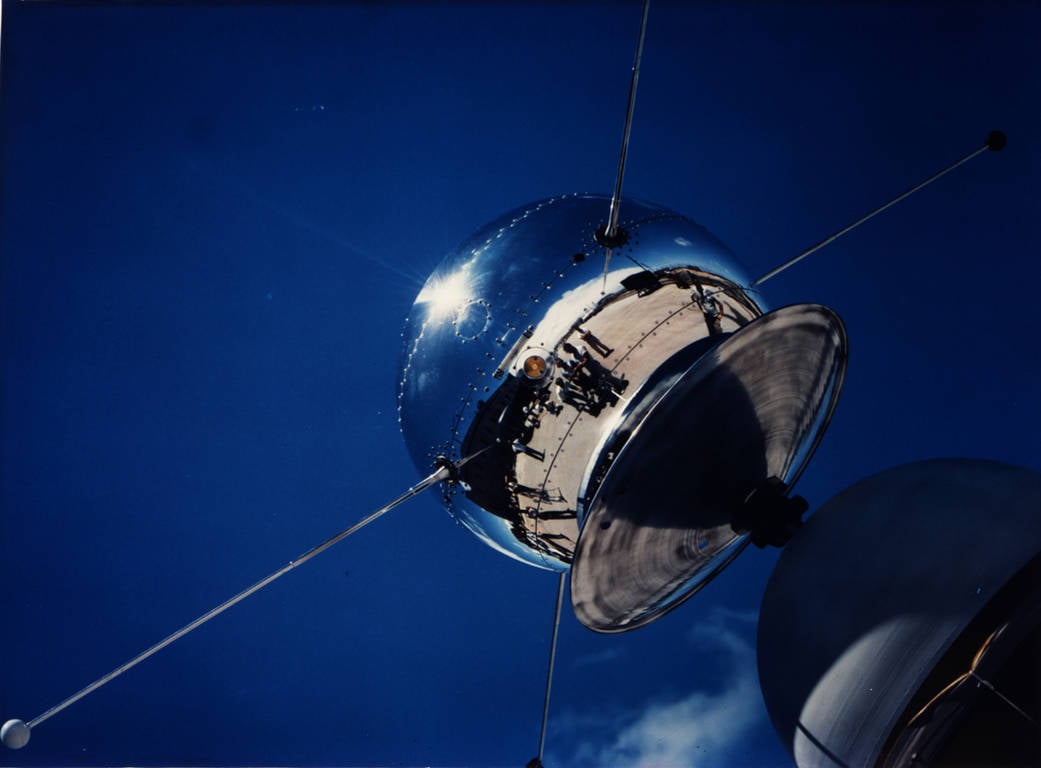
On 17 March 1958, a three-stage rocket lifted a polished aluminium sphere from Cape Canaveral and placed it in a long, elliptical orbit around Earth. Vanguard 1 was only 16.3 centimetres across and weighed about 1.5 kilograms. Six thin aerials made it look larger, but the spacecraft itself really was close to the size of a grapefruit.
Nearly seven decades later, it is still there. NASA identifies Vanguard 1 as the oldest human-made object remaining in Earth orbit. Its radio transmitters have been silent since 1964, yet observers can still track the sphere from the ground as it completes one circuit after another.
The claim that it will remain overhead for “another few centuries” needs some restraint. NASA has published an estimated orbital lifetime of about 240 years from launch, which would put re-entry around the end of the 22nd century. That is closer to another two centuries than an assured several centuries, and no forecast made that far ahead can supply a firm re-entry date.
The fourth satellite became the oldest survivor
Vanguard 1 was not the first satellite. It was the fourth, following Sputnik 1, Sputnik 2 and Explorer 1. It was also only the second successful American satellite. Those earlier spacecraft entered lower orbits and eventually fell back into the atmosphere. Vanguard 1 began with a perigee of roughly 650 kilometres and an apogee close to 4,000 kilometres, leaving most of each orbit far above the dense air that brings low satellites down.
That distinction matters. “Oldest object in orbit” means the earliest launched object that remains there, not the first object ever launched into orbit. Pieces of the Vanguard launch vehicle also remain in orbit from the same mission, but Vanguard 1 retains the clearer title of the oldest surviving satellite.
Project Vanguard had been chosen as the United States’ contribution to the International Geophysical Year. Its first satellite launch attempt, Vanguard TV-3, rose less than two metres on 6 December 1957 before losing thrust and exploding on the pad. Explorer 1 became the first successful American satellite on 31 January 1958. Vanguard 1 followed six weeks later, turning a programme associated with a highly public failure into one of the longest-running artefacts of the early space age. NASA’s history of Project Vanguard places that success within the creation of the agency’s Goddard Space Flight Center.
A simple spacecraft with an important new power source
The sphere carried no camera, propulsion system or computer. Inside were two radio transmitters and temperature sensors. One transmitter ran from a mercury battery. The other drew electricity from six small silicon solar-cell panels mounted on the outside of the sphere, making Vanguard 1 the first solar-powered satellite.
The battery transmitter lasted only until June 1958. The solar-powered transmitter continued until May 1964, when the last signal was received at a tracking station in Quito, Ecuador. The dates are set out in a NASA account published for Vanguard 1’s 50th anniversary. The spacecraft has been radio-silent ever since.
Silence did not make it invisible. Radar and optical observations can establish an object’s orbit without any working equipment aboard it. Vanguard 1 therefore continued to yield information after its transmitter stopped. Small changes in the path could be measured against predictions, allowing researchers to infer forces acting on the satellite.
The orbit became the instrument
Vanguard 1’s scientific importance was not limited to the temperatures relayed while its radios worked. Precise tracking showed that Earth’s shape was not a perfectly symmetrical flattened sphere. Differences in the satellite’s motion helped geodesists refine a slightly pear-shaped description of the planet, with a small asymmetry between the northern and southern hemispheres.
Researchers also used the orbit to study the density of the upper atmosphere and the effects of solar radiation pressure. Sunlight carries momentum, so even a tiny, light spacecraft can be nudged over time. Changes in solar activity can warm and expand the outer atmosphere, increasing drag at altitudes where it is normally extremely thin. NASA’s detailed history of the Vanguard science programme describes how tracking the little sphere exposed those effects.
This is why a satellite with almost no onboard instrumentation could remain scientifically useful. Its known size, low mass and long-lived orbit made it a test particle moving through a complicated gravitational and atmospheric environment. The spacecraft sent measurements for six years, but its trajectory itself carried a longer record.
Why the lifetime estimate changed
Early projections suggested Vanguard 1 might remain in orbit for about 2,000 years. That figure was later reduced to 1,000 years and then to roughly 240 years. The revisions reflected a better understanding of how solar radiation pressure, atmospheric drag and periods of high solar activity alter the orbit of a small, light object.
The present figure should not be treated as a countdown. Drag at Vanguard 1’s altitude varies with the Sun’s 11-year activity cycle and with rarer solar events. The orbit is also perturbed by the gravity of the Moon and Sun and by Earth’s non-uniform gravity field. Small differences accumulated over more than a century can shift a predicted decay date substantially.
NASA’s 240-year estimate implies a broad re-entry period around 2198. From 2026, that is about 172 years away. Other descriptions round the residual lifetime differently, which explains why Vanguard 1 is often said to have “centuries” left. The reliable conclusion is less exact: it is likely to survive well into the next century and probably into the one after that, not that anyone knows the day or even the decade when it will return.
An artefact and a piece of orbital debris
Vanguard 1 occupies two categories at once. It is a historic spacecraft whose solar cells helped establish a power system now used across the satellite industry. It is also an uncontrolled object with no ability to manoeuvre or remove itself from orbit. In the language of present-day space operations, it is orbital debris.
The sphere is too small and too distant to pose the kind of immediate collision concern associated with crowded low Earth orbit. Its long survival nevertheless illustrates a basic feature of orbital mechanics: reaching space and remaining there are different problems. At sufficiently high altitude, the atmosphere may take centuries to erase the energy supplied by a launch vehicle in a few minutes.
Ground observers have never needed the satellite to announce itself in order to know where it is. NASA’s spacecraft catalogue entry for Vanguard 1 preserves the mission record and orbital parameters under its international identifier, 1958-002B. The catalogue is the modern continuation of a tracking effort that began when the satellite was one of only a handful of artificial objects above Earth.
Vanguard 1 was built to transmit modest measurements during the opening months of the satellite era. Instead, its most enduring result has been its persistence. The grapefruit-sized sphere no longer reports anything from orbit, but every pass is a quiet demonstration of the height it reached in 1958, the weakness of drag there, and the long physical afterlife that a launch can create.
