
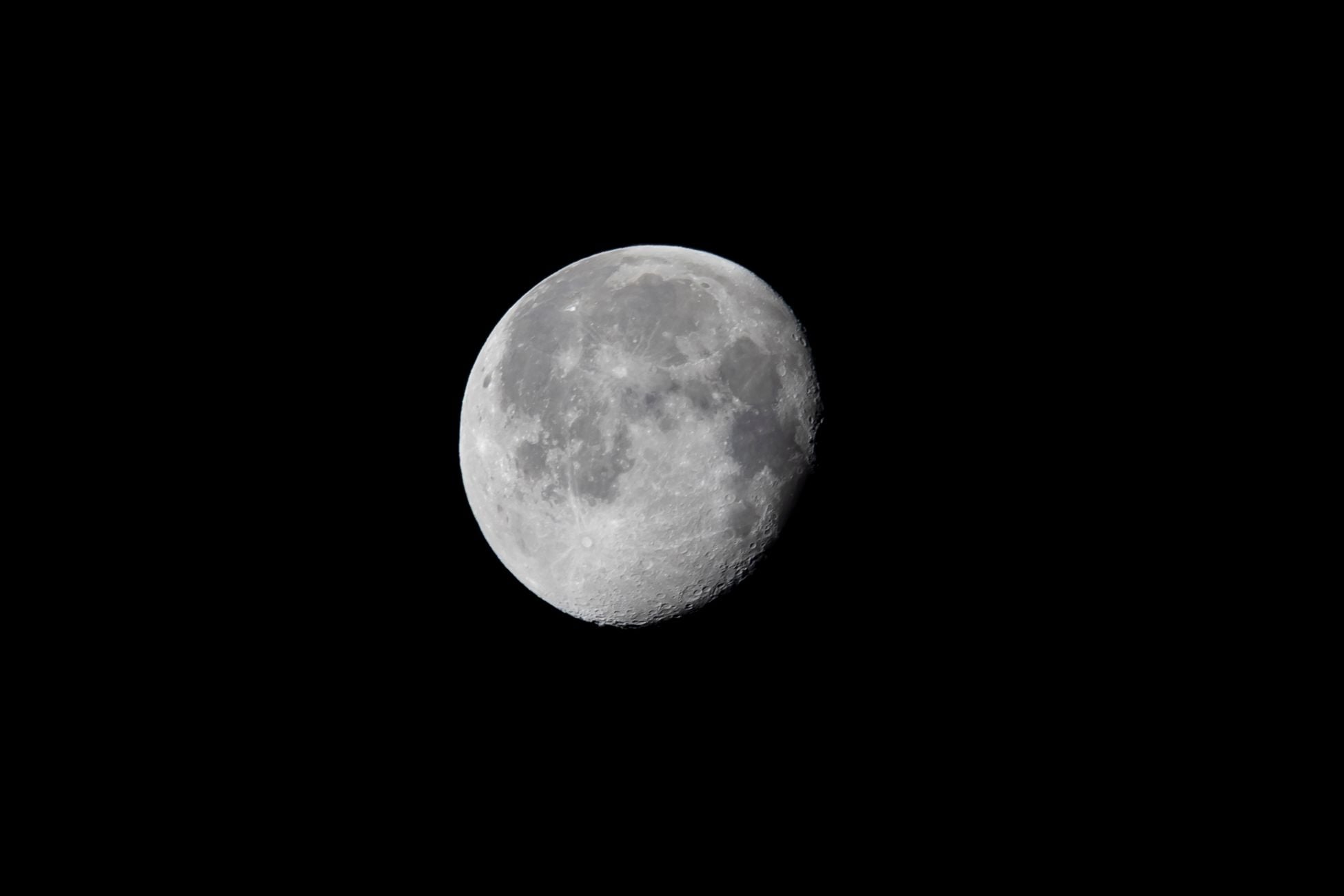
On the night of August 1, 1969, a green pulse of light left a telescope at the Lick Observatory in California, travelled a quarter of a million miles to the Sea of Tranquillity, struck a suitcase-sized panel of 100 fused-silica prisms that Buzz Aldrin had placed on the lunar dust eleven days earlier, and came back. The round trip took about 2.5 seconds. That single returned photon — one out of roughly 10^17 sent — marked the beginning of a measurement programme that is still running in 2026, and it is how we know, to the millimetre, that the Moon is sliding away from Earth at 3.8 centimetres a year.
That is roughly the rate your fingernails grow.
Over a human lifetime it adds up to about three metres. Over the 4.5 billion years since the Moon formed, it adds up to the reason our nearest neighbour now sits 384,400 kilometres away instead of hugging the young Earth at what some models put at less than a tenth of that distance.
The mirrors that never needed batteries
Apollo 11, 14 and 15 all carried retroreflector arrays. The Soviet Lunokhod 1 and 2 rovers carried two more. Five reflectors, all passive — no power supply, no electronics, no moving parts. Just corner-cube prisms cut so that any photon striking them bounces back in exactly the direction it came from, regardless of the angle of incidence.
That geometric trick is why the experiment has outlived every other piece of Apollo hardware still on the Moon. There is nothing to break. The prisms sit in the vacuum, cycling through 250-degree temperature swings every lunar day, and continue to return light. As the reflector experiment marked its 50th anniversary, it was still the longest continuously running experiment of the Apollo era.
The observatories that shoot at them have changed. The mirrors have not.
How you measure a quarter of a million miles to the millimetre
The technique is called lunar laser ranging. A telescope — historically at the McDonald Observatory in Texas, the Observatoire de la Côte d’Azur in France, and Apache Point in New Mexico — fires a short, powerful pulse of laser light at a known reflector site. A detector on the same telescope waits for the return. Time the round trip precisely enough, and you know the distance.
The pulses last a few tens of picoseconds. The clocks used to time them are atomic. The maths has to account for the atmosphere refracting the beam, Earth’s rotation shifting the telescope during flight, the tides deforming the ground the telescope stands on, and the relativistic warping of spacetime between here and there.
What comes out is a distance figure accurate to within a few millimetres on an object nearly 400 million metres away. That is the equivalent of measuring the distance from New York to Los Angeles and being off by less than the width of a human hair.
The precision distance measurement techniques now used across physics and industry trace much of their pedigree back to the demands of experiments like this one.
Why the Moon is leaving
The recession is driven by tides — but not the ones you see at the beach in an obvious way.
Earth spins once every 24 hours. The Moon orbits once every 27.3 days. Because Earth rotates faster than the Moon orbits, the tidal bulge the Moon raises in Earth’s oceans and crust is dragged slightly ahead of the Moon itself. That off-axis bulge has mass, and its gravitational pull tugs the Moon forward along its orbit.
Adding energy to an orbit makes it wider. The Moon climbs to a higher orbit, and in exchange it steals angular momentum from Earth’s rotation. Earth’s day is getting longer as a direct consequence.
Scientific American has laid out what this means over deep time: the Moon will keep drifting outward until the Sun swells into a red giant and consumes the whole system before the process finishes.
Aldrin’s suitcase
The Apollo 11 array Aldrin deployed contained 100 corner cubes in a 46-centimetre panel. He placed it near the lunar module, aimed roughly at Earth using a small sun-compass built into the frame. There was no follow-up alignment. Whatever tilt he set on 21 July 1969 is the tilt it still has.
The Apollo 14 array, deployed by Alan Shepard in 1971 (who famously hit golf balls on the Moon during that mission), is functionally identical. The Apollo 15 array, larger with 300 cubes, was carried by David Scott and remains the strongest signal returner of the five. That extra photon budget matters — as RedShark News noted in its account of the technology, the Apollo 15 reflector is the workhorse for most modern ranging campaigns.
And it settles a separate argument. Any observatory on Earth with the right equipment can bounce a laser off those panels and get a return. The reflectors are where the astronauts said they left them. The signal is not ambiguous.
The number is not constant
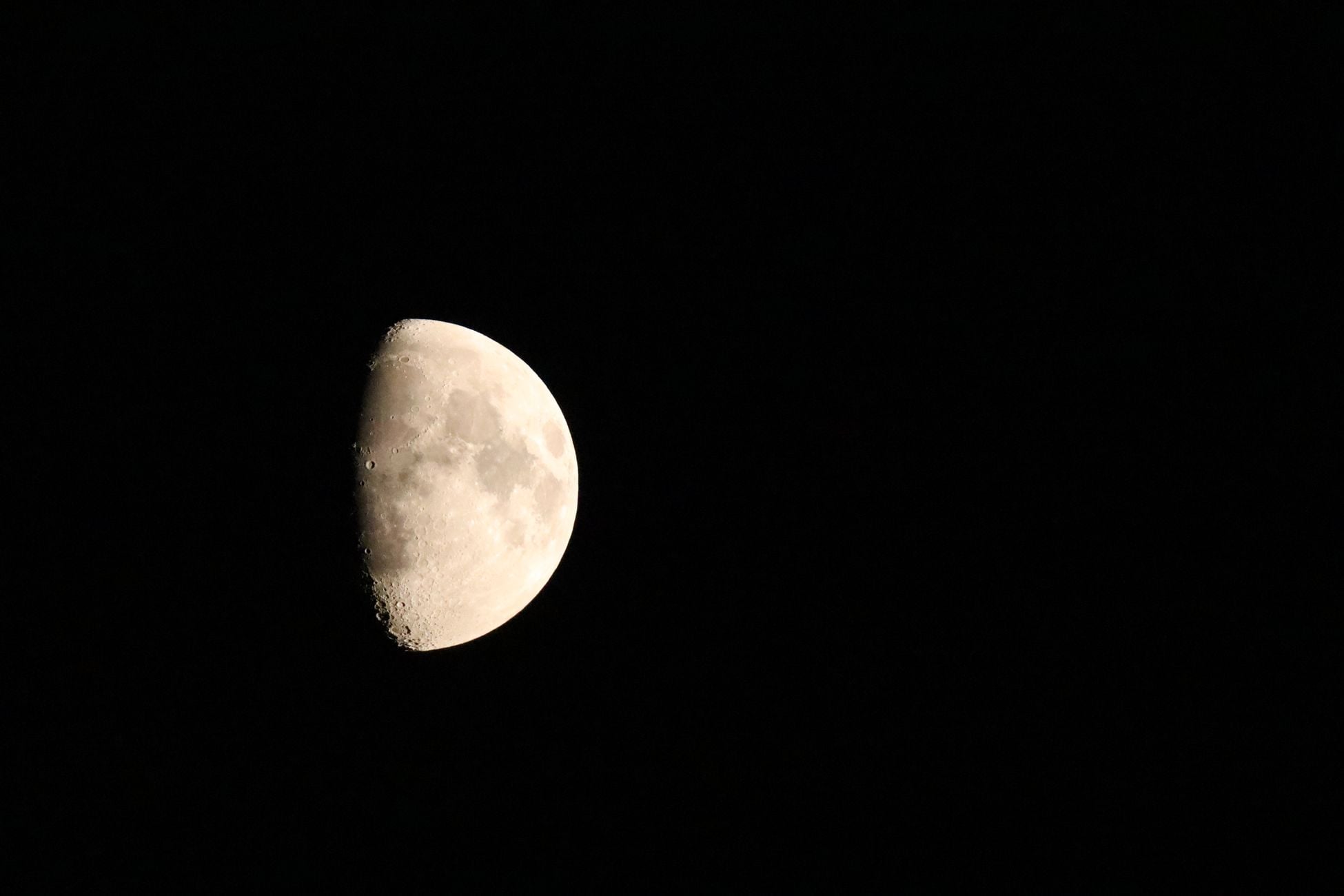
3.8 centimetres a year is the modern rate, not the historical average.
Tidal recession depends on the geography of Earth’s oceans, because ocean basins resonate at particular frequencies and amplify or damp the tidal bulge. The current arrangement of continents — Atlantic narrow and north-south, Pacific wide, a shallow Arctic — happens to produce unusually strong tidal friction. Geological evidence from tidal rhythmites, layered sediments that record ancient tidal cycles, suggests the Moon was receding more slowly for most of Earth’s history.
Run the current rate backwards and the Moon collides with Earth about 1.5 billion years ago, which is obviously wrong. The real curve is much shallower for most of the past, and steepened only when the continents drifted into their current tide-amplifying configuration.
What the millimetres are telling physicists
Lunar laser ranging is not really about the Moon anymore. It is one of the most stringent tests of general relativity anyone has ever run.
Einstein’s theory predicts that a massive body like Earth should fall towards the Sun at exactly the same rate as its Moon does — the equivalence principle applied to gravitating bodies. If Earth and the Moon fell at even slightly different rates, the Moon’s orbit would deform in a way the lasers could see. After more than fifty years of ranging, no such deformation has appeared. Einstein keeps winning.
The data has also constrained hypothetical variations in the gravitational constant G, tested whether gravity leaks into extra dimensions, and pinned down the size and state of the Moon’s liquid outer core by watching how the whole body flexes as it orbits.
The next generation of mirrors
The Apollo reflectors are showing their age — not mechanically, but through accumulated dust. Lunar dust levitates electrostatically during the terminator crossing, and after five decades a thin coating has degraded the signal compared to the 1970s.
NASA’s forthcoming Artemis missions and commercial lunar landers are carrying a new generation of single-cube reflectors, small enough to fit on a rover but designed to return a sharper pulse. China has also joined the ranging club: in 2025, a team successfully ranged the Tiandu-1 satellite at roughly 130,000 kilometres, a step toward independent lunar-distance measurements from Asian observatories.
Voyager 1 has drifted so far that a light-speed signal now takes nearly a full day to reach it. The Moon, by contrast, sits close enough that we can still see it drifting away one fingernail-width at a time.
A silent experiment
Something worth holding on to about all this: nobody on the Apollo crews had to do anything clever after deployment. Aldrin placed the panel, checked the level, walked away. Shepard did the same. Scott did the same. And for fifty-seven years the mirrors have sat in vacuum, cycling through lunar noons of 120°C and lunar midnights of -170°C, catching photons from telescopes their builders never met and sending them back.
The Apollo missions are sometimes described as an artefact of the Cold War — a spike of political will that produced twelve moonwalks and then vanished. As recent Artemis coverage has pointed out, one of the sturdiest rebuttals to any argument that the landings were faked is a mirror that anyone with a big enough telescope can still ping tonight.
Above your head, right now, five small panels are sitting in dust that has not been disturbed since the Nixon administration. Somewhere in California, or Texas, or the south of France, a green pulse is climbing out of the atmosphere towards one of them. In 1.25 seconds it will strike a corner cube. In another 1.25 seconds a handful of photons will return.
And the Moon, in that time, will have moved another 3 nanometres further away.
