
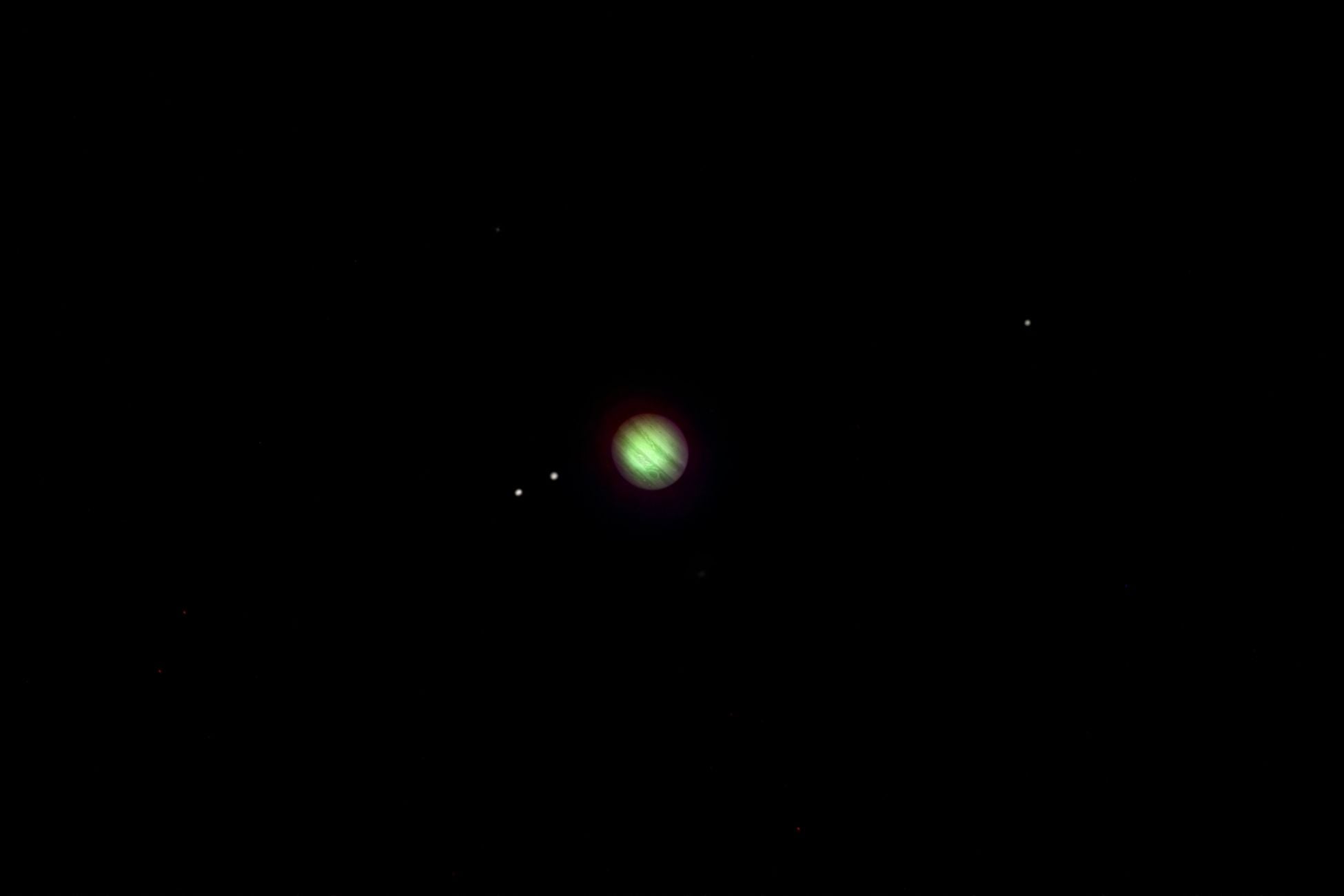
Jupiter, the largest planet in the solar system, tugs on our oceans with a force equal to roughly two-thousandths of one per cent of the Moon’s pull. Line up every other planet behind it — Venus at its closest approach, Mars, Saturn, the whole gravitational choir — and the combined tidal effect on a coastal tide gauge is smaller than the pressure change caused by a passing weather front. The Moon, a rocky ball sitting roughly 384,000 kilometres away, wins by a landslide that isn’t even close.
This is the fact that keeps resurfacing every time a viral post promises that a “planetary alignment” will trigger earthquakes, drain the oceans, or briefly cancel gravity. NASA has had to publicly debunk one such claim about Earth losing gravity in August 2026, a rumour that spread across social media before the year had even begun. The physics behind why these alignments do essentially nothing is worth sitting with, because the numbers involved are so lopsided they border on comic.
The reason distance beats mass, badly
Tidal force is not the same as gravitational force. Gravity pulls with a strength proportional to mass divided by distance squared. Tides, though, are about the difference in gravity between the near side of Earth and the far side — and that difference falls off with distance cubed, not squared. Cube the distance to Jupiter and the number becomes so large it swamps almost anything mass can contribute.
Jupiter at its closest is about 588 million kilometres from Earth. The Moon is 384,000 kilometres away. Jupiter is roughly 1,500 times farther. Cube that ratio and you get a number in the billions. Jupiter would need to be billions of times more massive than the Moon just to match its tidal pull. The gap between what Jupiter has and what Jupiter would need is enormous.
Run the math for the whole planetary lineup and the total tidal tug from every planet in the solar system, aligned in a straight line, comes to something on the order of a few parts per million of the Moon’s contribution. A stiff barometric pressure swing from an incoming storm — a millibar or two — moves sea level more than the entire planetary parade could dream of doing.
What actually raises the tides
The Moon does the majority of the work. The Sun, despite being far more massive than the Moon, contributes a smaller share because it sits much farther away and that distance-cubed penalty is brutal. When the Sun and Moon align at new and full moons, their combined pull produces spring tides — the highest highs and lowest lows of the month. When they pull at right angles, we get neap tides. Everything else in the sky is noise beneath the noise.
The relationship between mass, distance, and tidal effect has been tested in laboratories at the sub-millimetre scale, where physicists probe whether Newton’s inverse-square law holds at very short ranges. Experiments described in the Nature Index summary of these tests have found no deviation from the classical prediction down to distances smaller than a grain of sand. The math that says Jupiter can’t move our oceans is the same math that governs how a torsion balance in a basement laboratory responds to a lead weight the size of a marble.
The Jupiter number, spelled out
Two-thousandths of one per cent. Written as a decimal, that is 0.00002 — or two parts in 100,000. If the Moon raises a tide of one metre in the open ocean, Jupiter contributes about 20 micrometres. That is a few red blood cells laid end to end, and a few dozen times the wavelength of visible light. A number that small does not move water you could ever measure at a beach.
Venus is the one planet worth pausing on, and it proves the rule rather than breaking it. Venus weighs far less than Jupiter, but it swings much closer to Earth, and because the distance term is cubed that proximity wins out: Venus actually exerts a stronger tidal pull on our oceans than Jupiter — it is the strongest planetary tidal influence Earth feels, several times Jupiter’s. Even so, at its maximum that pull is thousands of times weaker than the Sun and Moon together, only a few thousandths of one per cent of the Moon’s effect. Mars, smaller still and rarely nearby, is a rounding error on a rounding error. When astronomers describe a planetary parade like the Mercury-Venus-Jupiter grouping visible in June 2026, they are talking about a visual arrangement in the sky, not a gravitational event. The planets look close because they line up along a line of sight. They are not physically close and they do not pull together in any meaningful way.
Weather fronts do more
A change of one millibar in atmospheric pressure — the kind of shift that happens routinely as a low-pressure system rolls across a coastline — raises or lowers sea level by about one centimetre. Storm surges from hurricanes can push sea level up by several metres in a matter of hours. Storm surges can exceed eight metres in places. Wind piles water against shorelines. Temperature gradients drive thermal expansion. Seasonal changes in ocean currents move sea level by tens of centimetres. Every one of these effects dwarfs the tidal pull of every planet in the solar system combined, by margins so vast that the comparison feels almost unfair.
Why the Moon is such a heavyweight
The Moon’s grip on Earth is not just historical accident. Over billions of years, the tidal interaction between Earth and Moon has been slowly transferring rotational energy from Earth to the Moon’s orbit. The Moon drifts outward by about 3.8 centimetres per year. Earth’s day gets longer. According to calculations of this tidal braking, Earth won’t reach a 25-hour day for roughly 200 million years. The engine driving that change is the same lunar tidal force that dominates our oceans today.
No planet does anything comparable to Earth. Jupiter’s gravitational influence on Earth’s orbit around the Sun is real — it perturbs our orbital elements over long timescales, shifts the eccentricity of the orbit by small amounts across millions of years, and helps shape the architecture of the inner solar system. But that is a completely different phenomenon from tidal force on the oceans. Long-term orbital perturbations and daily tidal bulges are not the same thing, and confusing them is where a lot of the viral misinformation gets its start.
The speculative fringe
Every so often a paper does explore whether distant gravitational bodies could have shaped Earth’s history in dramatic ways. A recent hypothesis considered whether rogue planetary flybys could have triggered mass extinctions by destabilising the orbits of Earth or nearby bodies. These are exotic scenarios involving objects passing within the inner solar system — nothing like the ordinary alignments of the known planets, which are millions of kilometres apart and moving on well-behaved orbits.
Even in the case of hidden oceans on distant icy moons, where gravitational effects from parent planets are enormous, the physics is dramatically different. On Europa or Enceladus, tidal flexing from Jupiter or Saturn drives heat into a subsurface ocean because those moons are locked in tight, elliptical orbits around massive planets at ranges of hundreds of thousands of kilometres — the same geometry Earth has with the Moon, but in reverse. Recent modelling suggests those hidden oceans may even be boiling beneath the ice from the heat that tidal squeezing generates. That is what real tidal coupling looks like: a moon caught in the grip of a nearby giant, not a giant planet sitting half a billion kilometres away.
Perfect alignments don’t happen anyway
The planets orbit the Sun in planes that are tilted slightly against each other. A truly straight-line, ruler-precise alignment of all eight planets is effectively impossible. What people call “alignments” are windows during which several planets appear within a narrow arc of the sky as seen from Earth — a visual coincidence, not a gravitational configuration. Even if every planet did line up perfectly, the calculation above still applies. The tidal budget of the entire solar system, minus the Sun and Moon, is a rounding error.
None of this diminishes the strangeness of the fact. Jupiter is a world 11 times the diameter of Earth, wrapped in storms larger than continents, with four moons Galileo saw through his telescope in 1610. It is a genuinely enormous object. And yet the tug it exerts on the water at a beach in California is smaller than the pressure signature of a cold front that will arrive tomorrow morning.
Twenty micrometres of Jupiter
Next time a viral post warns about a planetary alignment cancelling gravity or moving the oceans, picture the actual number. A tide of twenty micrometres from the largest planet in the solar system. A blood cell’s worth of Jupiter. The distance-cubed law is unglamorous — no one puts it on a t-shirt — but it explains why our world runs on the Moon and the Sun, and why the rest of the sky, for all its size and drama, barely touches the water at all.
