
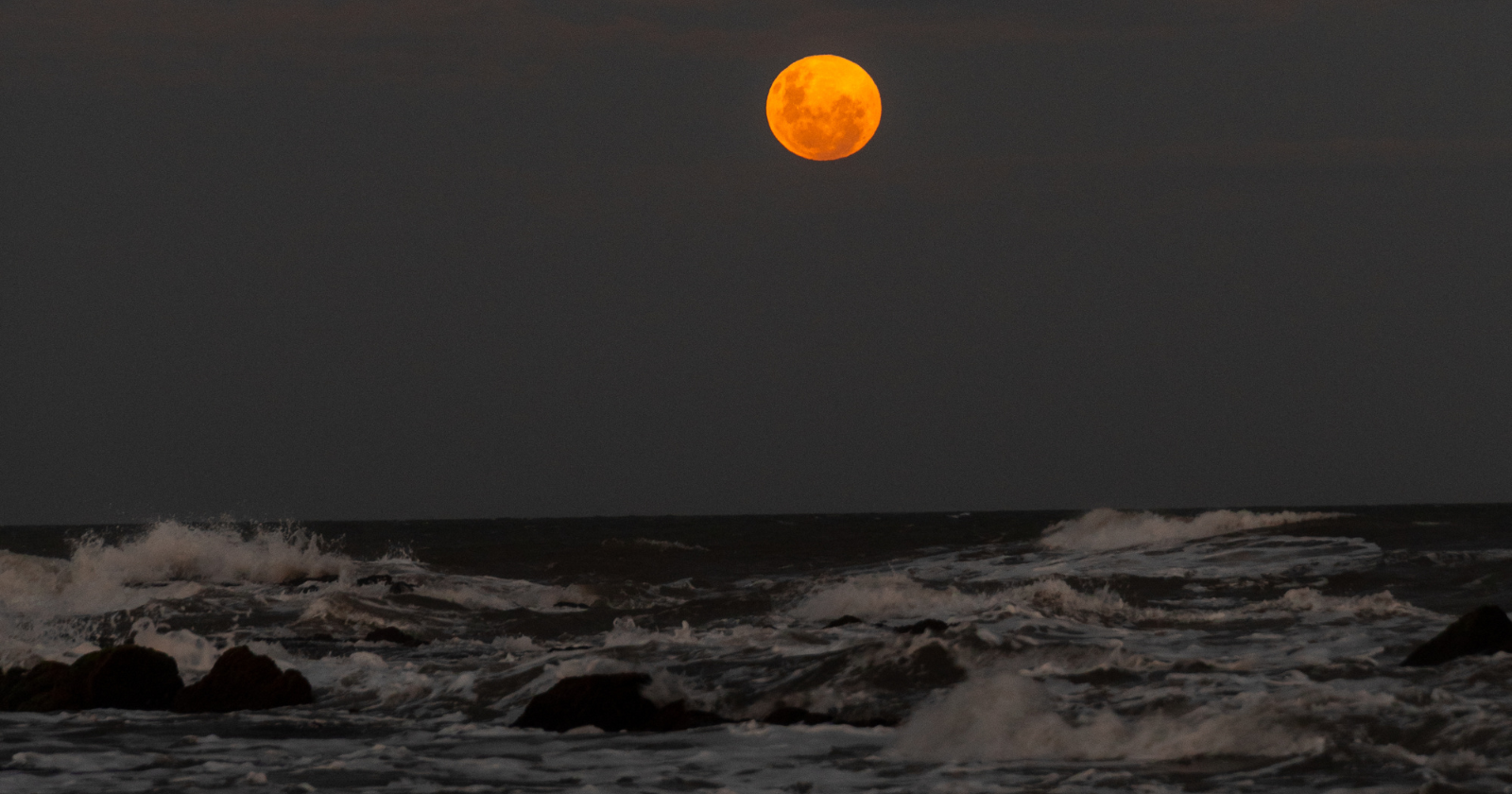
Isaac Newton worked out the answer in Book III of the Principia in 1687, and the numbers still surprise anyone who meets them for the first time. The Sun weighs about 27 million times more than the Moon. It sits 333,000 times more massive than the Earth. And yet, when the tide rolls up a beach in Cornwall or drops the mudflats of the Bay of Fundy by fifteen metres twice a day, the Moon is doing most of the pulling. The Sun contributes only about 46 percent as much tidal force as the Moon, despite outweighing it beyond comprehension.
The reason is buried in one word: difference.
Tides are a subtraction problem
Gravity between two bodies weakens with the square of the distance between them. Tides, though, do not care about gravity itself. They care about how much that gravity changes from one side of the Earth to the other. The near side of the Earth is pulled slightly harder than the centre. The far side is pulled slightly less. The planet gets stretched, very gently, along the line to whatever is pulling on it. Oceans, being liquid, respond first.
That stretching force falls off not with the square of distance, but with the cube of it. Double the distance to a body, and its tidal effect drops by a factor of eight. Distance kills tides much faster than it kills gravity.
The Moon sits about 384,000 kilometres from Earth. The Sun sits about 150 million kilometres away, roughly 390 times farther. Cube that ratio and you get a number close to 59 million. So even though the Sun is 27 million times heavier, the cube-of-distance penalty knocks its tidal pull down to roughly half of what the Moon manages. The exact figure, worked out from modern measurements, is about 46 percent.
What Newton actually calculated
When Newton laid this out, he had no way to weigh the Sun or the Moon directly. Working from Kepler’s orbital laws and the motion of the Moon around Earth, he did something cleverer than a direct measurement: he used the observed ratio of spring tides to neap tides to argue that the Moon’s tide-raising force must be stronger than the Sun’s, and that the Moon therefore had to be the denser of the two bodies. That qualitative conclusion — the closer, smaller body wins — has stood ever since.
His numbers, though, were rougher than his reasoning. Newton badly overestimated the Moon’s mass, putting it at roughly a fortieth of the Earth’s when the true figure is closer to one eighty-first, and his estimate of the Sun’s tidal pull came out near a quarter of the Moon’s rather than the modern value. The precise figures arrived only with later measurement. Today the Sun’s mass is put at about 27,068,700 times the Moon’s, and the distances have been pinned down by radar and laser ranging — but the shape of the argument, that the difference in gravity across a planet is what raises the tide and that it falls off with the cube of distance, is Newton’s.
The Sun holds about 99.86 percent of the mass in the entire solar system. Everything else — Jupiter, Saturn, Earth, every asteroid, every comet, the Moon, you — makes up the remaining fraction of one percent. Yet on any given afternoon, the tide clock on the wall of a harbourmaster’s office in Bristol is set by the smaller body.
Spring tides and neap tides
The 46 percent figure explains something anyone who has watched tide tables for a while already notices. Twice a month, the tides get bigger. Twice a month, they get smaller. These are the spring tides and neap tides, and they are the Sun asserting itself.
At a full moon or a new moon, the Sun, Earth, and Moon line up. The two tidal bulges add together. Spring tides — nothing to do with the season, everything to do with the water springing up — can be dramatically higher than average, especially in bays with the right resonance. The new moon in particular stacks the pulls end to end.
At first and third quarter, the Sun and Moon pull at right angles. The solar bulge partially cancels the lunar one. High tides run lower, low tides run higher, and the whole rhythm of the shoreline flattens out for a few days. If the Sun were negligible, this cycle would not exist. If the Sun matched the Moon, the tides at quarter phases would nearly vanish. The 46 percent ratio is exactly what produces the modest, twice-monthly swing between spring and neap that mariners have been reading for thousands of years.
Why the cube, not the square
The step from square to cube is where most explanations lose people, and it is worth slowing down for. Take Newton’s law of gravity: force falls off as 1 over distance squared. Now imagine a planet sitting at some distance d from the Sun. The near side of the planet is at distance d minus a bit — call it the planet’s radius. The far side is at d plus that same radius.
The gravity on the near side is stronger. The gravity on the far side is weaker. Subtract them. The subtraction leaves a term that depends on how much the pull changes across the width of the planet — a derivative, in the language of calculus. That derivative of an inverse-square law is an inverse-cube law. The exponent goes up by one when you differentiate. The tidal force therefore falls off as 1 over distance cubed.
This is why a nearby small object can beat a distant huge one. This is also why, if the Moon ever spirals close enough to a planet, tidal forces can rip it apart entirely — the Roche limit, named for the French astronomer Édouard Roche, is a direct consequence of the same cube-law. Saturn’s rings sit inside its Roche limit and consist of particles that cannot coalesce into a moon at that distance from the planet.
What this means for the Earth-Moon system
Tides do work. They stir the oceans, grind against continental shelves, and heat the sea floor by a small but measurable amount. Because the Earth spins faster than the Moon orbits, the tidal bulge is dragged slightly ahead of the Moon by friction. That off-centre bulge tugs the Moon forward in its orbit, giving it a tiny bit of extra energy. The Moon responds by moving outward — currently about 3.8 centimetres per year, a figure measured by bouncing lasers off the retroreflectors Apollo astronauts left on the lunar surface.
Meanwhile, the Earth’s own rotation is slowing. A day in the age of the dinosaurs was closer to 23 hours. A day in the Cambrian was closer to 21. Give it a few hundred million years and the day will lengthen further still. Eventually, in the far future, the Earth would rotate at the same rate the Moon orbits — the same face of the Earth locked toward the Moon, the same face of the Moon locked toward Earth. The Sun will not let that happen. Solar tides will keep dragging on the system long after the Moon-Earth pair has settled into that particular waltz.
Other places, other ratios
Earth is unusual for having a moon so big that it dominates its own tides. Mars has two moons, Phobos and Deimos, both tiny — Phobos is a 22-kilometre potato of a rock. Solar tides on Mars matter more than lunar ones, by a wide margin. On Jupiter, the tidal action is between the planet and its inner moons: Io gets flexed so hard by Jupiter’s tidal pull, and jostled by the resonances with Europa and Ganymede, that its interior melts and it becomes the most volcanically active body in the solar system, spewing sulphur hundreds of kilometres above its surface.
Tidal heating is now one of the main reasons astronomers get excited about icy moons. Europa’s suspected subsurface ocean, Enceladus’s geysers, the possibility of habitable environments far from the Sun — all of these trace back to the same cube-of-distance mathematics that governs why the tide in Boston Harbour rises higher at full moon than at first quarter.
The rock that outweighs the pull
There is one more thing worth sitting with. The Sun is a ball of hydrogen and helium 1.4 million kilometres across, burning through roughly the same core of nuclear fuel it has been fusing for 4.6 billion years. The Moon is a lump of silicate rock, no atmosphere, colder than a freezer at night, a fossil of the early solar system. One outweighs the other by a factor 27 million.
Twice a day, on every coast on the planet, the smaller one wins. Not because it is bigger, or brighter, or hotter, but because it is closer, and closeness — cubed — is the only currency the tides accept.
The next time a full moon rises over a harbour and the water is running unusually high up the wall, that extra few centimetres is the Sun, added in. Take it away and the tide would still come. Halve it and the spring-neap cycle would shrink. It is a small correction from a very large star, and it happens to be exactly 46 percent — a number that governs the timing of every fishing fleet leaving port at dawn.
