
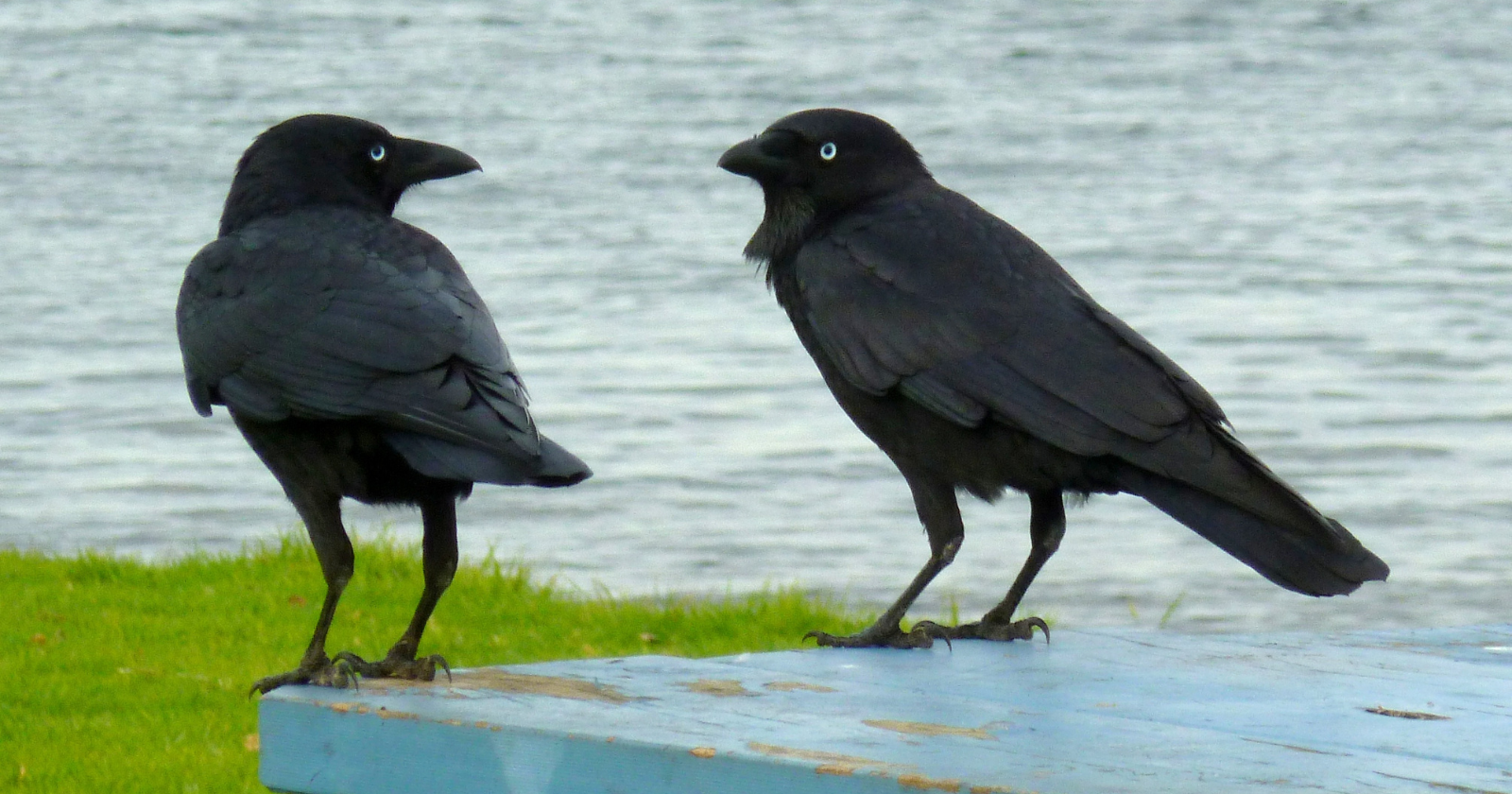
Put on the same rubber caveman mask a team of researchers once wore, walk across the University of Washington campus, and a good share of the local crows will start screaming at you. Many of them were not alive when the mask first meant anything to their neighbours. That is the durable, faintly unsettling result of a set of field experiments run by the wildlife biologist John Marzluff and his students from 2006 onward, and it holds up better than most claims about animal minds.
The core finding was published in 2010 in the journal Animal Behaviour, under the title “Lasting recognition of threatening people by wild American crows.” Wild Corvus brachyrhynchos learned to link a specific human face to a bad experience, then kept scolding that face for at least 2.7 years after a single encounter. That is the number the peer-reviewed paper was prepared to stand behind. Longer stretches turn up in later field observation, but 2.7 years is the measured floor rather than the ceiling.
What the mask experiment controlled for
Marzluff’s team did not just note that crows disliked certain people. They built the experiment to isolate the face from every other cue a bird might use to tell humans apart.
Researchers wore a rubber caveman mask while trapping, banding and releasing crows at sites near Seattle. The birds were held briefly and came to no lasting harm, but capture is stressful, and that was the point. A second, neutral mask, a commercially sold Dick Cheney model, was worn by people walking the same routes without trapping anyone. Clothing, height, gait and route were held roughly constant. The only reliable cue left was the face.
Afterwards, the dangerous mask drew scolding and mobbing whenever it reappeared, even when a different person wore it, tipped it upside down, or half-hid it under a hat.
The neutral mask drew almost nothing. What the crows had locked onto was the face, not the coat or the walk.
How the recognition spreads
Recognition also spread well beyond the birds actually caught. In a 2012 paper in Proceedings of the Royal Society B, Heather Cornell, Marzluff and Shannon Pecoraro separated three routes for that spread.
Crows that were trapped learned the face directly. Crows that only watched the capture, circling and calling in the mob overhead, picked it up as well. And young crows that had never seen a trapping scolded the mask on their own, having taken the cue from their parents. Over five years, the team tracked responses at the main campus. On one later walk in the dangerous mask, Marzluff was scolded by 47 of the 53 crows he passed, far more birds than had ever been present at a trapping.
This is the substance behind the headline about crows warning one another, and it is well documented. Stated plainly, the paper describes birds picking up an association from the alarm and mobbing of others, not crows convening to brief the flock. The transmission is social.
The intent is our word, not the data’s.
Why “grudge” is mostly the wrong word
Grudge is a satisfying word and a misleading one. No crow in these experiments was harmed. They were netted, banded and released. What persists is an association between a face and a threatening episode, expressed through the same alarm and mobbing that crows direct at hawks, cats and other predators.
Calling that a grudge imports a human story about resentment and remembered injury. That behaviour is narrower and more curious: a bird generalising from one bad afternoon into a lasting, shareable tag for a single individual, accurate enough to survive being tested against disguises. Whether anything resembling a feeling sits underneath is a separate question the field experiments do not answer.
Reading the brain scans
A related strand tried to look inside. In work published in 2012 in the Proceedings of the National Academy of Sciences with Marzluff as lead author, and described in the University of Washington’s own account, researchers used PET scans on wild crows shown threatening and caring faces. The scans showed activity in a region the authors describe as analogous to the mammalian amygdala, the structure tied to threat and emotion.
The sample was small, twelve adult male crows, so the result reads as suggestive rather than conclusive. An analogous region lighting up is consistent with the behaviour without proving that a crow feels fear the way a person does. The imaging fits the field data. It stops short of telling us what the bird actually experiences.
Where this sits in the wider work
The idea that birds can teach one another to recognise an enemy predates the crow work. Eberhard Curio’s blackbird experiments in the late 1970s showed that mobbing responses could be culturally passed along. A 2019 study of wild jackdaws in England found the same broad pattern in a different corvid. The practical version is older still: a seabird biologist took to wearing a Halloween mask on a Farallon Islands gull colony in 1980, because the birds had learned his ordinary face.
One firmly established point is modest and solid: a common urban bird can learn a human face from a brief encounter, hold the association for years, and pass it to birds that were never there. Less established is any rich inner life of resentment, or a general account of crow emotion. The open question is how much of what reads as memory and grievance is better described as a shared, low-cost warning system, which is harder to test than a mask on a campus path.