

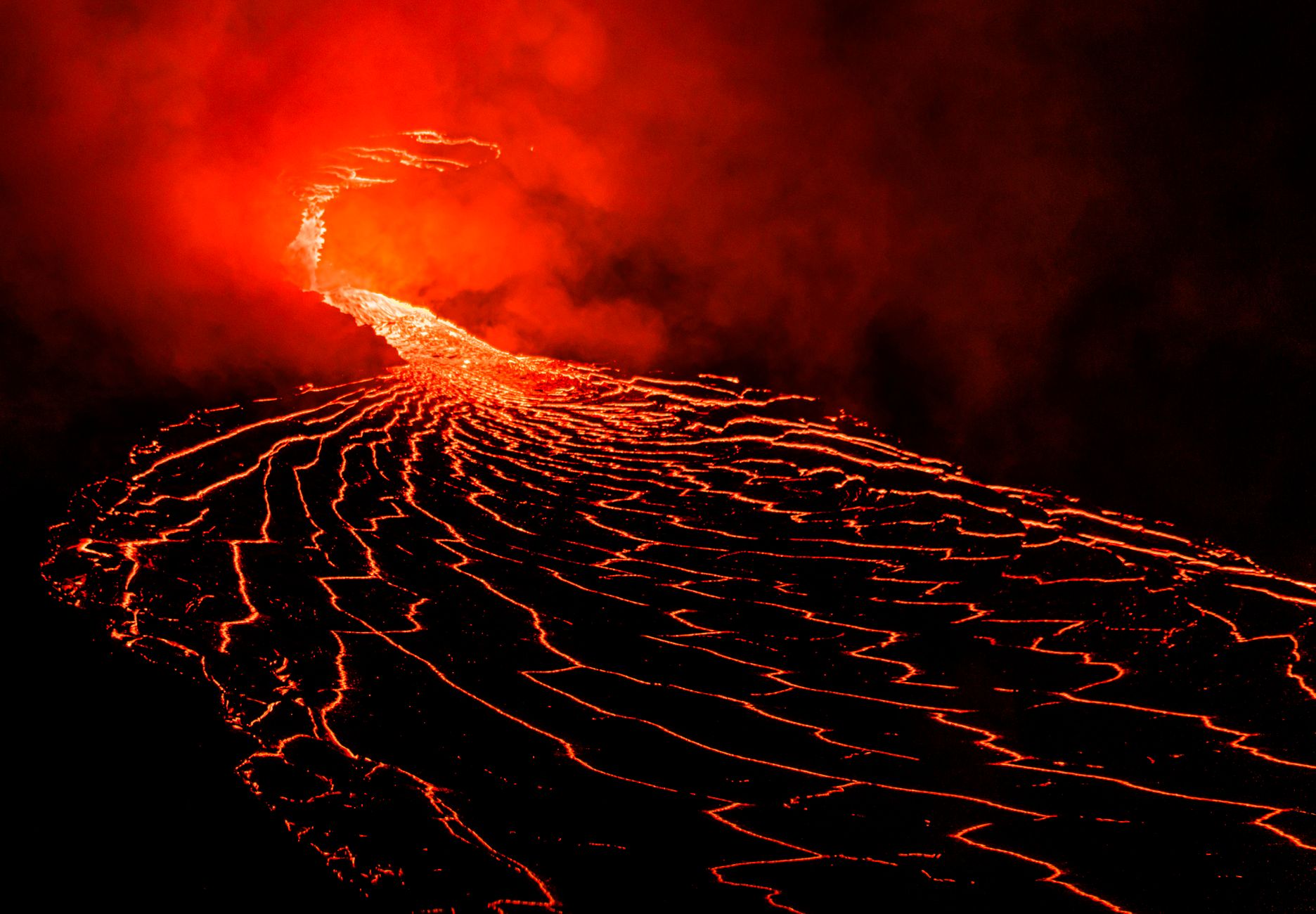
Roughly 5,150 kilometres beneath the soles of your shoes, at a boundary where pressure reaches around 330 gigapascals and temperatures rival the surface of the Sun, molten iron is freezing onto a solid ball the size of the Moon at a rate of about a millimetre a year. That crystallising crust is Earth’s inner core, and a September 2025 study led by researchers at the University of Oxford, the University of Leeds, and University College London has now pinned down the chemistry that lets it grow at all. The freezing itself is what powers the compass in your phone, the auroras over Tromsø, and the magnetic shield that keeps the solar wind from stripping the atmosphere away.
The inner core is a sphere of iron and nickel about 2,442 kilometres across. It sits inside a churning ocean of liquid iron alloy nearly 2,300 kilometres deep. And it is getting bigger, one atomic layer at a time, as the planet slowly bleeds heat into space.
A ball of iron the size of the Moon, growing
The inner core was only discovered in 1936, by the Danish seismologist Inge Lehmann, who noticed that certain earthquake waves bent in ways that only made sense if something solid sat inside the liquid outer core. Nearly a century later, geophysicists have a rough biography for that solid ball. It probably began crystallising somewhere between half a billion and 1.5 billion years ago, when the planet had cooled enough for the very centre to drop below the freezing point of iron under crushing pressure.
Since then it has been thickening. The number most often cited by seismologists is around one millimetre of radius per year, averaged over geological time. It sounds trivial. Spread across the surface of a body 1,221 kilometres in radius, though, it means the inner core adds roughly the volume of a small mountain range every year, and it has been doing so for something like a billion trips around the Sun.
The freezing does not happen the way ice forms on a puddle. There is no cold air above, no obvious temperature gradient in the everyday sense. The inner core is hotter than the outer core in absolute terms — estimated at 5,200 degrees Celsius or so. What matters is pressure. At the centre of the planet, iron atoms are squeezed so tightly that they lock into a solid lattice even at those temperatures. As the whole system slowly loses heat outward, the boundary at which iron can no longer stay liquid creeps outward too, and fresh crystals stick to the surface of the inner core.
Why pure iron would not work
Here the September 2025 paper does something clever. For years, models of core crystallisation had a stubborn problem: pure iron, under the conditions at the inner-core boundary, should require significantly more supercooling to begin freezing than the outer core actually provides. In plain terms, the sums did not add up. The core should not be freezing as readily as it plainly is.
The Oxford-Leeds-UCL team, whose work is described in a summary from ScienceDaily and a fuller EurekAlert release, ran quantum-mechanical simulations of iron mixed with lighter elements — carbon, silicon, oxygen, sulphur — at the pressures and temperatures found at the boundary. They found that carbon in particular changes the game. A small fraction of dissolved carbon lowers the energy barrier to crystallisation enough that iron can freeze under the modest supercooling the real Earth actually offers.
Without carbon, in other words, the inner core probably would not exist. Or it would be much smaller, or would have started forming much later. That has consequences that reach all the way up to the surface, because the freezing of the inner core is not just a geological curiosity. It is the engine.
The energy hidden in a phase change
Anyone who has watched ice form in a freezer has watched a phase change release heat. Liquid water carries more internal energy than solid ice at the same temperature, and when it freezes, that difference — the latent heat of fusion — has to go somewhere. Iron behaves the same way, only the numbers are much bigger and the setting is far stranger.
Each time a shell of molten iron crystallises onto the inner core, it dumps latent heat into the surrounding liquid. It also does something subtler. The lighter elements dissolved in the outer core — carbon, silicon, oxygen, sulphur — do not fit neatly into the solid iron lattice, so most of them are excluded from the growing crystal. They accumulate at the boundary as a buoyant, chemically distinct fluid, less dense than the iron above it.
That buoyant fluid rises. It has to. And as it rises through thousands of kilometres of molten iron, it stirs the entire outer core into motion. Convection driven by heat is one thing; convection driven by chemistry is another; the inner core provides both at once.
How a stirred pot of iron becomes a magnet
The moving iron in the outer core is electrically conductive, and it moves through the planet’s own weak magnetic field. That combination — a conductor sweeping through a field — generates electric currents, and those currents in turn generate more magnetic field. The process is self-sustaining, and it is called the geodynamo.
Physicists have known the rough outline for decades, but the details are still being worked out. A 2025 study by geophysicists at ETH Zurich and the Southern University of Science and Technology in China, showed that a fully liquid core could in principle sustain a dynamo on its own. But the solid inner core makes the real Earth’s dynamo far more efficient and, crucially, far more stable. Its slow growth provides a steady, long-lived source of the energy needed to keep the field running for billions of years.
Take away the freezing, and the currents in the outer core would slow. The field would weaken. Given enough time — tens of millions of years, not tomorrow — it would fade to something too feeble to deflect the solar wind. Mars appears to have gone through exactly that transition roughly four billion years ago, when its own core cooled past the point where it could drive a dynamo. What happened to the Martian atmosphere afterwards is visible today: stripped, thin, dry.
An onion at the centre of the planet
The inner core is not a uniform ball. Seismic waves from earthquakes travel about 3 to 4 percent faster along the planet’s rotation axis than perpendicular to it, an asymmetry noted for decades and detailed in a recent analysis of silicon and carbon in the core. There appear to be layers within layers, an innermost inner core with its own distinct structure, and hints that the whole thing has been rotating slightly differently from the mantle above it.
USC geophysicists reported in Nature Geoscience in February 2025 that the surface of the inner core may be actively deforming, with structural changes detected near the planet’s centre from decades of repeating earthquake data. The boundary is not a smooth sphere but something bumpy and evolving, with topography measured indirectly through the way seismic waves scatter off it.
Popular accounts sometimes describe the result as onion-like, and the Popular Mechanics coverage of the Oxford study uses exactly that image: shells of iron laid down over aeons, each recording the chemistry of the outer core at the moment it froze. If you could slice the inner core open, you would be reading a chronological archive of how the deep Earth has changed, ring by ring, since the Precambrian.
A millimetre, a magnetosphere, a habitable world
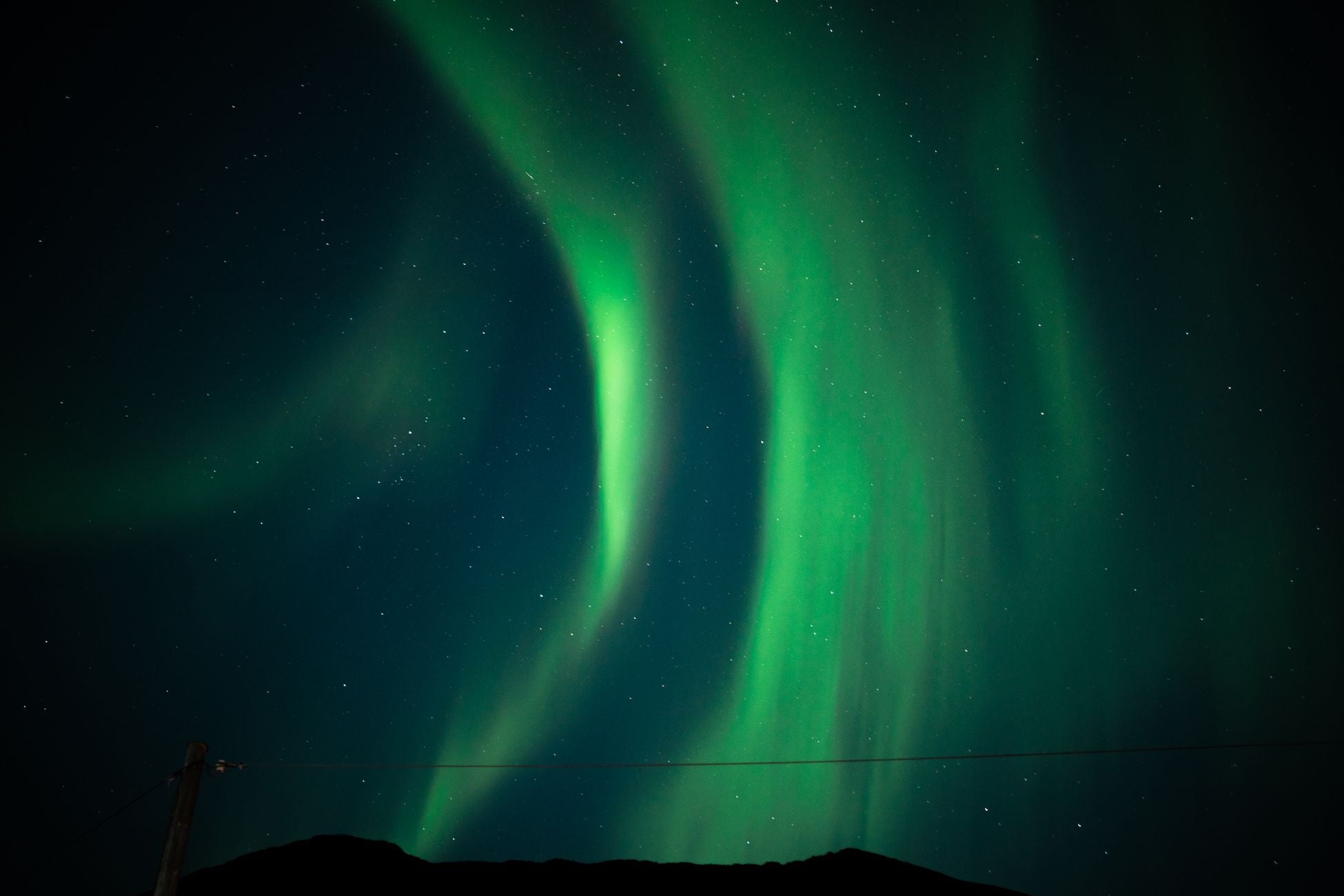
Put the pieces together and the scale becomes almost absurd. A millimetre a year of crystallisation, at a depth no probe will ever reach, releases enough latent and gravitational energy to stir a volume of molten metal larger than the Moon. That stirring generates a magnetic field that extends tens of thousands of kilometres into space, catches the charged particles streaming off the Sun, and funnels them toward the poles where they collide with the upper atmosphere and glow.
Every aurora over Iceland traces back, ultimately, to iron atoms locking into a crystal lattice thousands of kilometres underground. So does the fact that Earth still has an ocean and Mars does not. The connection between deep-Earth chemistry and surface habitability is direct enough that some researchers argue the same giant impact that formed the Moon also seeded the conditions that let the core evolve the way it did.
The inner core will not freeze forever. Estimates vary widely, but on timescales of a few billion years, the outer core will crystallise faster than the planet can shed heat, and eventually the whole system will run down. The field will falter. The atmosphere will begin its slow retreat.
Until then, somewhere under the crust and the mantle and the churning liquid iron, an atom of iron is finding its place in a lattice, releasing a tiny packet of heat, and pushing another parcel of light element upward through 2,300 kilometres of molten metal. The planet’s compass twitches. The auroras keep burning.