

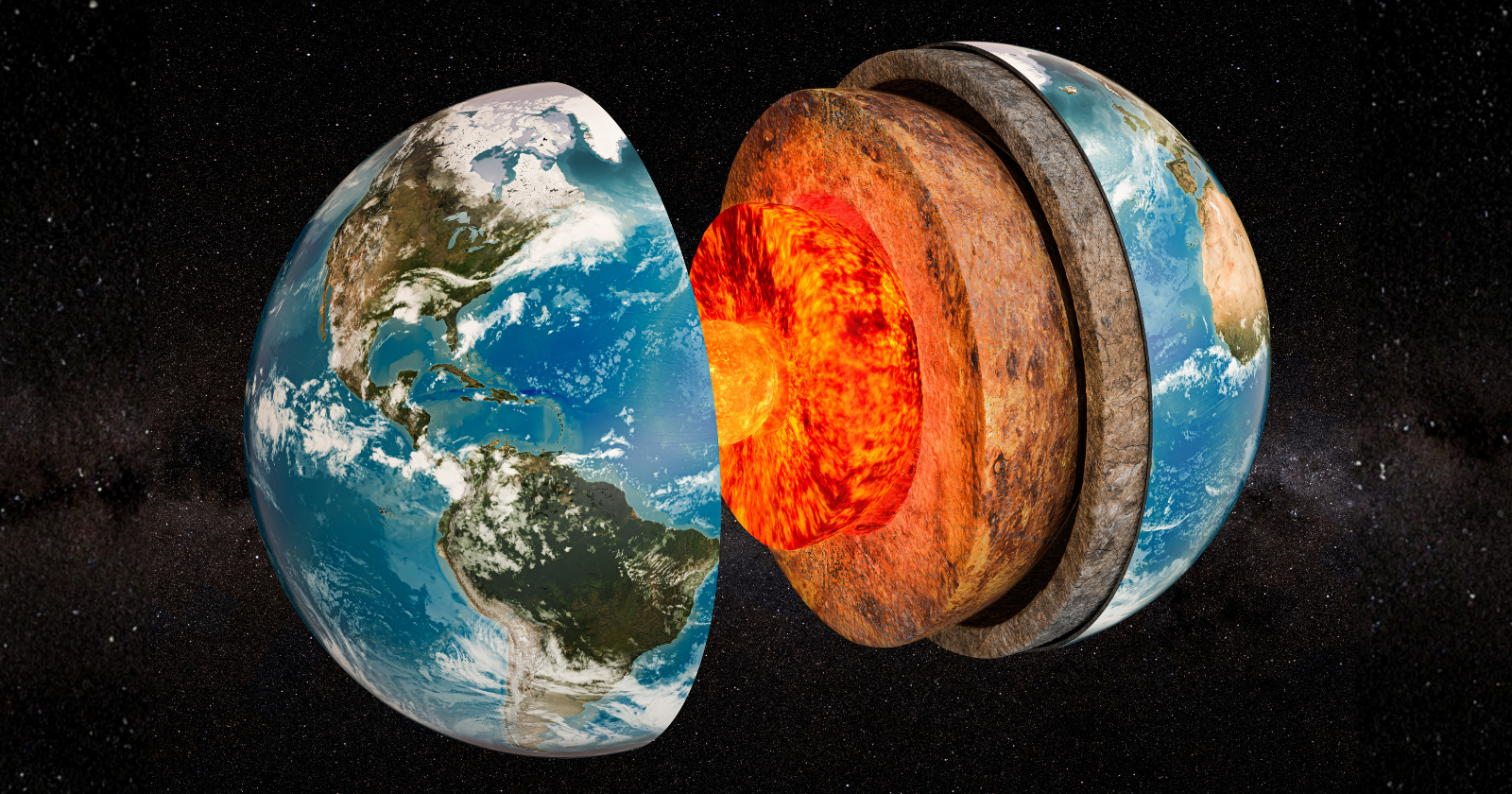
In 2023, seismologists at the Australian National University published evidence that Earth carries a hidden sphere inside its inner core, a ball of iron roughly 1,300 kilometres across whose crystals lean in a direction different from the crystals in the layer wrapped around it. They read it in the ringing of the planet itself, in the echoes of large earthquakes bouncing back and forth through the deepest thousands of kilometres of rock and metal under our feet.
The finding filled in a picture geologists had been building for a century. Earth was long taught as four neat layers: crust, mantle, liquid outer core, solid inner core. Now there was a fifth, tucked inside the fourth like a pit inside a peach.
And nobody has ever seen it. Nobody ever will.
How you find a ball you cannot reach
The deepest hole humans have ever drilled, the Kola Superdeep Borehole on the Russian side of the Barents Sea, went down 12.2 kilometres before the rock became too hot and plastic to drill through. The centre of the Earth sits 6,371 kilometres below the surface. Every claim about what is down there has to be inferred from waves.
When a large earthquake ruptures the crust, it launches two kinds of seismic waves into the planet. P-waves are compressional, like sound; they can travel through solids and liquids. S-waves are shear waves; they can only travel through solids. Both bend, reflect, and refract when they hit boundaries between materials of different density and stiffness.
Seismometers scattered across the globe pick up these waves minutes to hours after a quake, and by comparing arrival times and shapes at hundreds of stations, researchers can reconstruct where each wave went and what it passed through. It is essentially a CT scan of the planet, built out of thousands of natural exposures generated by tectonics.
The inner core, and then the inner-inner core
The inner core itself was only discovered in 1936, by the Danish seismologist Inge Lehmann, who noticed that P-waves arriving on the far side of Earth from a New Zealand earthquake were doing something they should not do if the whole core were liquid. She proposed a dense inner sphere at the middle, about 2,440 kilometres across, smaller than the Moon, made mostly of iron with some nickel. Its solidity was confirmed by later seismologists.
That inner core is astonishingly hot, around 5,400 degrees Celsius, about as hot as the surface of the Sun. It stays solid only because the pressure at that depth, about 3.6 million times atmospheric pressure, squeezes the iron atoms so tightly they cannot slide past each other.
By the 1980s, seismologists had noticed something odd about how waves travelled through this iron ball. P-waves moving from pole to pole crossed it faster than waves moving along the equator, by a few percent. The iron crystals inside the inner core were somehow aligned, all pointing roughly along Earth’s rotation axis, a property called anisotropy.
The first hint that the very centre might be different came in 2002, when Miaki Ishii and Adam Dziewoński at Harvard proposed an “innermost inner core”, a region a few hundred kilometres in radius where the iron seemed to line up along a different axis than the shell around it. For years the idea sat unresolved, with some studies supporting it and others finding no need for it.
What Phạm and Tkalčić heard
The sharpest picture came in two steps. In 2015, Tao Wang and Xiaodong Song, working at the University of Illinois and Nanjing University, analysed the autocorrelation of earthquake coda and reported that the iron crystals in the innermost part of the inner core point roughly east-west, while those in the surrounding shell line up north-south. Then, in 2023, Thanh-Son Phạm and Hrvoje Tkalčić at the Australian National University confirmed the distinct innermost core with a different technique: earthquake waves that bounce back and forth through the whole planet like a struck bell.
After a very large quake, such as the magnitude 9.1 Sumatra event in 2004 or the magnitude 9.0 Tohoku event in 2011, seismic energy reverberates for days. Waves cross the core, reflect off the far side of the crust, cross the core again, and keep going. Phạm and Tkalčić stacked recordings from roughly 200 large earthquakes and pulled a signal out of the noise: waves crossing the deepest 650 kilometres or so of the core behaved differently from waves crossing the surrounding shell of inner core.
In the outer shell of the inner core, the fastest direction for P-waves is roughly north-south, along the spin axis. In the innermost core, the fastest direction tilts toward the equatorial plane, closer to east-west. The iron crystals in the middle are still lined up, just lined up along a different axis.
The 2011 Tohoku earthquake in particular gave researchers an extraordinary dataset. That quake was so powerful it sent waves down to the core that bounced back and nudged the Japanese islands a few millimetres eastward. The same waves, recorded worldwide, helped fill in the picture of what was reflecting them.
Why the crystals would tilt
Iron under core conditions crystallises in a hexagonal close-packed structure, tiny stacks of atomic hexagons. Under the right conditions the whole population of crystals can align, producing the anisotropy seismologists measure.
The question is what makes them align one way in the outer shell and another way deeper in.
One idea is that the innermost core is a fossil. It formed early in the inner core’s history, when conditions were different, possibly with a weaker or differently oriented magnetic field. The crystals froze in that original orientation, and as the core grew outward, new iron crystallising on the surface of that seed grew in a different alignment set by the modern magnetic dynamo.
Another possibility is that the innermost core is a different crystal phase entirely, a body-centred cubic form of iron rather than hexagonal close-packed, stable only at the very highest pressures at the planet’s centre. Laboratory experiments squeezing iron in diamond anvil cells have suggested such a transition is plausible.

Either way, the border between the two zones marks a change in what the iron is doing on an atomic scale. It is a boundary as real as the one between water and ice, hidden thousands of kilometres below the nearest coastline.
The core inside a slowly changing planet
The inner core is not static. It grows about a millimetre a year as the liquid outer core cools and iron crystallises onto its surface. That crystallisation releases heat and light elements, which drives convection in the liquid outer core, which in turn generates Earth’s magnetic field. Without the inner core slowly freezing, the compass would not work, the auroras would fade, and the atmosphere would face the solar wind unshielded.
The inner core also appears to rotate slightly differently from the rest of the planet, sometimes faster, sometimes slower, in a pattern that shifts over decades. Some studies have suggested it may have recently paused relative to the surface. The innermost core, being embedded inside all of that, adds another layer to the puzzle.
More recent work has kept refining the picture. In August 2024, researchers at the Australian National University described a doughnut-shaped region within the liquid outer core, hinting that the deep Earth is even more structurally layered than the five-layer model suggests.
The same trick works on other planets
What made these discoveries possible, thousands of high-quality digital seismometers running worldwide, is now being exported off-planet. NASA’s InSight lander sat on Mars from 2018 to 2022 with a single very sensitive seismometer, listening for marsquakes.
In 2025, an analysis of that data reported that Mars appears to have a small solid inner core nested inside its liquid outer core, a structural echo of Earth. The seismic waves from marsquakes told the same kind of story that Earth’s quakes told, just with a single instrument instead of hundreds.
The technique that revealed Earth’s innermost core has become a standard for reading the insides of rocky planets. What began as an accident of geometry, the way a compressional wave bends when it hits an iron ball, is now a working method for probing worlds that no drill will ever touch.
A metallic ball the width of Texas, buried at the middle
The innermost core is roughly 1,300 kilometres in diameter, about the width of Texas, or a little over a third of the way across the Moon. It weighs somewhere in the neighbourhood of 10^22 kilograms, a small fraction of the Moon’s mass, packed into the very centre of the planet.
It has been there, in some form, since deep in the planet’s past, growing as the core slowly freezes. It has never seen sunlight. It never will. Every atom in it has been under crushing pressure since long before the first cell divided in a shallow sea, and it will still be there long after the last human building has weathered away.
Part of the reason anyone knows about it is that when the seafloor off Japan slipped in 2011, the ring of the planet carried the news out through every seismometer on Earth. Big quakes like that one are exactly the events Phạm and Tkalčić stacked together, listening carefully enough to hear a lump at the centre answer back.