

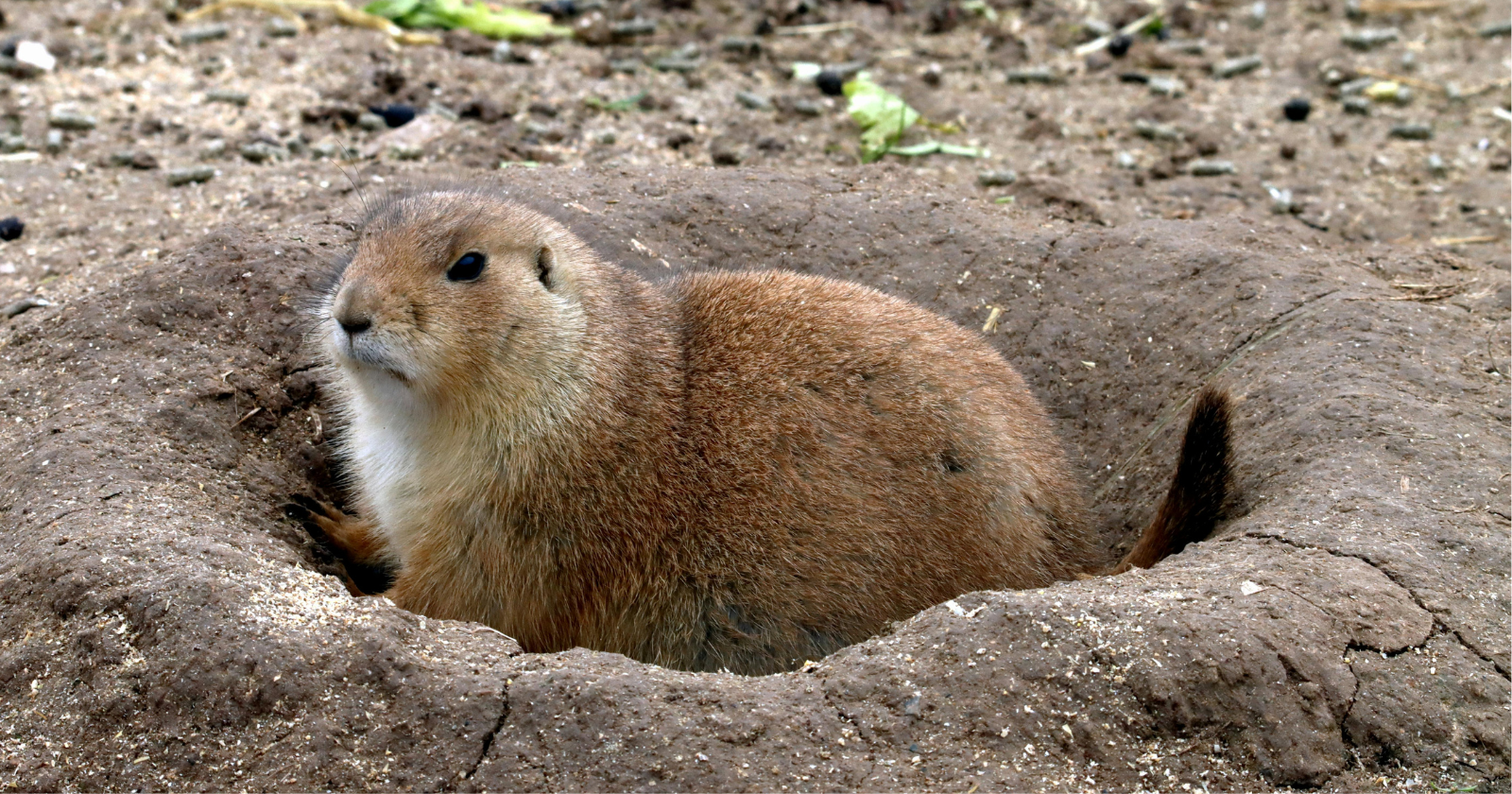
A prairie dog standing sentry over its colony does more with a squeak than sound a generic alarm.
That, at least, is the claim built up over roughly four decades of fieldwork by Con Slobodchikoff, an emeritus biologist at Northern Arizona University, and colleagues. The argument is that a Gunnison’s prairie dog alarm call carries information not only about what kind of predator is approaching, but, within a given call type, about features such as the intruder’s size, shape, and the colour of a person’s clothing. It is one of the more striking claims in animal communication research. It is also more carefully bounded, in the actual papers, than the popular retelling suggests.
The popular version tends to arrive fully formed: a prairie dog announcing “tall thin human in a blue shirt walking slowly across the colony.” That line is Slobodchikoff’s own gloss from interviews, a compression of several separate findings into one sentence. The published record is more piecemeal, and the pieces were assembled in a different order than the tidy summary implies.
What the recordings actually show
The category distinction came first. From the mid-1980s onward, Slobodchikoff and colleagues reported that Gunnison’s prairie dogs produce acoustically different alarm calls for different kinds of predator: red-tailed hawk, human, coyote, and domestic dog. The clearest test of whether listeners act on that distinction came later, in a 2006 paper in Behavioural Processes by Judith Kiriazis and Slobodchikoff. Live predators drew two qualitatively different escape responses: running to the burrow and diving in for hawks and humans, standing upright outside the burrow for coyotes and dogs. When the researchers played back recordings of the calls, the colony produced the same escape responses as it had to the live animals. That is the strongest leg of the whole structure, because it shows the information is not just present in the sound but acted on by the receivers.
The descriptive claims are a separate line of work, and they run only part of the way, from encoding toward, but not reaching, demonstrated understanding. A 1991 paper in Animal Behaviour, whose title is about distinguishing individual predators, in fact reported that within the single call type given for humans, the calls varied with the colour of clothes and the general shape of the individual person. A tighter colour test followed in 2009, in Animal Cognition: three similarly sized women walked a colony in blue, green, or yellow shirts. Calls for the blue shirt and the yellow shirt were statistically distinguishable. Calls for the green shirt were not reliably different from the yellow, a partial result that tracks the animals’ known colour vision rather than a clean “they name the colour” outcome.
Shape and size were tested in 2012, in Current Zoology. Slobodchikoff and colleagues moved a circle, a triangle, and a square across a colony at the same height and speed, to strip out the obvious explanation that prairie dogs simply have one call for things in the air and another for things on the ground. Around eighty per cent of calls for the circle and the triangle were correctly classified by discriminant function analysis, while calls for the square were muddier and often grouped with the circle. A second experiment, using two squares of different sizes, separated cleanly, at 100 and 90 per cent. The authors read this as evidence that the calls label abstract shape and size, not merely an object’s position.
Speed is the weakest of the descriptors. It appears mostly in Slobodchikoff’s broader interpretation, in which the rate of calling is said to track how fast a predator is moving, rather than as a cleanly isolated published result of its own. It is the part of the claim to hold most loosely.
Encoding is not the same as understanding
Most coverage runs two claims together. One is that the calls vary measurably with a predator’s features, which is what the acoustic analyses show and what a statistical classifier can recover above chance. The other is that the listening prairie dogs decode those specific features and act on them.
These are not equally well established.
The one place receivers have clearly been shown to act on the information is predator category, through the playback work. For the finer descriptors, the colour and the shape and the size, the picture is different. The information appears to be encoded in the calls, but, as Slobodchikoff’s own group has acknowledged in print, no published experiment has yet shown that other prairie dogs extract those descriptors and respond to them in a predictable way. A call can carry a measurable trace of a blue shirt without the colony treating “blue shirt” as a discrete instruction. That gap, between what a spectrogram contains and what a burrow full of rodents does about it, is where the story gets ahead of the evidence.
Why the word “language” does the arguing
Slobodchikoff has been willing to call this a language, and that word carries most of the controversy. He has argued that resistance to the term reflects a bias toward human exceptionalism rather than a fair reading of the data. Many linguists and philosophers hold the opposite position, reserving “language” for systems with properties, such as open-ended grammar, that no one claims prairie dogs possess.
The dispute is partly empirical and partly definitional, and the two keep getting tangled. Whether the calls contain more information than a simple alarm is a question the recordings can address. Whether that qualifies as language is a question about where to draw a line, and no spectrogram settles it. Keeping the two apart is useful when reading any headline on the subject.
What the evidence supports, and what to watch
This is a contested corner of a field where replication has been thin and much of the strongest framing comes from a single research group. That is not a reason to dismiss the work. It is a reason to hold the specifics loosely. The careful version of the finding is surprising enough on its own: a rodent’s alarm call is not one undifferentiated noise, and its acoustic structure varies with what the animal is looking at, in ways a machine can partly decode.
What would move the question forward is easy to name and hard to do. Independent replication beyond Slobodchikoff’s group. Larger samples across more colonies and more species. And, above all, receiver-side experiments that test whether prairie dogs act on those features themselves, and not just on the predator category. That last piece is the one the descriptive claims still lack. Until it arrives, the fair summary sits between the two poles: a prairie dog’s bark carries more than we once assumed, and less than the neatest version of the story would have it.