

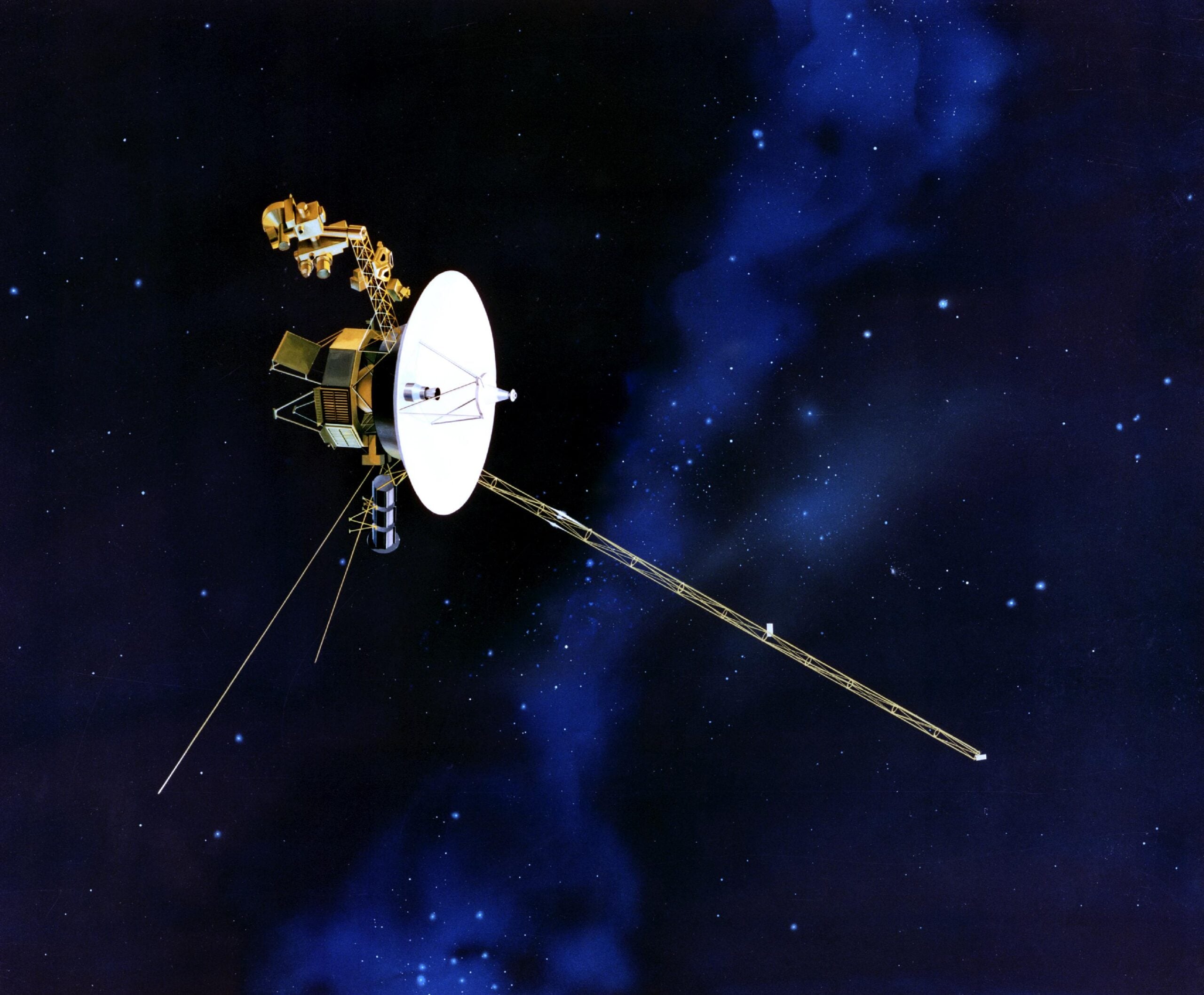
On 28 November 2017, engineers at NASA’s Jet Propulsion Laboratory sent Voyager 1 a command to fire four thrusters that had been silent since November 1980. The spacecraft was about 21 billion kilometres away, beyond the heliopause, and the team had to wait 19 hours and 35 minutes for the result to reach a Deep Space Network antenna in California.
The telemetry showed that the thrusters had delivered a sequence of 10-millisecond pulses exactly as intended. Hardware built in the 1970s had accepted a new job after almost four decades of inactivity.
It is tempting to describe this as restarting Voyager’s engines. That is not quite what happened. The small hydrazine thrusters did not accelerate the probe through interstellar space. They rotated it by tiny amounts so its dish antenna remained pointed at Earth.
A pointing problem becomes a communications problem
Voyager 1 communicates through a 3.7-metre high-gain antenna. At interstellar distances, a small pointing error can move Earth out of the antenna’s narrow radio beam. Thrusters fire in brief puffs to correct the spacecraft’s attitude and preserve the only link through which it can receive commands or return data.
NASA’s December 2017 account of the test says engineers had observed degradation in the attitude-control thrusters since 2014. They needed an increasing number of pulses to produce the same effect. More firings meant faster wear and greater demand on a finite propellant supply.
The spacecraft carried another set of four. These trajectory correction manoeuvre, or TCM, thrusters were identical in size and function, but they had been used during the Jupiter and Saturn encounters to adjust Voyager’s path and aim its instruments. Voyager 1’s final planetary encounter was Saturn, and the TCM set last fired on 8 November 1980.
The dormant thrusters had never performed this exact job
During the planetary mission, the TCM thrusters generally operated in a more continuous mode. They had never been asked to provide the millisecond pulses used for routine orientation. Engineers could not simply switch branches and assume the control system would behave as expected.
JPL assembled propulsion specialists Chris Jones, Robert Shotwell, Carl Guernsey and Todd Barber to reconstruct how the dormant branch should respond. NASA says the team recovered decades-old records and examined software written in an outdated assembler language. They modelled possible responses before preparing the command sequence.
The distance removed any possibility of real-time intervention. There was no joystick control and no way to stop the test after seeing an unexpected first pulse. The complete sequence had to be judged safe before transmission. By the time its result arrived at Goldstone, the physical event aboard Voyager had happened nearly 20 hours earlier.
On 29 November, the telemetry showed that all four TCM thrusters had performed as well as the attitude-control set. The spacecraft could use a system designed for trajectory changes during planetary flybys to maintain its antenna pointing during an interstellar mission.
Why 37 years of silence did not necessarily ruin them
These were not engines with lubricated pistons or bearings sitting in air. They were MR-103 hydrazine thrusters developed by Aerojet Rocketdyne. Liquid hydrazine passed over a catalyst and decomposed into hot gas, producing thrust without a spark-based ignition system.
Long dormancy still carried uncertainty. Valves could have failed, propellant pathways could have changed and heaters had to keep components within acceptable temperatures. The successful firing showed that this particular branch remained functional. It did not establish that spacecraft hardware is preserved simply by leaving it unused.
Redundancy was the decisive advantage. Both Voyager probes were built with multiple thruster branches because pointing control was essential during the original planetary mission. Decades later, engineers could assign a spare branch a role it had not been expected to perform for so long.
A spacecraft passed from one generation to another
Voyager 1 launched on 5 September 1977, after years of design and construction. By the 2017 test, it had been operating for four decades, long enough for original engineers to retire and for newer team members to inherit machinery older than their careers, and in some cases older than they were.
NASA has not published an age breakdown of the 2017 flight team, so that generational comparison is not a documented census. The underlying engineering problem is more revealing. The team had to recover design intent from old records, old code and institutional knowledge accumulated across several eras of the mission.
NASA’s current Voyager technical overview says the probes use custom General Electric computers made to JPL specifications. Operating them is not a matter of installing modern spacecraft software on an old platform. Commands must respect an architecture that left Earth in 1977 and cannot be physically upgraded.
The successful test bought time, not youth
Voyager project manager Suzanne Dodd said the revived thrusters could extend the spacecraft’s operating life by two or three years. Voyager 1 switched to the TCM branch in January 2018. Voyager 2 made a similar change in July 2019, according to NASA’s account of the probes’ power-management plan.
The reprieve did not halt ageing. Each spacecraft’s radioisotope thermoelectric generators lose about four watts of electrical output a year. Heaters, instruments, computers and communications equipment compete for a shrinking power budget, while propellant lines and valves continue to change.
In 2024, engineers had to move Voyager 1 to another thruster branch because silicon dioxide residue had narrowed tiny fuel inlet tubes. In 2025, the team revived a separate set of roll-control thrusters considered unusable since 2004. Those later recoveries involved different components, but they followed the same operating discipline: reconstruct the failure, identify a remaining margin and accept only the risks necessary to preserve control.
In April 2026, NASA shut down Voyager 1’s low-energy charged-particle instrument to conserve power, leaving two science instruments working. The mission now advances through carefully planned exchanges: one heater for another, one instrument for more time, one thruster branch for a less obstructed one.
The durable achievement is operational memory
The 2017 firing succeeded not because 1970s machinery somehow escaped ageing. It succeeded because the original spacecraft carried useful redundancy and a later team was willing to reconstruct what that redundancy could safely do.
The machinery crossed a generational boundary along with the heliopause. Engineers who did not design Voyager can still command it because records, software knowledge and cautious operating practices have been handed forward. That chain is now as necessary to the mission as the surviving hydrazine and plutonium power aboard the spacecraft.